
As the Dubai Airshow came to a close, a picture had emerged of a Gulf aerospace industry pivoting from being a consumer to an industrial force, taking control of its future.
Airlines in the region are leveraging their large order books to exert influence on the future of aircraft design, as they transform from mainly buying jets to manufacturing and exporting key products.
That signal was loud and clear on the first day of the biennial event on Monday.

As Emirates airline ordered another 65 Boeing 777-9 jets, cementing its position as the world's largest buyer of wide-body aircraft, the US plane maker agreed to conduct a feasibility study for a larger version to meet the airline's growth requirements.
“The Dubai Airshow signalled a definitive paradigm shift, moving beyond the traditional 'shopping mall' mentality to resemble a complex strategic chessboard,” Dean Mikkelsen, an independent aviation and security analyst, told The National.
“We are witnessing a maturation of the market where regional carriers are utilising their immense purchasing power not merely to secure inventory, but to dictate the industrial trajectory of original equipment manufacturers [OEMs].”
The Gulf aerospace industry is undergoing a strategic shift, taking its fate into its own hands and reducing reliance on global supply chains that have been faltering since the pandemic and slowing expansion plans.
“This year made it clear that the era of passive off-the-shelf procurement is ending; in its place is a new reality where the Gulf demands deep industrial participation, forcing manufacturers to adapt to the region's long-term strategic vision rather than the other way around,” Mr Mikkelsen said.
'Kingmaker' of wide-bodies
Emirates, the world's largest international airline, is not only the biggest operator of wide-body aircraft. The airline's president, Tim Clark, was heavily involved in influencing the design of the 777X in its initial stages when the programme was first announced. The latest purchase brings Emirates’ 777X orders to 270 planes, further solidifying its position as the largest 777X customer.
Boeing's agreement to study the feasibility of a larger version, the 777-10, comes as Emirates pushes to replace its Airbus A380 fleet.
“This move reinforces the airline's role as a 'kingmaker' in the wide-body segment, effectively positioning the customer as a co-designer,” Mr Mikkelsen said.
“By pushing for a variant tailored specifically to the high-capacity demands of the Dubai hub and the future expansion at Al Maktoum International, Emirates is signalling that it expects hardware built to its operational specifications rather than settling for market averages.
“It serves as a potent reminder that the region’s 'mega-hub' strategy remains the dominant force driving wide-body innovation.”
The airline is using its bargaining power to “shape Boeing's product road map”, Linus Bauer, founder of UAE-based boutique consultancy BAA & Partners, said. By securing options to convert its 777-9 orders into the larger 777-10, it is indicating “very concretely” that it wants higher-capacity aircraft for its ultra-dense, hub model, he said.
Emirates also urged Airbus to explore a larger version of its A350-1000 wide-body.
“Who will listen, will win,” said Sheikh Ahmed bin Saeed, chairman and chief executive of Emirates airline and group, referring to the two manufacturers.
Production ambitions accelerate
In a further sign of Gulf airlines taking charge of their supply chains, Emirates and French aerospace group Safran announced a deal to bring a manufacturing and plane seat assembly factory to Dubai.
The plant will initially focus on Emirates' business and economy class seats for cabin refurbishment projects, with plans to expand into new aircraft in the future.
The Safran deal “marks a pivotal and strategic co-operation that establishes Dubai as an aerospace manufacturing hub,” Sheikh Ahmed said.
The project also underscores ambitions for exporting Made in UAE products.
The deal will help in “creating highly skilled jobs, and developing capabilities to support Emirates and produce seats for export to other carriers”.
The move is critical for Emirates as it accelerates the retrofit of its older 777s and A380s and takes delivery of more than 300 aircraft on order.
To power through its growth plans unhindered, Emirates is also securing its own engine maintenance capabilities.
Emirates will build a new plant in Dubai to perform maintenance, repair and overhaul (MRO) for its Rolls-Royce Trent 900 engines powering its own A380 fleet from 2027, following an initial agreement with the UK engine-maker.
This comes as global airlines express growing frustration with delays from plane makers, seat manufacturers and engine producers.
“Following years of supply chain fragility, airlines and lessors are prioritising resilience and delivery reliability over experimental ambition,” Mr Mikkelsen said.
The UAE's push into aerospace production was also evident through Mubadala-owned Strata Manufacturing's deal with Airbus to start a new production line for the A320 model. Strata will make Ailerons at its plant in Al Ain, with an Emiratisation rate of 50 per cent, including engineers and production technicians.
Strata is also in talks with manufacturers for deals to make engine components for the first time, it told The National previously.
The UAE defence sector is also pushing for export sales. UAE defence conglomerate Edge and US defence tech company Anduril will enter into a joint venture to design, develop and produce autonomous air vehicles in a new manufacturing centre in the UAE.
The Emirates airline, Strata and Edge deals underscore the UAE's ambitions to develop its industrial sector and expand sales to export markets as part of its economic diversification agenda.
-
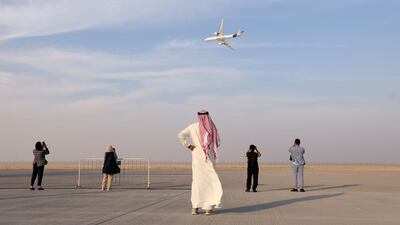
A display by the Airbus 350 at the Dubai Airshow. All photos: Chris Whiteoak / The National -

The event is attracting lots of delegates to Al Maktoum International Airport -

Sheikh Ahmed bin Saeed, chairman and chief executive of Emirates airline and group, at a media conference at the event -

The Rafale fighter jet is worth a watch as it takes to the skies above Dubai -
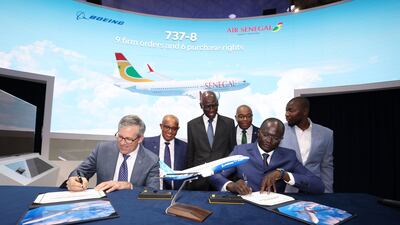
Brad McMullen, left, from Boeing and Yankoba Dieme from Air Senagal sign an agreement -
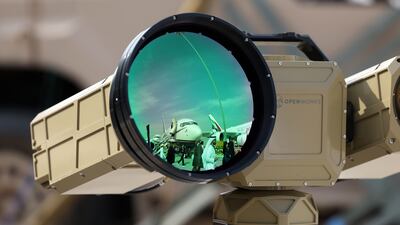
An air defence system on display -
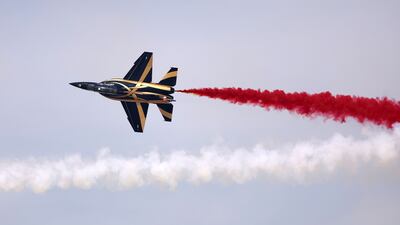
The UAE's Al Fursan aerobatic team put on a display -
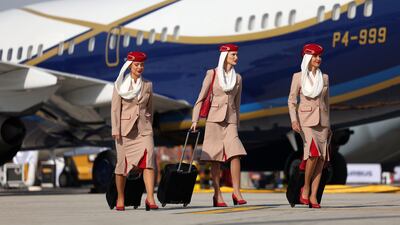
Emirates cabin crew arrive -
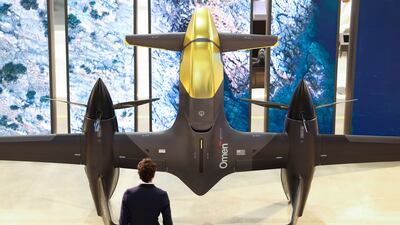
The Omen drone is displayed at the Edge stand -

Visitors arrive for the event, which is pivotal for airlines in the Middle East -
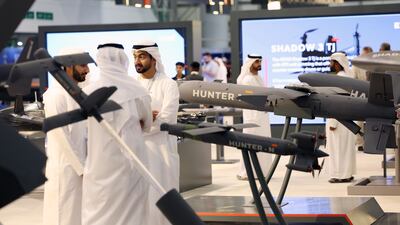
Abu Dhabi's Edge is among the companies exhibiting technology at the event -
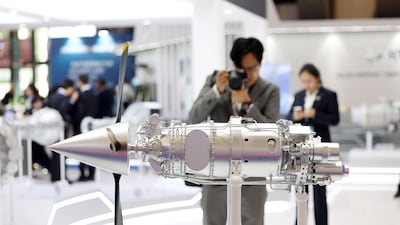
A turboprop engine. Companies use the event to meet plane makers, engine manufacturers and seat suppliers -
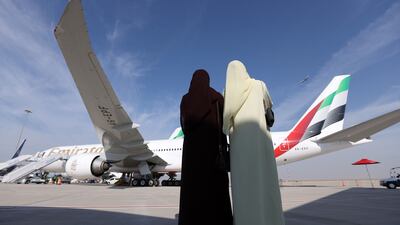
Visitors take a closer look at an Emirates Boeing 777 -
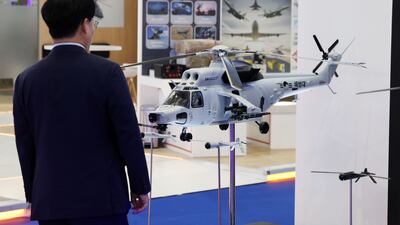
A model of a MAH-1 Marine attack helicopter. It is among the aircraft in the spotlight at the exhibition -
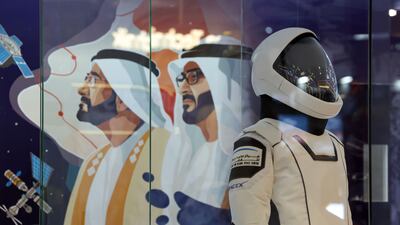
A spacesuit worn by SpaceX astronauts -

Model rockets at the Innospace stand. Space technology is in focus at the air show


Boeing-Airbus race with a side of Comac
The Dubai Airshow also underscored the competition between Boeing and Airbus for deals in the Middle East airlines, while Chinese plane maker Comac made its first appearance at a Middle East show to signal its challenge to the duopoly.
Boeing's order from Emirates was an endorsement for its long-delayed 777X programme, whose deadline has been moved to 2027. Meanwhile, Airbus converted all-Boeing operator flydubai with a provisional order for A321 Neos.
“While the show was not the biggest in terms of overall orders, realistically, both manufacturers could be content with orders received,” John Strickland, a UK-based aviation analyst and director of JLS Consulting, said.
“Boeing gained additional 777X orders from Emirates despite the carrier's frustration on the lengthy period to get their first aircraft.”
The Airbus order was “significant” because not only does it diversify flydubai's fleet from Boeing jets, but also increases market opportunities for long-range destinations which do not require the capacity offered by its previous order of 787 wide-bodies, he said.
Chinese plane maker Comac gained royal visitors such as Sheikh Ahmed and drew a curious crowd seeking to study its offerings.
“It was important for Comac to bring the C919 [narrow-body] … and probably is tied to its effort to win orders in the Middle East and elsewhere,” Scott Hamilton, consultant at Leeham Company, said.
consultant, Leeham Company
“Every order Comac wins is one taken away from Airbus or Boeing. But the very slow production ramp-up hurts Comac and doesn’t present a near or even medium-term threat.”
The real threat will become the next aeroplane in the single-aisle sector, he said.
“By that time, China should have a solid domestic aerospace cluster and proven aereoplane performance. We’re talking a generation away.”

