


Live updates: Follow the latest on Israel-Gaza
Lebanon's Rafic Hariri International Airport and Beirut port are keeping the country "breathing" with the continued movement of people and goods during unrelenting Israeli strikes, the country's civil aviation chief has said.
Lebanon's only international airport currently handles about 2,500 inbound travellers daily and a similar number of departures, a 60 per cent drop from pre-war levels, Fadi El-Hassan, director general of Lebanon's civil aviation authority, told The National on Monday at the International Programme for Civil Aviation Leaders in Dubai.
"Beirut-Rafic Hariri International Airport, in addition to Beirut port, are the main facilities to keep our country breathing, in terms of cargo and in terms of passengers, until now," he said.
"All the stakeholders at the airport – us as the civil aviation authority, the airport security, the investors, the companies working at the airport – are all collaborating together and working 24/7 to maintain our airport operations even in this situation."
-

The southern Lebanese village of Al Taybeh is shrouded by smoke during an air strike as Israeli forces seek out Hezbollah. AFP -
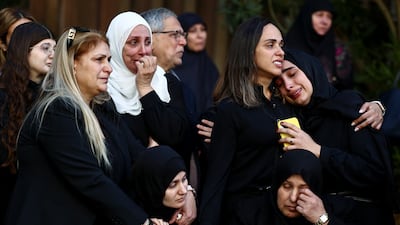
The sister, mother and the partner of Mohammad Farhat, a major with the Lebanese Army who was killed in an Israeli strike with two other soldiers on the outskirts of the village of Yater in southern Lebanon, attend an official memorial in Beirut. Reuters -
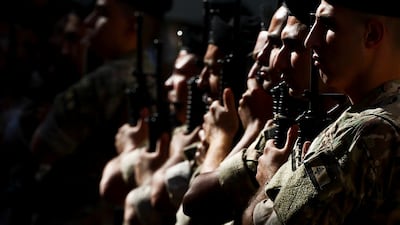
Lebanese Army soldiers take part in an official ceremony to pay tribute after the death of Maj Mohammad Farhat. Reuters -
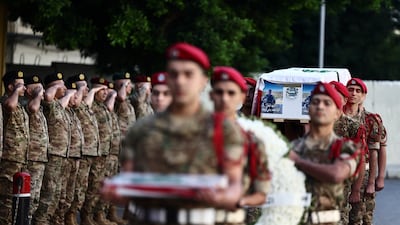
Lebanese Army soldiers carry the coffin of Maj Mohammad Farhat during an official ceremony to pay tribute in Beirut, Lebanon. Reuters -
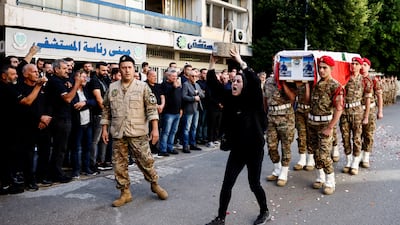
Emotions ran high at a memorial for Lebanese Army Maj Mohammad Farhat, who was killed in an Israeli strike with two other soldiers on the outskirts of the village of Yater in southern Lebanon. Reuters -
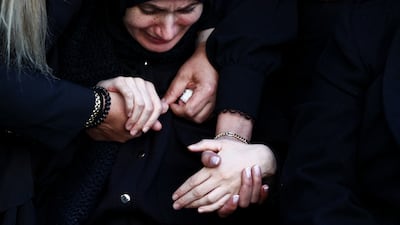
The relatives of Maj Mohammad Farhat are comforted by friends at a memorial in Beirut. Reuters -

The sister of Maj Mohammad Farhat at the official memorial to her brother in Beirut. Reuters -

Mourners at the official ceremony to pay tribute to Maj Mohammad Farhat of the Lebanese Army, who was killed in an Israeli strike with two other soldiers on the outskirts of the village of Yater in southern Lebanon. Reuters


Lebanon's only commercial airport continues to operate with flights by national flag carrier Middle East Airlines, while international airlines have suspended services to Beirut as Israel pummels areas near the hub.
MEA, as the airline is known, flies its Airbus planes to routes mainly in the Middle East and Europe including Dubai, Doha, Cairo, Amman, Istanbul, Paris, Larnaca, London, Frankfurt and Madrid, the airport's website says.
When Israel and Hezbollah last fought a war in 2006, Israel bombed the airport in the capital early on. Today it remains open and there is constant dialogue between Israel and Lebanese aviation authorities.
"Until now, there are guarantees that the airport will be, let us say, avoided from what is happening right now," Mr El-Hassan said. "There were some strikes close to the airport but it didn't affect any runway or taxiway. There was some debris on one of our runways and it was cleared and operating normally."
Asked how long the airport can continue operations under the current conditions, Mr El-Hassan said: "Whenever we will see there will be a danger which will directly affect our safety as an airport and will affect aviation safety and security, then of course we will stop. But for the time being, we are still operating and relying on routes which are almost away from the attacks."
International airlines ceased operations to Beirut weeks ago when Israel's began to fire rockets on Lebanon amid an all-out war in September against the Iran-backed Lebanese armed group Hezbollah.
While MEA deems its operations from the airport safe based on daily risk assessment calculations, foreign carriers have halted flights to avoid potential threats and numerous variables in a conflict area.
Indeed, Malaysian Airlines' flight MH17 from Amsterdam to Kuala Lumpur was shot down over eastern Ukraine on July 17, 2014, as fighting raged between pro-Russian separatists and Ukrainian forces, killing all 298 people onboard. The commercial plane's downing continues to serve as a reminder for the aviation industry of the crucial importance of information-sharing and route-planning during times of conflict.
Besides their own risk assessments, foreign airlines operating to and from Lebanon are also taking into account the steep insurance premiums to fly into Beirut, Mr El-Hassan said.
"Of course we hope that airlines will come back to Lebanon and at the end they have to make an assessment and they will decide," he said.
Flying remains the most straightforward way to leave Lebanon for those fleeing. The airport is also a crucial staging post for the arrival of international aid, with humanitarian flights continuing to land and depart.
After the war ends, Mr El-Hassan hopes the airport will resume plans to increase annual passenger traffic. "Hopefully soon, we will witness a ceasefire and everything will get back to normal," the civil aviation authority chief said.
The number of passengers handled at the airport in the January to September period fell 15.3 per cent year-on-year to 4.8 million, a report by Blominvest Bank found last month.
In September, the airport handled 485,332 passengers, down 27.03 per cent month-on-month, the report said.
"The activity at Rafic Hariri International Airport has decreased in September 2024 for the ninth consecutive month, as the Israeli-Hezbollah war in Lebanon escalated dramatically. Countries worldwide urged their citizens to leave Lebanon immediately, while most airlines cancelled their flights to Lebanon due to safety concerns," the report said.
"This situation led to rising ticket prices, and fears of difficulty securing seats. Additionally, concerns about potential Israeli strikes on Beirut’s airport have further exacerbated the situation, contributing to a sharp decline in tourist arrivals."

