I had just named my planet Bragi when I got the call. It was Lewisham Hospital in south London. They suggested I come quickly. I paused my game and looked at my wife. “It’s Mum,” I said. It was four days before Christmas in 2018 and outside south London was suffering a torrential downpour.
I couldn’t drive because I’d broken my ankle the week before, and so I sat in the back of the car as my wife sped us through the rain-slicked streets of Wimbledon and Tooting, the Christmas lights streaking down the windows as revellers spilt out of pubs.
We were too late. By the time we arrived, she was gone – at 69, no age. What a life, though. Four hours later, we were home. The next week was a fug of unreality, trying to make Christmas fun for the kids while figuring out how to live without “silly old Grandma”. New Year rolled around, and with it, the return of school and routine. That’s when the work really started.

I decided to return to Bragi.
No Man’s Sky is a vast space exploration game. The universe is procedurally generated with 18 quintillion planets to explore. You could play your entire life and discover only a fraction of what the game has to offer. Your aim is to make it to the centre of the universe through resource gathering, base building, trading and exploration. When you land on a planet, if you’re the first person to discover it, as you usually are, you get to name it. Bragi is the Norse god of poetry.

I spent much of the next month processing mother’s death among the stars and moons, farming ferrite dust for ion batteries, climbing mountains for sodium vegetation, mining caves for ancient artefacts. Bragi was a benign planet. The alien creatures that called it home looked like giant anteaters and roamed the plains in packs, but they left me alone. At night, the orange sky turned violet and was illuminated by the white rings of a nearby giant planet. It really was beautiful.
In the end, Mum’s death brought me to Abu Dhabi, but more of that later.

That I turned to games to help me should not have been a surprise. I still hum the theme tune to Kikstart 2, almost 40 years later. I was given a Commodore 64 for my 10th birthday and I used it to play entire Test matches on Graham Gooch Test Cricket, recording every game in a physical cricket score book, ball-by-ball. My friend Dave lived a few doors down from me, and he had an Amiga. He also lived in a bungalow, which I thought was pretty cool.
After school, we’d sit on his bed for hours and play Sensible Soccer while his mum cooked chicken nuggets and chips. Those tiny players with their huge heads, bending in banana shots from 40 yards – still the most satisfying football game ever made. Those little guys would pop up a year later on the battlefield in Cannon Fodder, the anti-war war game, which refused to take its violence too seriously while insisting that you should.

I didn’t know then, of course, that I would still be playing games 40 years later. After the Commodore 64 came the Mega Drive. Sonic the Hedgehog taught me that not all doctors are benevolent, Streets of Rage taught me how to punch a hoodlum, if the hoodlum only moves in one direction, and NHL 93 taught me the rules of ice hockey. It did more than that, though. It made me fall in love with the sport. I adopted the Chicago Blackhawks as my team, learnt all the players. For my 40th birthday, we went to Chicago to watch two games. For my 50th, we went to Toronto. I have bought every iteration of the game for the past 33 years. It also changed the course of my family’s life, although it would take more than 30 years for me to realise it.
At university, friendships were forged and broken over the PlayStation. Long evenings spent sitting on patio furniture (the landlord either too tight to give us a sofa or didn’t trust us not to ruin it) trying to blow up each other’s Worms with bazookas, banana bombs and exploding sheep. The controller was passed around, alliances were formed, reneged on, and revenge was plotted. Those evenings created my best friends.

In 1999, a year out of university, I started going out with the woman I would marry. The following summer, a game came out that we fell into together. Deus Ex was a cyberpunk conspiracy thriller in which almost every mission had several solutions. You could shoot your way through, sneak, hack the door or talk your way in. Perhaps she started watching me play because she realised I wasn’t going to turn it off, or maybe she genuinely enjoyed it, but within a couple of days she was sending me messages at work.
Deus Ex tonight?
She helped to solve puzzles, prevented me from just shooting everyone, and reminded me to manually save my progress. There is something about playing a game with someone you are falling for. You learn how they think, whether they are patient or reckless, whether they are interested in the details of the world or just want to charge to the exit. We spent weeks in that grim, rain-soaked future and probably learnt more about each other than 100 trips to Pizza Express.

By 2013 we had two children, and the youngest was still a baby when I played The Last of Us.
It is a story about a father. It opens with the worst thing that can happen to a parent, and it doesn’t get any easier. The writing is astonishing, but wandering post-apocalyptic America in the small hours between feeds, with the monitor beside me, was not entertainment in any ordinary sense. Hours upon hours of relentless survival horror, but I couldn’t stop. There is a moment in the game, about two-thirds of the way in, when Ellie and Joel stumble upon some giraffes roaming free in an abandoned city, and their sudden, inelegant beauty amid all the ugliness just lit my face to full beam. A little later, Ellie says the line: “After all we’ve been through, everything that I’ve done, it can’t be for nothing.”
I had to put the controller down.

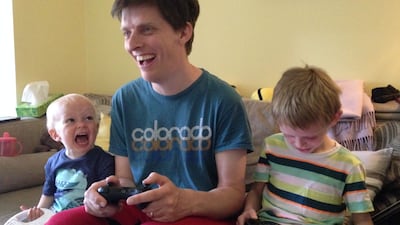
Then the kids got bigger and the games became communal once again. Minecraft, Mario Kart and Overcooked. We love Minecraft (please note the present tense) because it doesn’t tell us what to do. An entire world to do with as we wanted, to shape it in our image. Together, we built a whole city made out of wool. Then Mojang released an update that caused lightning to set fire to wool and the whole thing burnt down. The kids go to the Nether. I stay in the Overworld. They build farms and convoluted machines. I mine. I dig tunnels for hours, collecting the resources they will use. It is my thinking time.
When we play Overcooked, there is talk of divorce and of disowning parents. We are supposed to work as a team in a kitchen. But someone always forgets the onions, and we argue and tease and laugh until it hurts. One day, no one will suggest we play it. Most of the time, you don’t know you’re doing something for the last time. Like talk to your mum.

I spoke to her on the phone the day before she died. I’d just finished the first draft of a novel and was excited – just not as excited as she was for me. In the aftermath of her death, between playing No Man’s Sky and preparing for her memorial, I realised how much she had packed into her 69 years. She'd been a dancer in the '60s, had wet herself laughing while dancing at the London Palladium, had met royalty and turned down Tom Jones. She never took life too seriously, and passed on to me a playfulness that I've never lost. But she never got to live in the sun. That was the one thing she’d always wanted to do, and it never quite worked out.
Six months later, we were living in Abu Dhabi. We came for my wife’s job and I became a stay-at-home dad. The irony is, if she were alive, Mum would have visited so much we’d have been sick of her. But if she were alive, we’d still be in England.
That was seven years ago. We arrived six months before Covid-19 and spent much of lockdown playing Animal Crossing and Wilmot’s Warehouse. We watched 100 films in 100 days. A couple of summers ago, to escape the heat, we spent a Sunday at the ice rink at Zayed Sports City.
Our youngest adored it. Scampering around the ice without fear, he demanded to come the next week, and the week after. He wanted lessons, and eventually was good enough that his coach said: “So which is it, figure skating or hockey?”

I showed him NHL 24 on the PS5. We watched highlights on YouTube. He was excited. He would play hockey. We bought him the kit, he bought his own stick. He asked for synthetic ice tiles to practise at home. He worked so hard at his skating and stick work that within six months he was playing for Abu Dhabi Storms, alongside Canadians who were practically born with skates on. For two years, my life revolved around trips to the rink. Five days a week, I drove him to training, watched him skate, drove him home. Watching him strive to improve, watching him play the game I’ve loved for so long, was my favourite thing in the world. It sustained me.
Then, in early July, my wife took a job back home just as I had accepted my job at The National, and the three of them moved back. My empty-nest fears were realised overnight. I’m in a new, uncharted phase. Samuel is playing for the Swindon Thundercats now, and I get daily videos of his practice. It’s not the same as being there, but it will have to do. I’ve never lived alone before. I’m fighting the urge to think of my life as being on pause.
On November 19, I’ll press start on Grand Theft Auto VI. See where it takes me.

