The Voice of Hind Rajab receives record-breaking 24-minute ovation at Venice Film Festival


Evelyn Lau
  • English
  • Arabic

Kaouther Ben Hania’s The Voice of Hind Rajab, one of the most anticipated titles at this year’s Venice Film Festival, received a record-breaking 23-minute, 50-second standing ovation after its world premiere on Wednesday evening.

The response, believed to be the longest in film festival history, ended with the audience chanting “free, free Palestine” as the lights went up.

The Tunisian filmmaker’s drama reconstructs the events surrounding the death of Hind Rajab, 5, who was killed in Gaza City last January alongside four cousins, her aunt and uncle, and two paramedics who attempted to rescue her after the family's car came under fire from Israeli forces.

Hind was trapped for hours in the vehicle while on the phone with the Palestinian Red Cross. When paramedics finally reached her, both she and the rescuers were dead. Media reports later concluded an Israeli tank had likely fired more than 300 bullets into the vehicle. Hind's voice recording is used in the film.

The Voice of Hind Rajab received a 23 minute standing ovation.

The film’s reception eclipsed previous ovation-length records, including Pedro Almodovar’s The Room Next Door at Venice last year at 18 minutes, and Guillermo del Toro’s 2006 fantasy film Pan’s Labyrinth, which has held the record at Cannes Film Festival at 22 minutes.

Audience members were reportedly visibly emotional during the screening, with some still crying after the credits rolled. Actor Motaz Malhees raised a Palestinian flag amid chants, while the cast joined in, holding a photo of Hind.

The acclaim comes just days after a large protest gathered on the Lido on Saturday in support of Palestine and to denounce Israel’s ongoing war in Gaza.

The screening also underscored growing Hollywood support for the project, with Brad Pitt, Joaquin Phoenix, Rooney Mara, Alfonso Cuaron and Jonathan Glazer joining as executive producers. Phoenix and Mara attended the film's Venice premiere and photo call.

Ben Hania is one of Tunisia’s most internationally renowned directors. Her last film, Four Daughters, was nominated for Best Documentary at the 2024 Academy Awards, after having its premiere in Competition at Cannes and winning the Golden Eye award.

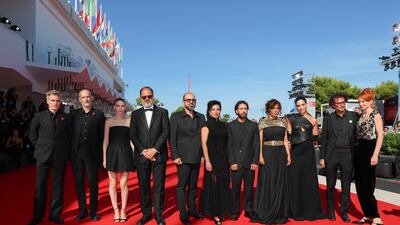
  • From left, Saja Kilani, director Kaouther Ben Hania, Clara Khoury, Motaz Malhees, and producers Nadim Cheikhrouha, Odessa Rae, Jim Wilson, Rooney Mara and Joaquin Phoenix, pose with a portrait of Hind Rajab, on the red carpet for the movie The Voice of Hind Rajab at Venice Film Festival. AFP
    From left, Saja Kilani, director Kaouther Ben Hania, Clara Khoury, Motaz Malhees, and producers Nadim Cheikhrouha, Odessa Rae, Jim Wilson, Rooney Mara and Joaquin Phoenix, pose with a portrait of Hind Rajab, on the red carpet for the movie The Voice of Hind Rajab at Venice Film Festival. AFP
  • Ben Hania holds a portrait of Hind Rajab, a five-year-old Palestinian girl who died in Gaza. AFP
    Ben Hania holds a portrait of Hind Rajab, a five-year-old Palestinian girl who died in Gaza. AFP
  • Khoury and Amer Hlehel on the red carpet. Getty Images
    Khoury and Amer Hlehel on the red carpet. Getty Images
  • Phoenix and Mara arrive for the screening. Reuters
    Phoenix and Mara arrive for the screening. Reuters
  • Kilani, who recreated Hind's call in the film, said at the premiere that the child's 'story carries the weight of an entire people'. EPA
    Kilani, who recreated Hind's call in the film, said at the premiere that the child's 'story carries the weight of an entire people'. EPA
  • The cast and producers on the red carpet in Venice. Getty Images
    The cast and producers on the red carpet in Venice. Getty Images
  • Malhees holds up a portrait of Hind Rajab. Getty Images
    Malhees holds up a portrait of Hind Rajab. Getty Images

Her 2021 feature The Man Who Sold His Skin was also nominated for an Oscar, in the Best International Feature category. Tunisia has already submitted The Voice of Hind Rajab as its entry for this year’s Best International Feature Oscar.

At the press conference earlier in the day, Ben Hania and her cast received another standing ovation. Actress Saja Kilani, who recreates Hind's call in the film, delivered an impassioned statement on behalf of the crew.

“Enough of the mass killing, the starvation, the dehumanisation, the destruction, and the ongoing occupation,” she said. “This film is not an opinion or a fantasy. It is anchored in truth. Hind’s story carries the weight of an entire people … It is the voice of every daughter and every son with the right to live, to dream, to exist in dignity.”


Living in...

This article is part of a guide on where to live in the UAE. Our reporters will profile some of the country’s most desirable districts, provide an estimate of rental prices and introduce you to some of the residents who call each area home.

COMPANY%20PROFILE
%3Cp%3E%3Cstrong%3EName%3A%20%3C%2Fstrong%3ESmartCrowd%0D%3Cbr%3E%3Cstrong%3EStarted%3A%20%3C%2Fstrong%3E2018%0D%3Cbr%3E%3Cstrong%3EFounder%3A%20%3C%2Fstrong%3ESiddiq%20Farid%20and%20Musfique%20Ahmed%0D%3Cbr%3E%3Cstrong%3EBased%3A%20%3C%2Fstrong%3EDubai%0D%3Cbr%3E%3Cstrong%3ESector%3A%20%3C%2Fstrong%3EFinTech%20%2F%20PropTech%0D%3Cbr%3E%3Cstrong%3EInitial%20investment%3A%20%3C%2Fstrong%3E%24650%2C000%0D%3Cbr%3E%3Cstrong%3ECurrent%20number%20of%20staff%3A%3C%2Fstrong%3E%2035%0D%3Cbr%3E%3Cstrong%3EInvestment%20stage%3A%20%3C%2Fstrong%3ESeries%20A%0D%3Cbr%3E%3Cstrong%3EInvestors%3A%20%3C%2Fstrong%3EVarious%20institutional%20investors%20and%20notable%20angel%20investors%20(500%20MENA%2C%20Shurooq%2C%20Mada%2C%20Seedstar%2C%20Tricap)%3C%2Fp%3E%0A
Ten tax points to be aware of in 2026

1. Domestic VAT refund amendments: request your refund within five years

If a business does not apply for the refund on time, they lose their credit.

2. E-invoicing in the UAE

Businesses should continue preparing for the implementation of e-invoicing in the UAE, with 2026 a preparation and transition period ahead of phased mandatory adoption. 

3. More tax audits

Tax authorities are increasingly using data already available across multiple filings to identify audit risks. 

4. More beneficial VAT and excise tax penalty regime

Tax disputes are expected to become more frequent and more structured, with clearer administrative objection and appeal processes. The UAE has adopted a new penalty regime for VAT and excise disputes, which now mirrors the penalty regime for corporate tax.

5. Greater emphasis on statutory audit

There is a greater need for the accuracy of financial statements. The International Financial Reporting Standards standards need to be strictly adhered to and, as a result, the quality of the audits will need to increase.

6. Further transfer pricing enforcement

Transfer pricing enforcement, which refers to the practice of establishing prices for internal transactions between related entities, is expected to broaden in scope. The UAE will shortly open the possibility to negotiate advance pricing agreements, or essentially rulings for transfer pricing purposes. 

7. Limited time periods for audits

Recent amendments also introduce a default five-year limitation period for tax audits and assessments, subject to specific statutory exceptions. While the standard audit and assessment period is five years, this may be extended to up to 15 years in cases involving fraud or tax evasion. 

8. Pillar 2 implementation 

Many multinational groups will begin to feel the practical effect of the Domestic Minimum Top-Up Tax (DMTT), the UAE's implementation of the OECD’s global minimum tax under Pillar 2. While the rules apply for financial years starting on or after January 1, 2025, it is 2026 that marks the transition to an operational phase.

9. Reduced compliance obligations for imported goods and services

Businesses that apply the reverse-charge mechanism for VAT purposes in the UAE may benefit from reduced compliance obligations. 

10. Substance and CbC reporting focus

Tax authorities are expected to continue strengthening the enforcement of economic substance and Country-by-Country (CbC) reporting frameworks. In the UAE, these regimes are increasingly being used as risk-assessment tools, providing tax authorities with a comprehensive view of multinational groups’ global footprints and enabling them to assess whether profits are aligned with real economic activity. 

Contributed by Thomas Vanhee and Hend Rashwan, Aurifer

Updated: September 04, 2025, 12:07 PM