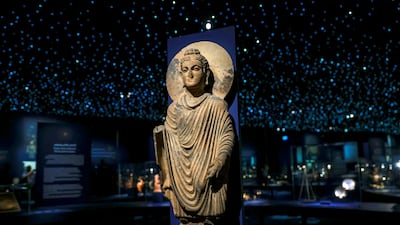

Visitors to Louvre Abu Dhabi's latest exhibition begin their journey in darkness, lights above mimicking a star-filled sky. It's a reminder of a time when sailors relied on the heavens to navigate the Indian Ocean, carrying spices, precious stones and textiles between distant civilisations.
Such voyages connected communities from East Africa and the Arabian Peninsula to India, China and South-East Asia, establishing commercial and cultural relationships that developed over centuries.
Their history is explored in Spices and Wonders: Sailing the Indian Ocean, opening at Louvre Abu Dhabi on Wednesday, October 14, and running until February 14, 2027.

Organised in partnership with the Guimet National Museum of Asian Arts in Paris, the exhibition brings together about 240 artworks and historical objects from 24 lenders, covering maritime exchange from antiquity to the 17th century.
Among them are archaeological discoveries, jewellery, religious artefacts and objects recovered from shipwrecks. Six detailed models of historic vessels and specially created maps illustrate how sailors crossed vast waters and transported goods between continents.

The exhibition places the Arabian Gulf at the centre of its narrative, examining the region's historical role in these networks.
“The story is told from here, and that is something we consider very important at Louvre Abu Dhabi: telling the story from the region,” says Guilhem Andre, the museum's director of scientific, curatorial and collections management “This has never really been done on this scale before.”
The exhibition features loans from institutions including the Asian Civilisations Museum in Singapore, the National Museum of the Philippines and the Al Sabah Collection in Kuwait.
Pierre Baptiste, director of collections and curatorial staff at the Guimet in Paris, says the exhibition explores how people established relationships through commerce and spiritual exchange.
The Arabian Gulf's pearl industry provides a significant regional example. Pearls harvested from its waters travelled to markets in India and beyond, while materials such as carnelian were traded across the ocean from ancient times.

Later networks expanded the circulation of gemstones, jewellery, furniture and textiles. Andre said the objects revealed how discoveries of new sources of gold, spinels, rubies and emeralds influenced jewellery production. Diplomatic gifts also feature, demonstrating how valuable objects helped establish relationships between rulers and communities.
Beyond the goods themselves, the exhibition examines the techniques that made these journeys possible.
Its opening gallery recreates the darkness experienced by ancient navigators, who relied on stars and coastal landmarks to determine their position.
“The main idea was to give visitors a sense of what people at the time experienced,” Baptiste says.
Subsequent galleries explore navigational instruments, including the kamal, used in Arab and Indian maritime traditions, and the astrolabe. Twenty-four maps created specifically for the exhibition trace the routes connecting ports across the ocean.
Six large ship models represent Arabian, South-East Asian, Chinese, Portuguese and Spanish maritime traditions. Andre says they were constructed in South Africa over the course of a year, drawing on extensive historical research.

The models are accompanied by objects recovered from shipwrecks, offering evidence of the cargo these vessels carried.
Baptiste says advances in underwater archaeology since the 1990s have enabled researchers to recover significant quantities of material from sunken ships, including objects originating in China, India, Spain and Mexico.
Among the most valuable commodities were spices, which commanded high prices alongside luxury products such as jewellery and textiles.
Cultural exchange is another central theme. A Buddha sculpture from present-day Pakistan, loaned by the Guimet, reflects the influence of ancient Greek and Roman artistic traditions on Buddhist sculpture.
The final gallery examines four religious traditions that spread across the Indian Ocean, showing how beliefs travelled along the same routes as commercial goods.
Andre says merchants and pilgrims often crossed these waters for different purposes, carrying objects and practices that became part of life in distant communities.

“Religion was not separate from trade,” he says. “They were all part of the same relationships and exchanges.”
The exhibition also offers a perspective on maritime history that predates the expansion of European influence in Indian Ocean commerce during the 17th and 18th centuries.
Baptiste says the decision to conclude the historical narrative in the 17th century was deliberate, allowing visitors to understand the networks that existed long before European powers became prominent in the region.
These earlier connections, he says, laid the foundations for the expansion of international commerce in subsequent centuries.
“We wanted to approach the history of commercial relationships from a multicultural perspective,” he says. “Europe was only one part of this story.”
Spices and Wonders: Sailing the Indian Ocean runs at Louvre Abu Dhabi from October 14, 2026, until February 14, 2027. The exhibition will subsequently travel to the Guimet in Paris, where it will be presented from May 12 to September 6, 2027.

