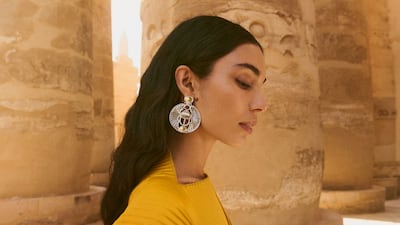

The opening late last year of the billion-dollar Grand Egyptian Museum at Giza, home to the famous treasures of Tutankhamun, came at the perfect time for Van Cleef & Arpels, which was finalising its vast new high jewellery collection titled Fascinating Egypt. Unveiled in June, the collection immortalises the land of the pharaohs in rubies, emeralds, sapphires and diamonds, adding a fresh chapter to our enduring fascination with this ancient civilisation.
That fascination was ignited in Europe by Napoleon’s disastrous invasion of Egypt in 1798. French scientists and scholars followed in his wake, flocking to the Nile and the Great Pyramids to uncover the riches and sophisticated culture buried within. This led to Champollion’s deciphering of the hieroglyphs on the Rosetta Stone in 1822 and the installation of the Luxor Obelisk on Place de la Concorde in Paris in 1836.

Public intrigue grew as museums and collectors swooped in during the late 19th century to acquire sphinxes, sarcophagi, hieroglyphs and other unearthed antiquities, while Egyptian aesthetics began inspiring designers and artisans across Europe.
It was the discovery in November 1922 by British Egyptologist Howard Carter of the golden splendours in the tomb of boy-king Tutankhamun, however, that opened the floodgates for Egyptomania. A frenzy of creativity followed, infusing the decorative arts, music, ballet, theatre and jewellery with motifs spanning everything from pharaohs and lotus flowers to pyramids and sphinxes.
Van Cleef & Arpels and Cartier drew on the patterns and figures adorning the Valley of the Kings, giving them new life in sleek, modern silhouettes set with diamonds, onyxes and emeralds. It also influenced a new, prominent era of design: Art Deco.

Now Van Cleef & Arpels is reviving that aesthetic with 180 abstract and figurative pieces paying homage to Egyptian culture and craftsmanship, while expressing the maison’s own artistic language. “For many years, the maison, so inspired by Egypt in the 1920s, has wished to prolong the story and present its own vision of this ancient heritage,” explains Catherine Reinier, president and chief executive of Van Cleef & Arpels.
Embodying that spirit of renewal are the fresco-like Paysage bracelets, featuring futuristic landscapes of pyramids, a profile of Tutankhamun, and architectural friezes of columns and hieroglyphs. There is a ruby and diamond lotus brooch and the Beauté Légendaire necklace, inspired by Egyptian breastplates but rendered in a lighter form. Hieroglyph-inscribed clips resemble fragments from a tomb, while dazzling figures depict pharaohs as well as Cleopatra.
The flamboyant royal also features in Geneva-based jeweller Boghossian’s new high jewellery collection, Queens of Time, although not in figurative form. The collection draws inspiration from queens across Europe and Asia, with Cleopatra, who ascended the throne as co-regent with her brother in 51 BC, evoked through a dramatic Greco-Egyptian knot necklace in golden-yellow mother-of-pearl and yellow diamonds.

Many ancient Egyptian jewellery techniques – including repousse, engraving, wire work, casting, stone setting and beading – remain in use today. Motifs such as scarabs, cobras, lotus flowers and hieroglyphs, as well as ornamental stones such as lapis, have repeatedly re-emerged as symbols of glamour, both in the early 20th century and now.
Historic examples can be found throughout the Grand Egyptian Museum, which spans 5,000 years of history. Regular visitors, Egyptian jewellery designers Amina Ghali and her mother Azza Fahmy remain enthralled at the quality of goldsmithing achieved thousands of years ago. “It is honestly mind-blowing,” says Ghali, head designer at her mother’s eponymous brand.
Particularly astonishing is the gold mask of Tutankhamun. “It was created using casting, yet when you walk around it, you won’t find a single solder line. My mother and I often think: how were they able to do that thousands of years ago? Even today, achieving something that seamless would be extremely difficult.”

The museum’s opening is sparking a new wave of interest in Egypt’s cultural heritage and design language, and Azza Fahmy is perfectly placed to respond, having opened a boutique there. “Ancient Egypt has always been a major source of inspiration for us,” explains Ghali.
“My mother and I travel to Luxor every year, and we spend days in the temples studying the carvings, proportions and symbolism up close. These trips are incredibly grounding, allowing us to reconnect with the source and understand the stories behind these symbols.”
One of the brand’s most recent collections centres on the scarab, a symbol of renewal and protection – “a beautiful reminder of transformation and new beginnings. And that’s the spirit we wanted to bring into the pieces,” says Ghali.
That symbolism has made the scarab a recurring jewellery motif, from Cartier in the 1920s to contemporary designers such as Bibi van der Velden from Amsterdam and Lito Karakostanoglou from Athens. Van der Velden creates scarab rings and talismanic rock-crystal pendants containing 3,000-year-old bronze ushabti, or funerary figurines, bought at auction.
For Karakostanoglou, meanwhile, scarabs are a recurring and emblematic motif. “It is true that ancient cultures have always inspired my work, especially the meaning embedded in their symbols,” the designer says.

Lito Fine Jewellery’s Cosmic Guardians collection, launched in July, interprets the ancient symbol through a modern lens, setting colourful, naturally iridescent beetles – preserved by famed French taxidermist Deyrolle – into boldly contemporary gold jewellery.
Clients, she explains, are drawn to the scarab’s talismanic quality. “They want that ancient, potent symbolism woven into the brand’s DNA – and the scarab carries that heritage effortlessly. It’s elaborate, yes, but it’s also deeply personal – quiet armour for the modern wearer.”
Sarah Ysabel Narici, founder of New York jewellery brand Dyne, has been fascinated by Egypt since childhood, drawn most strongly to hieroglyphs. She loves the tension in her work, she says, “between ancient history and the future, and the ability to tell stories of humanity through jewellery”.
Her bespoke Loverglyph rings take the concept of hieroglyphs and use a combination of talismanic and modern symbols to tell the wearer’s story – demonstrating just how vividly the visual language of ancient Egypt continues to inspire contemporary jewellery.


FOLLOW TN MAGAZINE