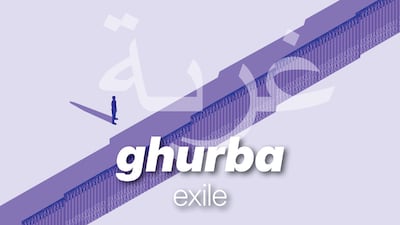

How does a word describe a feeling that is far more intricate than physical distance? Ghurba, the Arabic word for exile, speaks of standing between worlds, carrying memories of one place while trying to put down roots in another. Across the region, ghurba colours personal stories, shapes artistic expression and continues to resonate in a society where mobility and migration are part of many lives.
Ghurba, our Arabic word of the week, is rooted in the letters qaf-raa-baa-haa. It comes from the word ghareeb which means strange. To travel to another country, or become exiled unwillingly, is to be made a stranger in a foreign land, thus a word like ghurba coming from strange makes sense. Someone in exile is called mughtarib.
Ghurba has deep roots in Arab culture. Early poets described it through images of journeys across vast deserts and the longing for a familiar horizon. Their verses often placed the traveller at the edge of the known world, reflecting on the cost of ambition and the comfort of memory. The emotional landscape these poets created continues to influence how the region understands the experience of being away from home.
In the Gulf, the emotional contours of ghurba are often expressed through music. In Mohammed Abdu’s song Ghareeb Al Dar, which translates to a land’s stranger, he gives voice to the turmoil of someone trying, and failing, to free himself from longing.
In its opening lines, the singer confesses: “A stranger to the home, and all I hope for is distraction. I try to soothe my heart from the love of my beloved.” His attempt is futile, and he realises how misguided the advice of others has been. “I heard counsel from one who knows little, who thinks that distance from home brings comfort.”
The song reflects a truth shared across many experiences of ghurba. Separation does not always bring clarity. Sometimes it intensifies what a person tries hardest to forget.
The final verses turn tender and direct, giving the song its emotional centre. “He calls to me, saying return, stranger of the home. You have no place but your place with me. Your place is in my eyes, my eyes, and my heart never tires of your love.” In these lines, ghurba becomes not just longing but reconciliation. The home that once felt distant extends its hand, reminding the wanderer that belonging is not erased by absence.
In more recent history, ghurba has taken on new meanings as migration became a defining element of life for millions of Arabs. Students departed for universities abroad, professionals pursued careers overseas and entire communities rebuilt their lives far from their original homes. For many, this shift was driven by hope. The routines of daily life in foreign cities, the need to navigate new languages and the effort to preserve cultural habits all contributed to a layered sense of displacement. Ghurba is neither purely sorrowful nor purely liberating. It is an in-between space where opportunity and nostalgia coexist.