

If 2021 was the year the corporate world joined the net-zero revolution, then 2022 is the year that pledges must turn into climate action.
The corporate world is ready to take it up a level, with the topic set to take centre stage at next week’s virtual Davos hosted by the World Economic Forum.
“I don't think any large gathering of business leaders nowadays can afford to ignore the question of climate change and sustainability — it's really becoming a licence-to-operate issue now,” Jeffrey Beyer, managing director of Dubai-based sustainability consultancy Zest Associates, told The National.
That’s because 2021 was a pivotal moment for the climate change campaign. Despite a number of challenges ranging from pandemic lockdowns to supply chain disruptions and extreme weather patterns, companies and consumers finally started to take sustainability seriously.
“The public has really woken up to this. Before, the word 'cop' meant policeman — now it's a shorthand for UN Climate Change Conference. Cop has become a household name and the amount of attention that these conferences are getting is unprecedented. There is fear and pressure and impatience and pretty high expectations,” Mr Beyer said.
-
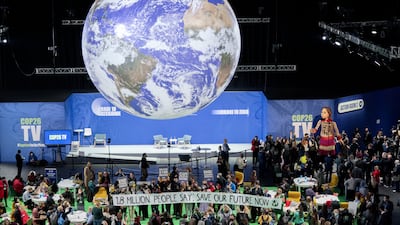
Little Amal, a giant puppet depicting a Syrian refugee girl, visits the Action Zone at the Cop26 summit in Glasgow for the opening of the Gender Day event. PA -

US House Speaker Nancy Pelosi poses with senators in Glasgow. Reuters -
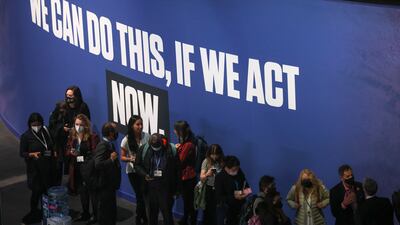
People gather at the venue on day 10 of the summit. Reuters -
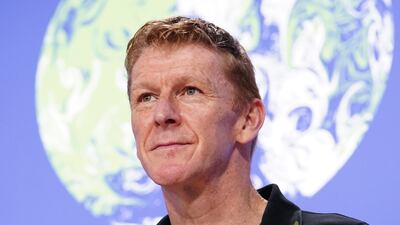
Astronaut Tim Peake attends 'In conversation: The science behind Cop' during the Science and Innovation Day. PA -

A delegate walks past Cop26 branding at the venue. Reuters -

Alexandria Ocasio-Cortez, US representative for New York's 14th congressional district, poses for a picture inside the Blue Zone at Cop26. Getty Images -
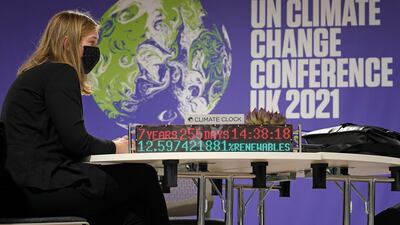
A delegate sits on a table that has an installation showing the 'Climate Clock'. AP Photo -

A person walks through the venue of the Cop26 summit in Glasgow, Scotland. Reuters -
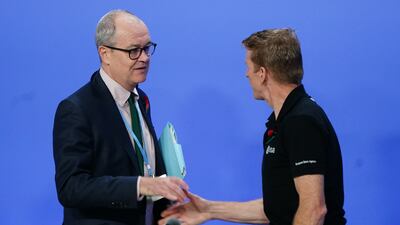
Sir Patrick Vallance, the British government's chief scientific adviser, shakes hands with astronaut Tim Peake ahead of their appearance at Cop26. PA -
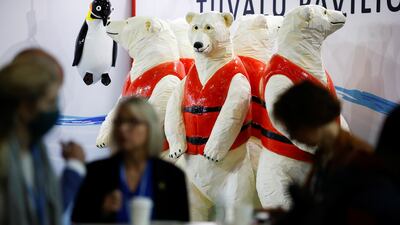
Statues of polar bears wearing life jackets are on display at the summit. Reuters


Companies cannot afford to ignore sustainability
For companies, this means making sure they work with and invest in sustainability, not only to attract investment but also the right kind of talent.
A recent study by healthcare firm Bupa found that Gen Z will go out of their way to work for more ESG-driven firms, even taking pay cuts to secure the right role.
Cop26, the two-week climate summit in Glasgow that concluded in November, did not achieve all of its aims but the general consensus was that the event was largely a success.
A shift in sentiment among corporates helped former Bank of England governor Mark Carney cajole major banks, investors and insurers representing $130 trillion in assets to decarbonise their businesses by the middle of the century.
Thanks to Mr Carney's efforts, private finance is now committed to science-based net-zero targets and near-term milestones through the Glasgow Financial Alliance for Net Zero (GFANZ), which he set up in April last year.
GFANZ members are required to set robust, science-based near-term targets within 12-18 months of joining, with more than 90 of the founding institutions already doing so by Cop26 in early November.
“2021 was an important year for climate,” said Stuart Lemmon, chief executive of EcoAct Northern Europe, which helps businesses enact decarbonisation strategies.
“I have worked in the sector for over 25 years and for the first time, I didn’t have to argue the case for climate change and why we urgently need to act,” said Mr Lemmon, who is also the interim managing director of Atos’s Net Zero Transformation.
“Instead, climate change was at the top of the agenda, climate science was in mainstream news and organisations across all sectors were coming to us to find out what they can do to calculate and reduce their emissions.”
What prompted the corporate shift?
It was the publication of the Intergovernmental Panel on Climate Change (IPCC) report in August that really prompted the corporate call to action.
The IPCC’s stark warning of a “code red for humanity” helped to solidify the significant cultural shift Mr Lemmon witnessed at Cop26, “where we were no longer debating if climate change was real but instead looking to climate science for solutions”.
2021 was certainly the year of climate pledges, with more countries and organisations setting clear net-zero targets, and 67 regions, 1049 cities, 5,235 companies, 1039 educational institutions, 441 financial institutions and more than 3,000 hospitals joining the UN’s Race to Zero and making a commitment to halve emissions by 2030 and achieve net zero carbon emissions by 2050 at the latest.
While Cop26 ended with the summit’s president, Alok Sharma, close to tears over a change in the wording of the final deal, 196 countries still adopted the Glasgow Climate Pact, reaffirming the goal of limiting the increase in temperatures to well below 2°C (and if possible, under 1.5°C) above pre-industrial levels.
Despite Mr Sharma’s tears, Mr Beyer said the climate change outlook for 2022 comes from a place where Cop26 “largely worked out”.
-
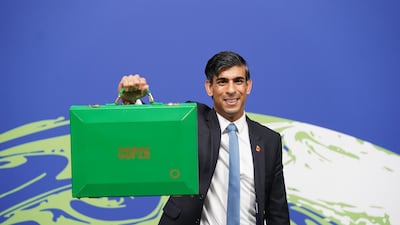
Rishi Sunak, Britain’s Chancellor of the Exchequer, holds his green box at the Cop26 summit in Glasgow, before a meeting a group of finance ministers. PA -
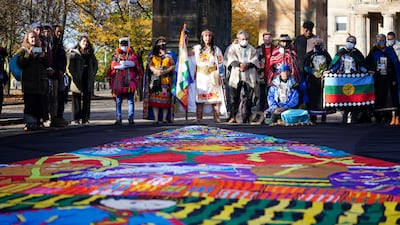
Indigenous leaders in ceremonial dress gather at the McLennan Arch in Glasgow Green to march to the Scottish Event Campus in Glasgow, announcing their arrival at the Cop26 summit. PA -

Rishi Sunak delivers a speech to Cop26 delegates. Getty Images -
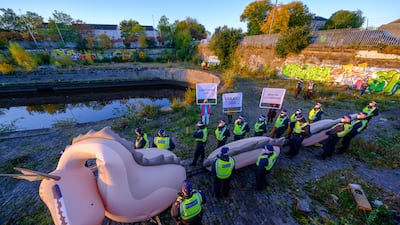
Police officers guarding an inflatable Loch Ness Monster at Govan Dry Dock after it was seized in a dawn raid in Glasgow. PA -
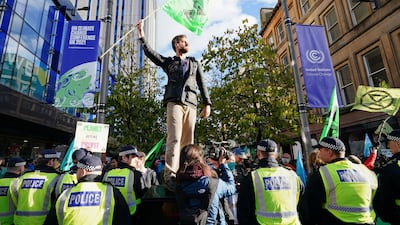
Police and demonstrators at a Extinction Rebellion protest on Buchanan Street, during the Cop26 summit in Glasgow. PA -
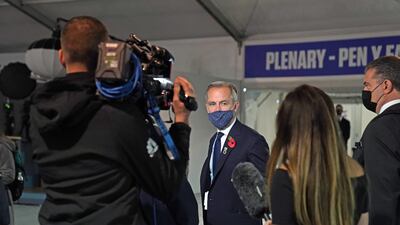
Mark Carney, the former Bank of England governor, speaks to a TV crew at the summit. PA -
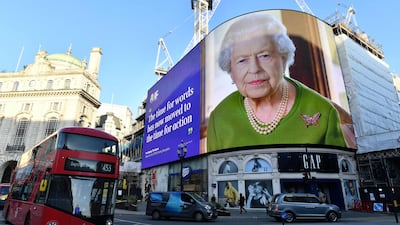
A quote from a message delivered by Britain's Queen Elizabeth to the Cop26 Summit taking place in Glasgow is displayed at Piccadilly Circus in London. AFP -
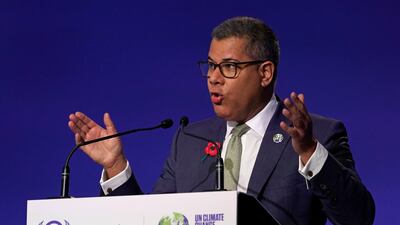
Alok Sharma, president of Cop26, makes his point. AP Photo -

Indigenous Amazon delegate Romancil Gentil Kreta wears a Cop26 branded face mask. Reuters -
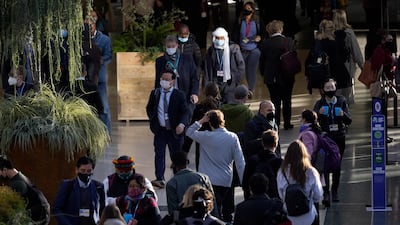
Delegates arrive for another day at the summit in Glasgow. AP Photo -
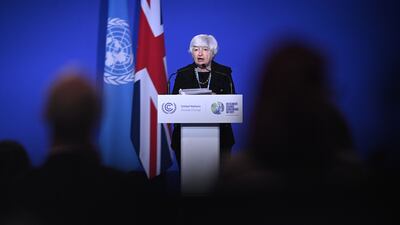
US Treasury Secretary Janet Yellen delivers a speech at the opening of Finance Day at Cop26. AFP


“Alok Sharma was in tears and it was fraught, but he got the resolution. So, the Paris Agreement got the framework in place, and then Cop26 was about finalising the rule book,” said Mr Beyer.
“From now on, Cop27 and beyond is going to be really about implementation.”
That implementation will not only rely on policymakers, but also on businesses and people.
“A lot of big companies have a lot of scrutiny on what their climate commitments are. And increasingly, that scrutiny is going to move beyond just commitments and towards actions,” said Mr Beyer.
“This means big players will really have to show they are reducing emissions and not just committing to do it by 2050.”
Smaller companies must raise their climate change game too
While some of the some of the world’s major banks, including Bank of America and Santander, as well as insurers and asset managers joined GFANZ to find creative ways to channel private money purposefully into investment that advances net-zero goals, Mr Beyer said small companies need to step up, too.
“Big companies have sustainability officers, they have whole departments working on this.” said Mr Beyer.
“Many small businesses don't have the capacity or the knowledge to know where to start, so that's where policy and regulation come into play, because the sustainable choice should be the best choice from an environmental and an economic perspective.”
While setting a 2050 goal is good, having a 2040 goal and a 2035 and even 2025 goal is even better for firms of all sizes, said Mr Beyer.
“There’s this pressure from a lot of consumers and from governments to shorten the horizon of these goals and create these intermediate steps along the way, rather than going to net zero in 2050 and you're still at 90 per cent of your emissions at 2049.”
Mobilising money is the perennial challenge
Bringing business on board was important, but two key things were left unresolved at Cop26.
The first was the failure, yet again, to meet financial commitments, with wealthy countries failing to meet the $110 billion annual funding target set in Paris to subsidise developing nations' efforts to move towards carbon neutrality.
Although Mr Sharma pointed to the substantial mobilisation of the private sector as the catalyst needed to provide momentum where governments had held back, mobilising money has been the “perennial challenge” of the climate change race.
But with the mechanism for the Green Climate Fund now in place, the real challenge is about capitalising that fund and “making sure that investment can really flow”, said Mr Beyer.
However, there is also recognition that government money can only go so far.
“Really, that money should be used to leveraging and to crowd in private sector investments,” he said.
“So, rather than direct loans and grants from governments, it's about leveraging the private sector to open up its pocketbook and contribute to the solution. And we’re talking big money — to solve climate change requires trillions.”
Carbon pricing must happen this year
Government policy is also needed when it comes to carbon pricing, energy firm bosses say.
“In order to get market forces to work, you have to create prices. So, carbon trading systems would work but it has to be done — we’ve been talking about that for donkey's years,” said Dr Frigyes Lestak, chief executive and board member of F2V.
With 30 years of experience in the oil and gas sector, including 15 years working for Shell, Mr Lestak's company now works on flare reduction strategies, turning the $30bn worth of gas burned across the globe “into something useful, such as electricity".
Last year, World Trade Organisation chief Ngozi Okonjo-Iweala urged the International Monetary Fund, World Bank and Organisation for Economic Co-operation and Development to join forces to adopt a common approach towards a global carbon price.
“This is the future,” Ms Okonjo-Iweala said in October, “but what we have now is a very fragmented system”.
Although envoys from almost 200 nations have debated a global framework for carbon markets for decades at the UN climate talks, previous attempts to create a global market have sputtered.
Carbon-pricing initiatives have sprung up in 65 jurisdictions, the World Bank says, but the patchwork of systems each work differently and target pollution from different sources.
Bank of England policymaker Catherine Mann said this week that adopting a global price on fossil fuel pollution could spur investment and productivity that would lift the world economy out of its torpor.
Mr Lestak said “something is lopsided” in the whole renewable energy story if companies strive to be resource efficient but are only rewarded for half of their objective.
“Carbon pricing has to happen this year,” he added.
What's in store at Cop27 and Cop28?
It’s not only carbon pricing that needs addressing. The Glasgow Climate Pact recognised the current Nationally Determined Contributions (NDCs) are far from on track to reach this goal, requiring a re-examination at Cop27.
“The 1.5°C goal requires greenhouse gas (GHG) emissions to be reduced by 45 per cent by 2030 compared to 2010 levels, yet current NDCs amount to a 14 per cent increase of GHG,” Mr Lemmon said.
“The Cop presidency therefore called on parties to revisit and strengthen the 2030 targets in their NDCs as necessary to align with the Paris Agreement temperature goal by the end of 2022. Thereafter, parties will have to update their NDCs every five years in line with the decision adopted on 'common time frames'."
This puts pressure on Cop27 in Egypt to ensure that net-zero strategies are not only on track, but things not achieved in Glasgow are agreed to at the November event.
Maria Mendiluce — chief executive of the We Mean Business Coalition, a non-profit organisation that strives to catalyse business and policy action to halve emissions by 2030 — said while Cop26 kept the 1.5°C goal alive, “the goal is in intensive care".
“Paris was all about ambition, ambition, ambition. From now, it is about action, action, action and the question is how are companies and countries going to meet the very ambitious targets?” she said.
Ms Mendiluce expects Cop27, hosted in Africa for the first time, will shift to the needs of developing countries while also focusing on adaptation, climate finance and managing the inevitable impacts of climate change.
This will become an opportunity to discuss the issue of loss and damage, said Mr Beyer, examining payments from developed to developing countries to compensate for the effects of climate change.
“It’s challenging for any country presiding over Cop to take on board loss and damage as its flagship issue because it is so thorny but if anybody is in a position to do it, it's Egypt because of the constituency that they represent,” he added.
Looking ahead to Cop28, Ms Mendiluce expects the UAE event to be even more “important” because of “the global stock take".
“A lot of discussions in Glasgow were about potential greenwashing and ‘there’s lots ambition but no action’, but for the first time next year, countries and companies will have to show result and think about their goals for 2030,” she said.
“In our view, transparency and results — where countries and companies want to look good — will accelerate action in the next couple of years.”
Has the transition caused the energy crisis?
Finance might have flipped since the corporate world woke up to the realities of climate change, but pledging to no longer invest in oil and gas is a concern for Mr Lestak because consumers still need to power homes and drive cars and have access to cheap energy.
“So, what happened to the gas prices? The industry stopped investing and we are now paying four times more because there's a supply crunch,” he said.
“We need to be a little bit more nuanced. It’s the right strategy to think that these kind of investments are getting riskier and riskier — but denying any kind of investment is short-sighted.”
Ms Mendiluce insists Europe’s energy crisis is not a result of the energy transition but because of the post-Covid supply chain bottlenecks following pandemic lockdowns.
“It Is important that policymakers have a holistic view and stick to the transition because if they start to invest in gas infrastructure … it will not be needed afterwards and will become a waste of money,” she said.
“Instead, they should invest in interconnecting the different power systems to advance and accelerate the adoption of renewable energy and educate consumers on how to consume less energy.”
Adaptation will also be a prominent theme at Cop27 and the business sector must start work on its transition plans now, Ms Mendiluce added.
“If businesses have adaptation plans, they benefit the communities where they work because they make those communities more resilient. So, we need to help them understand what they need to do.”

