

Live updates: Follow the latest news on Israel-Gaza
The White House on Thursday said it would not support any plans by Israel for a major military operation in the southern Gazan city of Rafah, because it would spell disaster for the Palestinian civilians who have sought refuge there.
National Security Council spokesman John Kirby said Secretary of State Antony Blinken had made US concerns about such operations clear during meetings with Israeli officials.
“Any major military operation in Rafah at this time, under these circumstances, with more than a million – probably more like a million and a half – Palestinians who are seeking refuge … in Rafah, without due consideration for their safety would be a disaster,” Mr Kirby told reporters.
“And we would not support it.”
Israel's military struck areas of Rafah on Thursday, killing at least 13 people, according to Palestinian health officials.
But Mr Kirby played down prospects of any imminent plans for a major Israeli ground operation in the city.
“We haven't seen any indications that there's operational planning or at least planning at the level of specificity that tells us an operation or major ground operation around Rafah is imminent,” he said.
“We just haven't seen a plan.”
Mosque hit in deadly Israeli air strike on Rafah – video
His comments come after Israeli Prime Minister Benjamin Netanyahu rejected the latest ceasefire proposal put forward by Hamas, and said he would expand the offensive into Rafah, the southern Gazan city where civilians were ordered to go to find safety from the fighting.
Mr Netanyahu's rejection came after American, Qatari and Egyptian efforts to bring about a deal. The three countries ironed out a framework for a hostage release in Paris last week.
On Tuesday, Hamas sent a counter proposal that included Israel's withdrawal from Gaza, a permanent ceasefire and a reconstruction plan with a three-year timeline.
They also envisage a detainee and hostage swap between Israel and Hamas.
Mr Netanyahu called the counter proposal “delusional.”
State Department deputy spokesman Vedant Patel echoed Mr Kirby's statements.
“We would not support the undertaking of something like this without serious and credible planning as it relates to the more than one million people who are sheltering there,” Mr Patel said.
Mr Blinken ended a four-day tour of the Middle East on Thursday, his fifth visit to the region since war broke out after Hamas's October 7 attack on southern Israel.
He said he had told Israeli leaders in meetings that they had to take steps to protect civilians in Rafah and the wider Gaza – a request he has made repeatedly on prior trips but that so far have born few results.
“Israel has the responsibility, has the obligation to do everything possible to ensure that civilians are protected and that they get the assistance they need in the course of this conflict,” Mr Blinken told reporters in Tel Aviv on Wednesday.
Hundreds of aid lorries begin to cross Rafah border – in pictures
-

Lorries carrying humanitarian aid queue at the Rafah border crossing between Egypt and Gaza. Reuters -

The aid has been allowed to enter the besieged Palestinian enclave under a temporary truce agreement between Hamas and Israel. Reuters -

Lorries carrying aid and diesel enter Gaza through the Rafah border crossing. Getty Images -

Aid to be sent to Gaza during the pause in the war. Getty Images -
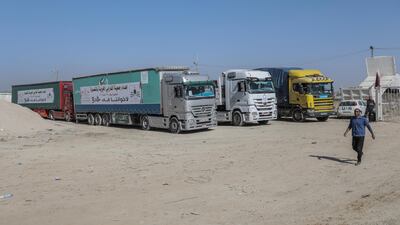
The UN says 200 aid lorries travelled from Nitzana to the Rafah crossing between Egypt and Gaza. Getty Images -

It was the largest volume of aid to enter the enclave since the humanitarian deliveries resumed on October 21. Getty Images -
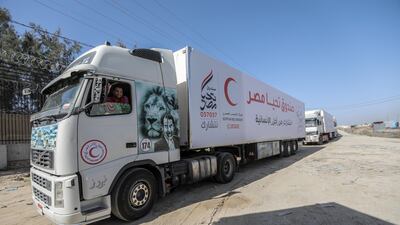
Lorries carrying 129,000 litres of fuel and four loaded with cooking gas crossed into Gaza. Getty Images



