

Follow the latest news on the US midterm elections 2022
Governor Ron DeSantis's landslide re-election in Florida has solidified his status as the fastest-rising star in the Republican Party.
Mr DeSantis is considered the biggest rival to Donald Trump in 2024, should both men seek the party's nomination for president.
After winning his state by more than 19 per cent — a better showing than the Republicans managed in many other parts of the country — conservatives are beginning to circle around Mr DeSantis as their best shot at winning back the White House.
Conservative television outlet Fox News heralded the governor as “the new Republican Party leader”. The New York Post, a conservative tabloid, called Mr DeSantis “DeFUTURE”, while Mr Trump became “Trumpty Dumpty”.
At the same time, former associates of Mr Trump are reportedly urging him to delay his speculated “big announcement”, originally scheduled for next week.

'Two more years'
Mr Desantis's 19.4 per cent margin of victory was the largest in Florida's history. It also eclipsed Mr Trump's victory during the 2020 presidential election, where he carried the state by a little north of three points.
A notable win for Mr DeSantis was in Miami-Dade County, which has a large Latino population. It was the first time a Republican governor candidate won the county.
He also won Palm Beach County, another Democratic stronghold.
It was further proof that Florida is now firmly in the control of Republicans after Mr Trump won the state in 2020 and 2016.
“We not only won election, we have rewritten the political map,” a victorious Mr DeSantis declared on Tuesday night.
Possibly even more impressive was that Mr DeSantis carried Republicans down-ballot in elections across the state, showing his political clout. And all six school-board candidates that he endorsed won.
In the weeks leading up to election night, the Florida governor travelled across the country to attend events of other Republican candidates, an unmistakable sign of his national ambition and recognition. During his election night watch party, supporters chanted “two more years”, egging him on to run for president in 2024.
Mr DeSantis has not publicly said if he will run.
A populist in Florida
In his first term as Florida governor, Mr DeSantis echoed many of the populist sentiments espoused by then-president Trump.
During the height of the coronavirus pandemic in 2020, Mr DeSantis opposed the social distancing and quarantining guidelines advised by the Centres of Disease Control and Prevention. As metropolitan cities across the US were shuttered, Florida's residents were seen flocking to its beaches.
The governor also fought back against the use of face masks and said receiving the Covid-19 vaccine was a personal choice, pitting him against infectious disease expert Dr Anthony Fauci.
Also winning him plaudits in Republican circles was signing a bill into law that restricted teaching gender identity and sexual orientation in schools. And he revoked the special district status of Disney, one of the state's largest private employers, after the company pledged to challenge the law.
“We will never, ever surrender to the woke mob,” Mr DeSantis told supporters, using a term used to describe advocates of progressive policies.
He also sought to position himself as one of the most vocal opponents of President Joe Biden's immigration policies, a long-standing central issue for Republican voters.
In September, Mr DeSantis pitted himself squarely against the Democratic president by transporting about 50 Venezuelan migrants from Texas to wealthy Martha's Vineyard in Massachusetts.
-
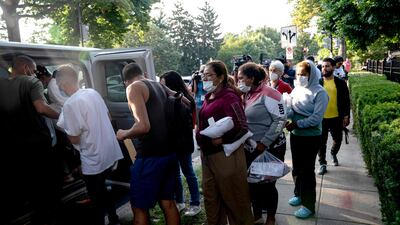
Two busloads of migrants from the US-Mexico border arrived outside Vice President Kamala Harris's home in Washington on Thursday. AFP -

Texas Governor Greg Abbott confirmed that the buses from Texas arrived at the Naval Observatory in north-west Washington. AFP -

Since April, Mr Abbott has ordered buses to carry thousands of migrants from Texas to Washington, New York City and Chicago to highlight criticisms of President Joe Biden’s border policy. AFP -

Migrants from Venezuela, who boarded a bus in Texas, wait to be transported to a local church by volunteers after being dropped off in Washington. AFP -

Many migrants who cross the US border illegally from Mexico are temporarily shielded from deportation to seek asylum in immigration court or released on humanitarian role, once they are freed by US authorities. AFP -

Mr Abbott said Texas sent two buses of migrants to Washington in an effort to call on Mr Biden's administration to 'secure the border. AFP -
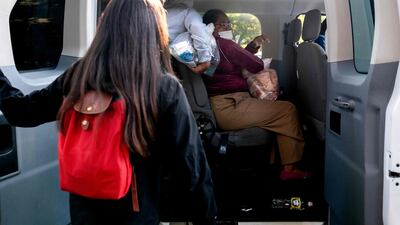
A volunteer assists migrants who were bused from Texas to Washington. AFP -
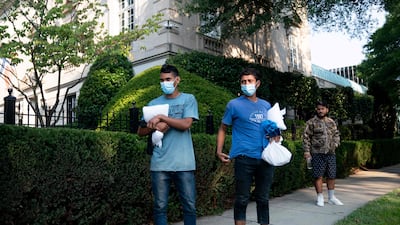
Mr Abbott and other Republican governors have bused migrants to Democratic-held cities across the US in opposition to Mr Biden's border policies. AFP -

A migrant at Martha’s Vineyard, Massachusetts. Reuters -

Venezuelan migrants are seen at the Martha's Vineyard Regional High School, Massachusetts. Reuters -
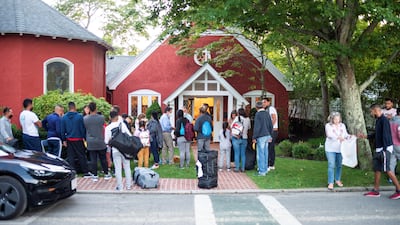
Martha's Vineyard, a summer holiday destination, has a year-round population of only 20,000 people. Reuters -

Venezuelan migrants play football outside the Martha's Vineyard Regional High School, Massachusetts. Reuters -

Volunteers assist Venezuelan migrants outside St Andrew's Church in Martha's Vineyard. Reuters


The White House condemned Mr DeSantis for treating migrants as “political pawns”.
Mr Biden met his potential 2024 challenger for the first time last month after Hurricane Ian, which destroyed part of the state's infrastructure and left more than 100 people dead.
“Mr President, welcome to Florida. We appreciate working together across various levels of government,” Mr DeSantis said during a news conference in the beach town of Fort Myers.
It was a highly anticipated in-person meeting between the Democratic presidential incumbent and the conservative rising star. After Mr DeSantis's high-profile election win on November 8, it may also be a precursor to the 2024 presidential election.

