

The Democrats are in deep trouble in rural America, and as the US midterm elections approach, the party’s support in the country's heartland is plummeting.
Already struggling to hold on to the House of Representatives in the November 8 elections, the Democrats could be dealt a fatal blow by rural voters.
If the elections go as badly as some polls have predicted, President Joe Biden could face two years as a lame duck: powerless to legislate and held hostage by a resurgent right-wing Republican Party.
In the 2020 presidential election, Mr Biden secured 194 rural counties. Compare this to Bill Clinton winning more than 1,100 in 1996 and Barack Obama capturing 455 in 2008.
The situation has since worsened, with Glenn Youngkin flipping Virginia last year to become governor, running up a massive 27-point lead in the most sparsely populated parts of the state.
Mr Youngkin’s victory underlined how Republican attacks on Democrats as representatives of the “coastal liberal elite” have hit home.
Some lay the blame with Chuck Schumer, currently the party’s Senate leader who, in 2016, argued the Democrats should focus on the suburbs rather than the rural hinterland.
“For every blue-collar Democrat we lose in western Pennsylvania, we will pick up two moderate Republicans in the suburbs in Philadelphia, and you can repeat that in Ohio and Illinois and Wisconsin,” he said.
Pennsylvania Senate race — in photos
-
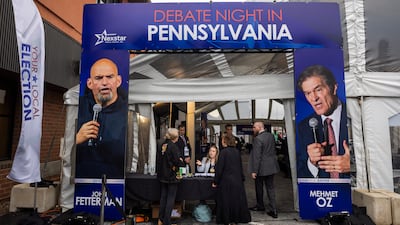
A sign outside the Pennsylvania Senate debate between Democratic candidate John Fetterman and Republican Mehmet Oz in Harrisburg, Pennsylvania, on Tuesday. EPA -
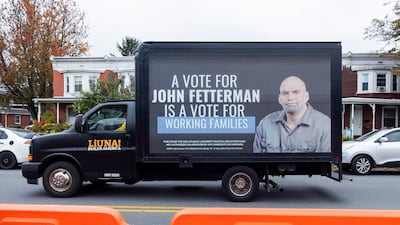
A truck promoting Mr Fetterman drives by the site of his debate with Dr Oz in Harrisburg. EPA -

Oz and Fetterman signs in Pennsylvania -
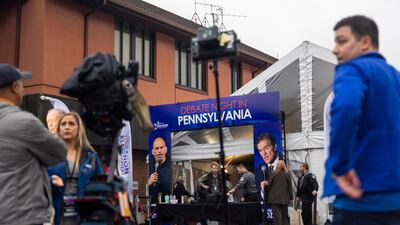
All in readiness for the Fetterman-Oz debate. EPA -
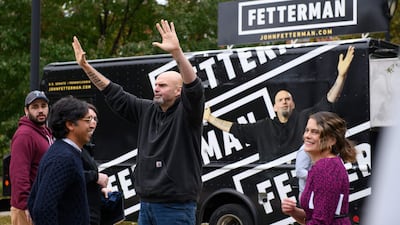
Pennsylvania's Lieutenant Governor John Fetterman waves to supporters after speaking at Dickinson Square Park in Philadelphia on Sunday. AFP -
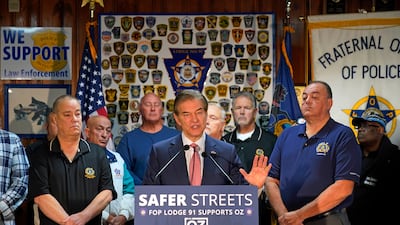
Dr Oz visits the Fraternal Order of Police Lodge 91 in West Homestead, Pennslyvania, last week. AP -
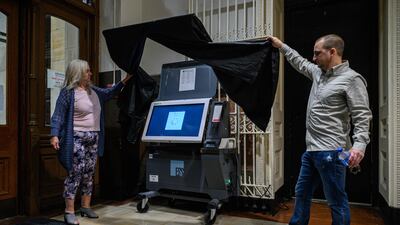
A voting machine at city hall in Philadelphia, ready for the midterm elections. AFP -
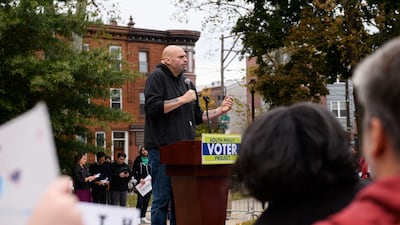
Mr Fetterman speaks to supporters on Sunday. AFP -

Dr Oz greets supporters after a community discussion on safer streets, on October 13 in Philadelphia. AFP -
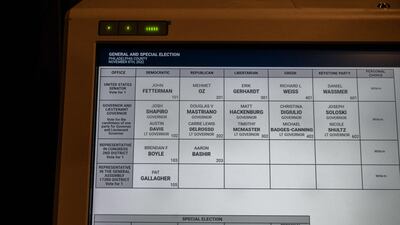
Candidates' names on the screen of a voting machine at city hall in Philadelphia on Monday. AFP


Experts believe the strategy — and the leftward drift of the party — has done huge damage.
“The brand of the party has become more and more toxic in rural areas,” Robin Johnson, adjunct professor of political science at Monmouth College in Illinois, told The National.
“Candidates running — even those who are moderate — are being attacked because of the D behind their name, which is becoming quite harmful to their chances.
“It’s happening more recently, especially in the [Donald] Trump years. The Democrats are haemorrhaging numbers to such an extent the floor is bottoming out.”
Previously, he said, Democrats would get 35-40 per cent of the vote in rural areas. Then it was 25-30 per cent. Now there are some areas where Mr Biden received less than 20 per cent of the vote.
“In a lot of these rural counties, it makes a difference. It did for Trump in Wisconsin and Pennsylvania in 2016,” Mr Johnson said.
“The Democrats stopped investing in rural areas — they put their money into urban areas. They stopped reaching out and these are the results.
“A lot of the races will be really close and rural areas will play a role and, in some cases, put the Republicans over the top.”
What are the US midterm elections and why are they so important? — video
Christopher Galdieri, professor of politics at Saint Anselm College in New Hampshire, also identified the long-term trend.
“In rural areas, the Democrats are so far in the hole. They used to win seats in places like the Dakotas and Montana, but that is not the case anymore,” he told The National.
“Part of it is redistricting, with rural states packing Democratic-leaning voters into districts with few rural voters.”
Redistricting is the process of dividing or organising an area into new political districts for the purpose of better representing a population.
“The population is whiter in rural areas than it is in urban areas, so a candidate that can win New York City or Philadelphia is not going to play so well in rural New York or Pennsylvania,” Mr Galdieri said.
“Then there are cultural issues. The big one is guns. But you also have, for the want of a better term, identity politics.
“A lot of voters in rural areas view cities and those who live there with suspicion or even hostility. If people think you are the party of the urban elite, it’s going to be harder to win these folks over.”
Mr Johnson added: “Democrats should concentrate on issues like the economy rather than social issues which divide the nation. They should try to rebuild the brand from the bottom up.”
Democrats are hunting for a solution, although time is running out.

Illinois Congresswoman Cheri Bustos and a clutch of Democratic politicians including five members of the House of Representatives produced a report last year focused on how the party could win on Donald Trump’s turf.
Her approach required a lot of shoe leather, shadowing constituents at their jobs, meeting voters when they did their grocery shopping and knocking on a lot of doors.
Cindy Axne, a US representative from Iowa, said Democrat candidates should focus on newspapers and radio stations.
“When the majority of my counties tune into Fox and other conservative media, it’s important to bring the message to them,” she wrote.
“I do four weekly/biweekly radio shows in four different rural counties that reach people at their kitchen table and in the cab of their combine.”
Mr Johnson concurred with this mode of operation, saying: "[Democrats] need to train people to canvass properly and also take out advertising in local papers and radio stations even in off-years.”
The message appears to be fight local, avoid cultural issues and focus on the “kitchen table” concerns that resonate with voters outside the big cities.
For Elissa Slotkin, a congresswoman from Michigan, the key is local knowledge.
“I sometimes feel like I’m running for mayor in hundreds of small towns and cities at once," she said.

