


Russia's war in Ukraine and the perilous state of global security are fuelling calls for reform of the institution supposed to enforce world peace: the UN Security Council.
Built from the ashes of the Second World War, the Security Council was established in 1945. Critics say it has become all but useless on key security issues, as the five permanent members who can veto meaningful action agree on so little in today's fractured world.
Perhaps equally pressing is that vast parts of the world have no permanent representation on the council. Areas with no guaranteed voice include India, whose population of 1.4 billion will soon outstrip China's, as well as Latin America and Africa, which have a combined population nearing two billion.
“The UN has structural challenges. And we all agree on that. It can be better. And to take on the challenges of the 21st century, it must be better,” Linda Thomas-Greenfield, the US ambassador to the UN, said on Monday.
Following up on comments made by President Joe Biden at the UN General Assembly last month, Ms Thomas-Greenfield said the US supports an expansion of the Security Council to include unrepresented regions.
Currently, frequent deadlock at the council is all but ensured as the US, UK and France are often at loggerheads with geopolitical foes Russia and China — all of whom have veto power. Aside from the Ukraine war, the council has been unable to intervene in Syria or Ethiopia.
Veto power derives from Article 27 of the UN Charter, which says that all substantive decisions of the council must be agreed to unanimously. The 10 rotating non-permanent members have no veto power.
In his UN speech, Mr Biden attacked Russia for its war in Ukraine and its subsequent vetoes of resolutions aimed at condemning or curtailing the violence.
He urged members to avoid using vetoes “to ensure the council remains credible and effective”.
“A permanent member of the UN Security Council invaded its neighbour, attempted to erase a sovereign state from the map. Russia has shamelessly violated the core tenets of the” UN's founding charter, he said.
Russia illegally annexes parts of eastern Ukraine — in pictures
-
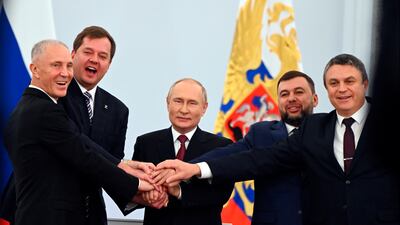
From left, Moscow-appointed head of Kherson region Vladimir Saldo, Moscow-appointed head of Zaporizhzhia region Yevgeny Balitsky, Russian President Vladimir Putin, leader of the Donetsk People's Republic Denis Pushilin, and leader of the Luhansk People's Republic Leonid Pasechnik during a ceremony to sign an annexation agreement with Russia in Moscow. AP -
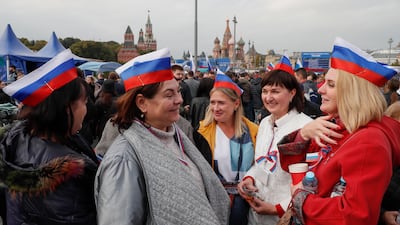
Russians gather for a celebration after the ceremony in central Moscow. EPA -
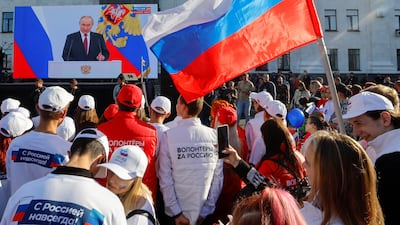
People gather near a screen showing Mr Putin during a broadcast of the ceremony. Reuters -
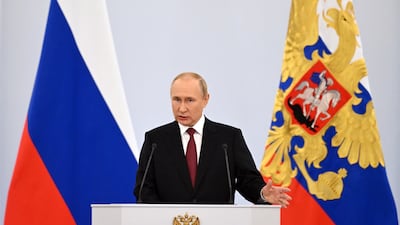
Mr Putin speaks during the ceremony to sign the treaties for the new territories' accession to Russia at the Grand Kremlin Palace in Moscow. EPA -
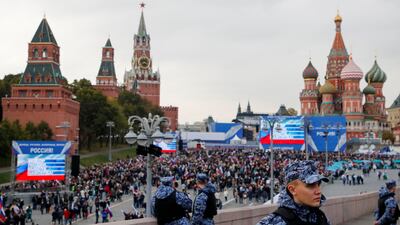
Law enforcement officers stand guard as people walk towards Red Square to attend the ceremony marking the annexation of the Russian-controlled territories. Reuters -

Participants listen to Mr Putin at the ceremony in the Georgievsky Hall of the Great Kremlin Palace in Moscow. Reuters -
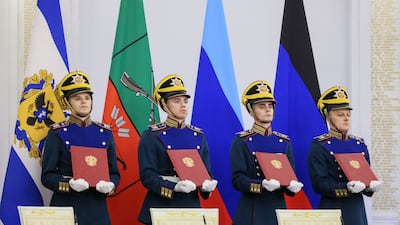
Honour guards attend the ceremony. Reuters -
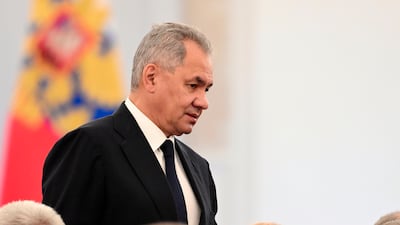
Russian Defence Minister Sergey Shoigu arrives at the ceremony. AP -

People walk towards Red Square in Moscow. Reuters -
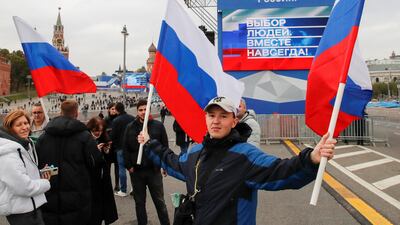
People gather in front of screens located near the Kremlin before the live broadcast of the ceremony. Reuters


The US leader said the time has come for the UN to become “more inclusive so that it can better respond to the needs of today's world”.
Ms Thomas-Greenfield said the US was consulting with UN members on a “listening tour” to hear ideas.
“After all, part of realising a more representative Council is ensuring everyone sees themselves in the process, although we know everyone can’t be on the Security Council,” she said.
Since launching its invasion of Ukraine, Russia has vetoed several resolutions, including one condemning Moscow's so-called referendums that were used to justify the annexation of four regions in eastern Ukraine.
A senior US administration official told The National: “What's changed for us is we've made clear that we're not going to defend an outdated status quo.”
And, he added, it's entirely in the security interest of the US.
UN Security Council members assail Russia over the Ukraine war — in pictures
-
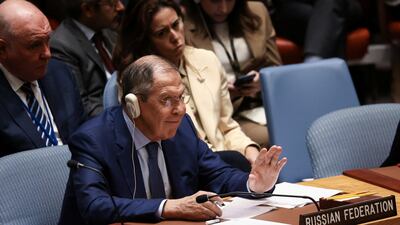
Russian Foreign Minister Sergey Lavrov attends a meeting of the UN Security Council during which Moscow was strongly criticised over the war in Ukraine. Reuters -
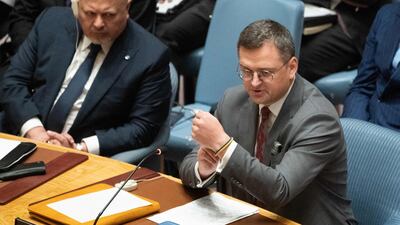
Ukrainian Foreign Minister Dmytro Kuleba speaks at the meeting, in which US Secretary of State Antony Blinken said Russian President Vladimir Putin should be held to account. AFP -
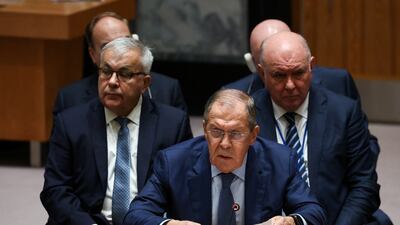
Mr Lavrov defended Russia's actions in Ukraine. Reuters -
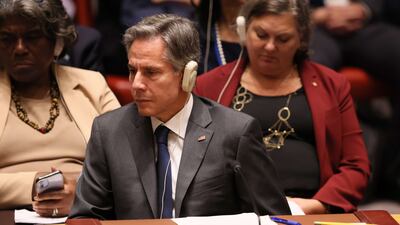
Mr Blinken listens to Mr Lavrov. Russia has announced a "partial mobilisation" of citizens, calling up 300,000 reservists to fight in Ukraine. AFP -
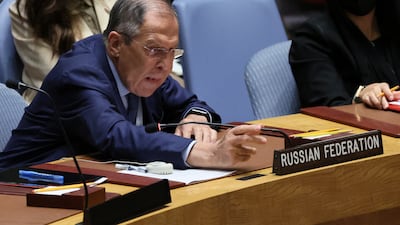
Mr Lavrov at the UN. Russia has stated its willingness to use nuclear weapons to defend its territory. Reuters -
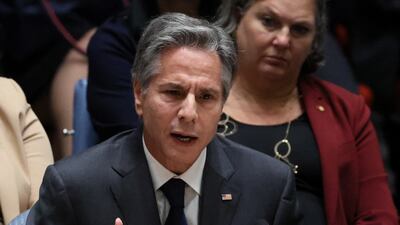
Mr Blinken speaks in New York. Reuters -
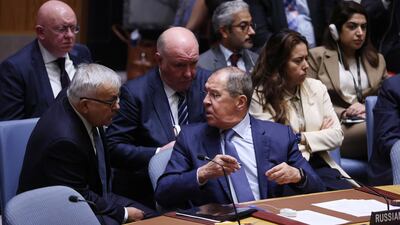
Mr Lavrov and Russian deputy foreign minister Sergey Vershinin, left, confer during the Security Council meeting on Ukraine. EPA -
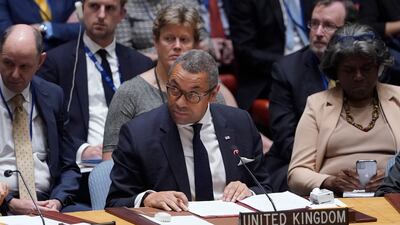
Britain's Foreign Secretary James Cleverly watches Mr Lavrov walk out while he is speaking. AP Photo -
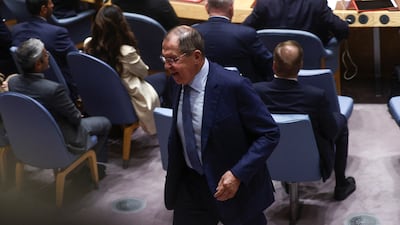
Mr Lavrov leaving the chamber. Reuters -
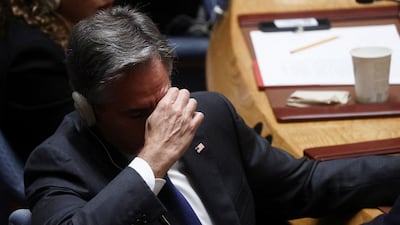
Mr Blinken is deep in concentration. Reuters


The Security Council’s structure has only been changed once in its 77-year history. Many question how long the council’s legitimacy can last without additional membership that would more accurately reflect current realities.
Whereas India, a nuclear power with one of the world’s fastest growing economies, has a population of 1.4 billion and no permanent council seat, France, with a population of 67 million, does.
And Japan, the second biggest donor to the UN, has only served as a non-permanent member.
“The world has waited for 77 long years for reforms. It cannot wait anymore,” India’s ambassador to the UN Ruchira Kamboj told The National.
“While the overwhelming majority of UN member states firmly support the comprehensive reforms of the Security Council, a handful of status-quoists have consistently opposed any reform.
“We don’t even have a negotiating text.”
Any reform of the Security Council would involve intense negotiations that must accommodate geopolitical and regional rivalries.
Richard Gowan, UN director for the International Crisis Group, said China could act as a spoiler if it perceives the US is trying to enhance the standing of rivals.
“If Beijing thinks the US is trying to boost Japan's status at the UN, the Chinese will go all out to derail the process,” Mr Gowan said.
In his first speech to the General Assembly in September, German Chancellor Olaf Scholz emphasised that up-and-coming, dynamic countries and regions of Asia, Africa and Latin America had to be given a stronger political voice on the world stage. He also stressed that Germany was willing to take on greater responsibility.

Many proposals have been floating around for the reform of the Security Council. Switzerland, which will for the first time in its history become a non-permanent member of the Security Council in 2023, supports its expansion but opposes additional veto rights.
The Swiss ambassador to the UN Pascale Baeriswyl told The National that the Alpine nation has been pushing for reforms of the working methods of the Security Council since 2006.
A Canadian spokesman said Ottawa supports limiting the use of the veto, but noted any changes would require the agreement of the five permanent members, and there is currently “no consensus” to do this.
Russia’s war against Ukraine has already spurred a significant but modest change: in April, the UN General Assembly, where no state has a veto, decided by consensus that it would meet whenever a veto is cast in the Security Council.
Such action puts veto wielders on the spot and throws additional scrutiny on any obstruction.
The General Assembly this year convened following vetoes by China and Russia on proposed sanctions on North Korea in May, after a Russian veto on Syria humanitarian aid in July and again this month following Moscow's veto of a resolution “deploring” its illegal annexations in eastern Ukraine.
But a failed reform debate could exacerbate the sense that the UN is irrelevant, said Mr Gowan.
“That is the big risk associated with the US raising the issue.”

