A pedestrian walks past a Department of Justice Federal Bureau of Investigation seal outside the J Edgar Hoover FBI building in Washington. AFP

US Justice Department opposes revealing Trump search affidavit


  • English
  • Arabic

The US Justice Department on Monday said it opposes unsealing the affidavit that prosecutors used to obtain a federal judge's approval to search former president Donald Trump's Florida home, where they seized classified documents.

“If disclosed, the affidavit would serve as a road map to the government's continuing investigation, providing specific details about its direction and likely course, in a manner that is highly likely to compromise future investigative steps,” prosecutors wrote in their filing.

The former president's Republican allies in recent days have ramped up their calls for Attorney General Merrick Garland to unseal the document, which would reveal the evidence that prosecutors showed to demonstrate they had probable cause to believe crimes were committed at Mr Trump's home — the standard they had to meet to secure the search warrant.

  • Supporters of former US president Donald Trump protest against the FBI raid at Mar-a-Lago in Palm Beach, Florida. South Florida Sun-Sentinel / AP
    Supporters of former US president Donald Trump protest against the FBI raid at Mar-a-Lago in Palm Beach, Florida. South Florida Sun-Sentinel / AP
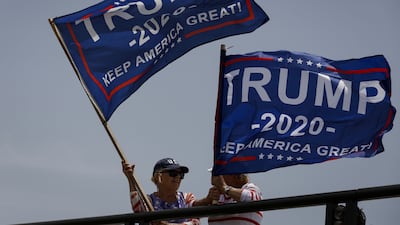
  • Trump supporters demonstrate outside Mar-a-Lago. Bloomberg
    Trump supporters demonstrate outside Mar-a-Lago. Bloomberg
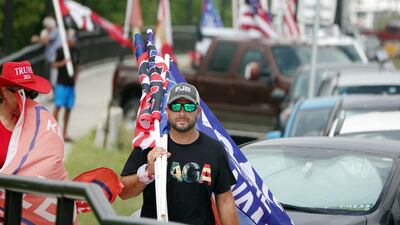
  • Trump supporters wave flags and hold signs outside Mar-a-Lago after the FBI carried out a search warrant at the former president's residence. EPA
    Trump supporters wave flags and hold signs outside Mar-a-Lago after the FBI carried out a search warrant at the former president's residence. EPA
  • Mr Trump is facing intensified legal and political pressure after FBI agents searched his Florida home to investigate whether he took classified documents from the White House when he left office. Bloomberg
    Mr Trump is facing intensified legal and political pressure after FBI agents searched his Florida home to investigate whether he took classified documents from the White House when he left office. Bloomberg
  • Supporters of Mr Trump demonstrate outside Mar-a-Lago in Palm Beach. Bloomberg
    Supporters of Mr Trump demonstrate outside Mar-a-Lago in Palm Beach. Bloomberg
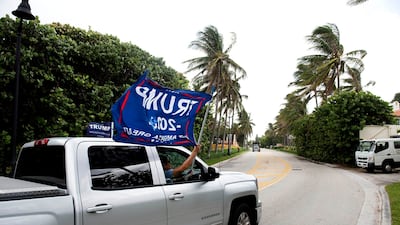
  • A Trump supporter waves a flag outside Mar-a-Lago. Bloomberg
    A Trump supporter waves a flag outside Mar-a-Lago. Bloomberg
  • A Trump supporter drives past the former president's estate. AP
    A Trump supporter drives past the former president's estate. AP
  • Trump supporters, members of the media and law enforcement gather near Mar-a-Lago. The Palm Beach Post / AP
    Trump supporters, members of the media and law enforcement gather near Mar-a-Lago. The Palm Beach Post / AP
  • A flag flies in the air near former President Donald Trump's Mar-a-Lago estate. AP
    A flag flies in the air near former President Donald Trump's Mar-a-Lago estate. AP
  • A Trump supporter holds the Betsy Ross flag at a gathering outside the former president's Mar-a-Lago home. Reuters
    A Trump supporter holds the Betsy Ross flag at a gathering outside the former president's Mar-a-Lago home. Reuters

On Friday, at the Justice Department's request, a federal court in south Florida unsealed the search warrant and several accompanying legal documents that showed that FBI agents carted away 11 sets of classified records from Mr Trump's Mar-a-Lago resort.

Some of the records seized were labelled “top secret” — the highest level of classification reserved for the most closely held US national security information.

Such documents usually are kept in special government facilities because disclosure could damage national security.

The Justice Department on Monday cited this as another reason to keep the affidavit sealed, saying the probe involves “highly classified materials”.

The agency said it would not oppose the release of other sealed documents tied to the search, such as cover sheets and the government's motion to seal.

The warrant released on Friday showed that the Justice Department is investigating the breach of three laws, including a provision in the Espionage Act that prohibits the possession of national defence information and another statute that makes it a crime to knowingly destroy, conceal or falsify records with the intent to obstruct an investigation.

Mr Trump has since claimed, without evidence, that he had a standing order to declassify all of the materials recovered at his home.

The decision by Mr Garland to unseal the warrant was highly unusual, given the Justice Department's policy not to comment on pending investigations.

On the same day Mr Garland announced his decision to seek to unseal the warrant, an armed man with right-wing views tried to breach an FBI office in Cincinnati, Ohio.

He was later shot dead by police following a car chase.

Prosecutors on Monday cited the recent violence and increasing threats against the FBI as another reason not to release the affidavit.

“Information about witnesses is particularly sensitive given the high-profile nature of this matter and the risk that the revelation of witness identities would impact their willingness to co-operate with the investigation,” they wrote.


The Saga Continues

Wu-Tang Clan

(36 Chambers / Entertainment One)

'Gold'

Director:Anthony Hayes

Stars:Zaf Efron, Anthony Hayes

Rating:3/5

Notable salonnières of the Middle East through history

Al Khasan (Okaz, Saudi Arabia)

Tamadir bint Amr Al Harith, known simply as Al Khasan, was a poet from Najd famed for elegies, earning great renown for the eulogy of her brothers Mu’awiyah and Sakhr, both killed in tribal wars. Although not a salonnière, this prestigious 7th century poet fostered a culture of literary criticism and could be found standing in the souq of Okaz and reciting her poetry, publicly pronouncing her views and inviting others to join in the debate on scholarship. She later converted to Islam.


Maryana Marrash (Aleppo)

A poet and writer, Marrash helped revive the tradition of the salon and was an active part of the Nadha movement, or Arab Renaissance. Born to an established family in Aleppo in Ottoman Syria in 1848, Marrash was educated at missionary schools in Aleppo and Beirut at a time when many women did not receive an education. After touring Europe, she began to host salons where writers played chess and cards, competed in the art of poetry, and discussed literature and politics. An accomplished singer and canon player, music and dancing were a part of these evenings.


Princess Nazil Fadil (Cairo)

Princess Nazil Fadil gathered religious, literary and political elite together at her Cairo palace, although she stopped short of inviting women. The princess, a niece of Khedive Ismail, believed that Egypt’s situation could only be solved through education and she donated her own property to help fund the first modern Egyptian University in Cairo.


Mayy Ziyadah (Cairo)

Ziyadah was the first to entertain both men and women at her Cairo salon, founded in 1913. The writer, poet, public speaker and critic, her writing explored language, religious identity, language, nationalism and hierarchy. Born in Nazareth, Palestine, to a Lebanese father and Palestinian mother, her salon was open to different social classes and earned comparisons with souq of where Al Khansa herself once recited.

%20Ramez%20Gab%20Min%20El%20Akher
%3Cp%3E%3Cstrong%3ECreator%3A%3C%2Fstrong%3E%20Ramez%20Galal%3C%2Fp%3E%0A%3Cp%3E%3Cstrong%3EStarring%3A%3C%2Fstrong%3E%20Ramez%20Galal%3C%2Fp%3E%0A%3Cp%3E%3Cstrong%3EStreaming%20on%3A%20%3C%2Fstrong%3EMBC%20Shahid%3C%2Fp%3E%0A%3Cp%3E%3Cstrong%3ERating%3A%20%3C%2Fstrong%3E2.5%2F5%3C%2Fp%3E%0A
Ten tax points to be aware of in 2026

1. Domestic VAT refund amendments: request your refund within five years

If a business does not apply for the refund on time, they lose their credit.

2. E-invoicing in the UAE

Businesses should continue preparing for the implementation of e-invoicing in the UAE, with 2026 a preparation and transition period ahead of phased mandatory adoption. 

3. More tax audits

Tax authorities are increasingly using data already available across multiple filings to identify audit risks. 

4. More beneficial VAT and excise tax penalty regime

Tax disputes are expected to become more frequent and more structured, with clearer administrative objection and appeal processes. The UAE has adopted a new penalty regime for VAT and excise disputes, which now mirrors the penalty regime for corporate tax.

5. Greater emphasis on statutory audit

There is a greater need for the accuracy of financial statements. The International Financial Reporting Standards standards need to be strictly adhered to and, as a result, the quality of the audits will need to increase.

6. Further transfer pricing enforcement

Transfer pricing enforcement, which refers to the practice of establishing prices for internal transactions between related entities, is expected to broaden in scope. The UAE will shortly open the possibility to negotiate advance pricing agreements, or essentially rulings for transfer pricing purposes. 

7. Limited time periods for audits

Recent amendments also introduce a default five-year limitation period for tax audits and assessments, subject to specific statutory exceptions. While the standard audit and assessment period is five years, this may be extended to up to 15 years in cases involving fraud or tax evasion. 

8. Pillar 2 implementation 

Many multinational groups will begin to feel the practical effect of the Domestic Minimum Top-Up Tax (DMTT), the UAE's implementation of the OECD’s global minimum tax under Pillar 2. While the rules apply for financial years starting on or after January 1, 2025, it is 2026 that marks the transition to an operational phase.

9. Reduced compliance obligations for imported goods and services

Businesses that apply the reverse-charge mechanism for VAT purposes in the UAE may benefit from reduced compliance obligations. 

10. Substance and CbC reporting focus

Tax authorities are expected to continue strengthening the enforcement of economic substance and Country-by-Country (CbC) reporting frameworks. In the UAE, these regimes are increasingly being used as risk-assessment tools, providing tax authorities with a comprehensive view of multinational groups’ global footprints and enabling them to assess whether profits are aligned with real economic activity. 

Contributed by Thomas Vanhee and Hend Rashwan, Aurifer

Updated: August 16, 2022, 5:48 AM