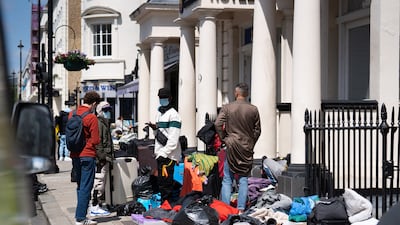
An Iraqi Kurdish refugee who is staying at the Comfort Inn hotel in Pimlico, London. Amy McConaghy / The National

From fishing in Africa to hotel boredom: The reality of UK's broken asylum system


Tariq Tahir
  • English
  • Arabic

Sitting on a wall outside the hotel where he now lives, Alex Karre’s frustration soon boils over when talking about his life in London.

The 23-year-old former fisherman from Congo was one of a group of migrants who staged a protest after, he claims, they were “lied to” about why they were sent there, as well as the cramped conditions in which they say they now find themselves.

All he wants to do is go out to work while his claim is processed but is instead bored, penniless and stuck in a small room shared by four men.

“I have no money but if they give me papers today, then tomorrow, I’m going to work, 100 per cent,” he told The National.

The migrants stuck in the Comfort Inn hotel in Pimlico, central London, are the reality of Britain’s broken asylum system.

The latest figures reveal that the UK has a backlog of 137,583 asylum claims compared with 97,630 in May last year. Prime Minister Rishi Sunak has sought to save £250 million ($311 million) from the accommodation outlay by introducing shared rooms. People like Mr Karre are the first to be caught up in the policy. "You should be willing to a share a taxpayer-funded hotel room in central London," Mr Sunak said.

Mr Karre has been waiting about a year and a half while his asylum claim is processed, while others at the hotel have been waiting two years.

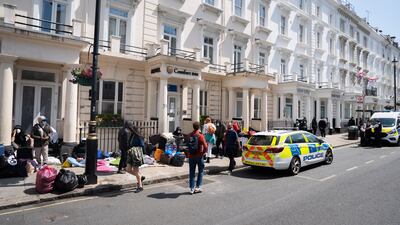
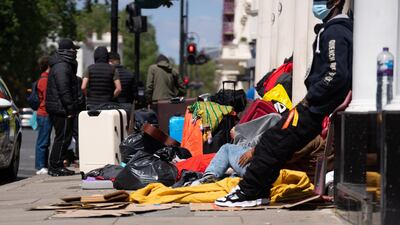
During their protest, about 25 asylum seekers sat on the pavement with their belongings outside the Comfort Inn, a stone’s throw from some of London’s most exclusive addresses.

Another migrant who The National spoke to, a 24-year-old from Iraqi Kurdistan, also took part in the protest.

Like Mr Karre he arrived on a migrant boat after crossing the English Channel but now finds himself trapped in the system.

“For us it’s like a prison. This is a really nice area if you have money but we can’t do anything.”

Mr Karre alleges that the migrants eventually ended their protest after being told “if you don’t go in” then their support would be withdrawn and “we will be homeless”.

“We live in a small bed in small room with four people in one room. There’s nowhere to leave your stuff and the bed is one up, one down,” he said.

“The room is enough for two people maybe but not four. The room smells and the bathroom is inside the room. We don’t want trouble but we don’t want to live here.”

The refugees say they are living in these cramped rooms. Photo: Supplied

They now get by on about £8 a week, the price of a single Won Ton noodle dish at the nearby two-Michelin-star restaurant A Wong.

“You can imagine, one year and seven months, not allowed to work, nothing,” Mr Karre said.

“I’m 23 and I want to buy something but I have no money. What am I going to do? I’m not going to rob someone.”

Mr Karre makes the case for being allowed to work while his asylum claim is being processed, saying he often hears about the cost of the asylum system to taxpayers.

“If they’re spending a lot of money the best way is to give us papers and I go to work, pay my bills and pay my tax,” he said.

“If I pay tax, you’re not going to spend any money on me. But they don’t want to give us that. It’s just about the politics.”

The Iraqi Kurd, who was a chef at home, would also like to work but instead often finds himself wandering the streets just for something to do.

They were previously housed in a hotel in Ilford but were moved to their present accommodation, the circumstances of which are what appear to have provoked the protest.

“We were living there for one year and seven months and it was good," Mr Karre said.

“They said ‘you guys are going to the best hotel’ and because it was central London we were happy to come. They didn’t tell us what it would be like.

  • The scene outside the Comfort Inn hotel on Belgrave Road in Pimlico. All photos: PA
    The scene outside the Comfort Inn hotel on Belgrave Road in Pimlico. All photos: PA
  • Men barricade entrance with suitcases after they were allocated bunk beds.
    Men barricade entrance with suitcases after they were allocated bunk beds.
  • The group, which appeared to be men only, took to the pavement outside the Comfort Inn
    The group, which appeared to be men only, took to the pavement outside the Comfort Inn
  • The group refused to accept the offer of government-funded accommodation
    The group refused to accept the offer of government-funded accommodation
  • The group said they would stay outside until their demands for single rooms are met.
    The group said they would stay outside until their demands for single rooms are met.
  • Photos taken at the scene show bedding laid out on cardboard and bags and suitcases.
    Photos taken at the scene show bedding laid out on cardboard and bags and suitcases.
  • The protest is taking place just 2km from the prime minister’s residence.
    The protest is taking place just 2km from the prime minister’s residence.

“They lied to us. We were so angry. So we went outside.”

He is reluctant to discuss exactly how he travelled from his homeland but said he left "because you know the politics in Africa" and had heard that "Britain is a good country".

"When I was in Africa I was working, fishing on the sea. Here I'll do anything."

Ten tax points to be aware of in 2026

1. Domestic VAT refund amendments: request your refund within five years

If a business does not apply for the refund on time, they lose their credit.

2. E-invoicing in the UAE

Businesses should continue preparing for the implementation of e-invoicing in the UAE, with 2026 a preparation and transition period ahead of phased mandatory adoption. 

3. More tax audits

Tax authorities are increasingly using data already available across multiple filings to identify audit risks. 

4. More beneficial VAT and excise tax penalty regime

Tax disputes are expected to become more frequent and more structured, with clearer administrative objection and appeal processes. The UAE has adopted a new penalty regime for VAT and excise disputes, which now mirrors the penalty regime for corporate tax.

5. Greater emphasis on statutory audit

There is a greater need for the accuracy of financial statements. The International Financial Reporting Standards standards need to be strictly adhered to and, as a result, the quality of the audits will need to increase.

6. Further transfer pricing enforcement

Transfer pricing enforcement, which refers to the practice of establishing prices for internal transactions between related entities, is expected to broaden in scope. The UAE will shortly open the possibility to negotiate advance pricing agreements, or essentially rulings for transfer pricing purposes. 

7. Limited time periods for audits

Recent amendments also introduce a default five-year limitation period for tax audits and assessments, subject to specific statutory exceptions. While the standard audit and assessment period is five years, this may be extended to up to 15 years in cases involving fraud or tax evasion. 

8. Pillar 2 implementation 

Many multinational groups will begin to feel the practical effect of the Domestic Minimum Top-Up Tax (DMTT), the UAE's implementation of the OECD’s global minimum tax under Pillar 2. While the rules apply for financial years starting on or after January 1, 2025, it is 2026 that marks the transition to an operational phase.

9. Reduced compliance obligations for imported goods and services

Businesses that apply the reverse-charge mechanism for VAT purposes in the UAE may benefit from reduced compliance obligations. 

10. Substance and CbC reporting focus

Tax authorities are expected to continue strengthening the enforcement of economic substance and Country-by-Country (CbC) reporting frameworks. In the UAE, these regimes are increasingly being used as risk-assessment tools, providing tax authorities with a comprehensive view of multinational groups’ global footprints and enabling them to assess whether profits are aligned with real economic activity. 

Contributed by Thomas Vanhee and Hend Rashwan, Aurifer

Traits of Chinese zodiac animals

Tiger:independent, successful, volatile
Rat:witty, creative, charming
Ox:diligent, perseverent, conservative
Rabbit:gracious, considerate, sensitive
Dragon:prosperous, brave, rash
Snake:calm, thoughtful, stubborn
Horse:faithful, energetic, carefree
Sheep:easy-going, peacemaker, curious
Monkey:family-orientated, clever, playful
Rooster:honest, confident, pompous
Dog:loyal, kind, perfectionist
Boar:loving, tolerant, indulgent   

MATCH INFO

AC Milan v Inter, Sunday, 6pm (UAE), match live on BeIN Sports

Benefits of first-time home buyers' scheme
  • Priority access to new homes from participating developers
  • Discounts on sales price of off-plan units
  • Flexible payment plans from developers
  • Mortgages with better interest rates, faster approval times and reduced fees
  • DLD registration fee can be paid through banks or credit cards at zero interest rates
Specs

Engine: Dual-motor all-wheel-drive electric

Range: Up to 610km

Power: 905hp

Torque: 985Nm

Price: From Dh439,000

Available: Now

Newcastle United 0 Tottenham Hotspur 2
Tottenham (Alli 61'), Davies (70')
Red card Jonjo Shelvey (Newcastle)

Updated: June 08, 2023, 7:13 AM