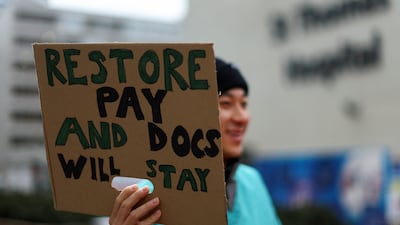
Junior doctors hold placards at a picket while on strike outside StThomas' Hospital in London. EPA

Junior doctors earn less than coffee shop workers, says BMA union


Gillian Duncan
  • English
  • Arabic

Junior doctors can make more money working as baristas, according to the chairman of the British Medical Association, the doctors' union, which is calling for a 35 per cent pay rise for the profession.

Prof Philip Banfield said junior doctors have received a series of “sub-inflation pay rises” which means they are earning about a third less than they would have in 2008.

He told BBC Radio 4 on Monday: “They are qualifying with about £100,000 ($120,360) of debt and then earning £14 an hour.

“BMA House has a Pret a Manger next to it, and they are offering more currently. Junior doctors are very bright, they are intelligent. They are driven. They have choices and it’s just ridiculous the state they are in. they are overworked.”

He was speaking as junior doctors started to strike for 72 hours, threatening to create the worst disruption to the health service since strike action began.

However, Prof Banfield said the NHS will actually be safer for patients, because more experienced doctors will step up.

Prof Banfield said that any danger faced by patients would be the "same danger that occurs every day".

"It's a scandal that three to 500 patients are dying each week in the current health service because of the chronic underfunding," he said.

Asked if the danger would be increased by the absence of junior doctors, he said: "What is going to happen over this next three days is that we are going to see senior doctors - I don't like the words junior and senior, this is just a level of experience and training - so we're seeing consultants and specialists doctors cover.

"They will stop, or should stop, their elective work and actually the NHS is maintaining a great deal of elective work. So we should see that the service is safe."

The strike, which coincides with Chancellor Jeremy Hunt’s budget on March 15, is calling for better pay and conditions, with the BMA calling for a reversal of a 26 per cent cut in real wages since 2008-2009.

Junior doctors strike in the UK - in pictures

Health Secretary Steve Barclay said in a statement: “We have been working closely with NHS England on contingency plans to help protect patient safety during strikes”.

“I hugely value the hard work of junior doctors and urge unions to come to the negotiating table”, he added.

Prime Minister Rishi Sunak’s government has been resisting the doctors' demands, saying it would stoke inflation.

The upheaval will come at a brutal time for the NHS, which has already been struggling with a tough winter and flu season, and significant staff shortages.

Patients have faced long waits for emergency care and ambulances have been queuing outside emergency departments. And more trouble is brewing as consultants are being balloted to join their junior colleagues in strike action.


Mercer, the investment consulting arm of US services company Marsh & McLennan, expects its wealth division to at least double its assets under management (AUM) in the Middle East as wealth in the region continues to grow despite economic headwinds, a company official said.

Mercer Wealth, which globally has $160 billion in AUM, plans to boost its AUM in the region to $2-$3bn in the next 2-3 years from the present $1bn, said Yasir AbuShaban, a Dubai-based principal with Mercer Wealth.

Within the next two to three years, we are looking at reaching $2 to $3 billion as a conservative estimate and we do see an opportunity to do so,” said Mr AbuShaban.

Mercer does not directly make investments, but allocates clients’ money they have discretion to, to professional asset managers. They also provide advice to clients.

“We have buying power. We can negotiate on their (client’s) behalf with asset managers to provide them lower fees than they otherwise would have to get on their own,” he added.

Mercer Wealth’s clients include sovereign wealth funds, family offices, and insurance companies among others.

From its office in Dubai, Mercer also looks after Africa, India and Turkey, where they also see opportunity for growth.

Wealth creation in Middle East and Africa (MEA) grew 8.5 per cent to $8.1 trillion last year from $7.5tn in 2015, higher than last year’s global average of 6 per cent and the second-highest growth in a region after Asia-Pacific which grew 9.9 per cent, according to consultancy Boston Consulting Group (BCG). In the region, where wealth grew just 1.9 per cent in 2015 compared with 2014, a pickup in oil prices has helped in wealth generation.

BCG is forecasting MEA wealth will rise to $12tn by 2021, growing at an annual average of 8 per cent.

Drivers of wealth generation in the region will be split evenly between new wealth creation and growth of performance of existing assets, according to BCG.

Another general trend in the region is clients’ looking for a comprehensive approach to investing, according to Mr AbuShaban.

“Institutional investors or some of the families are seeing a slowdown in the available capital they have to invest and in that sense they are looking at optimizing the way they manage their portfolios and making sure they are not investing haphazardly and different parts of their investment are working together,” said Mr AbuShaban.

Some clients also have a higher appetite for risk, given the low interest-rate environment that does not provide enough yield for some institutional investors. These clients are keen to invest in illiquid assets, such as private equity and infrastructure.

“What we have seen is a desire for higher returns in what has been a low-return environment specifically in various fixed income or bonds,” he said.

“In this environment, we have seen a de facto increase in the risk that clients are taking in things like illiquid investments, private equity investments, infrastructure and private debt, those kind of investments were higher illiquidity results in incrementally higher returns.”

The Abu Dhabi Investment Authority, one of the largest sovereign wealth funds, said in its 2016 report that has gradually increased its exposure in direct private equity and private credit transactions, mainly in Asian markets and especially in China and India. The authority’s private equity department focused on structured equities owing to “their defensive characteristics.”

Updated: March 13, 2023, 9:35 AM