


The way the UK treats asylum seekers should comply “with international laws”, members of the UN Human Rights Council have said.
As they examined the UK's human rights record, they highlighted government plans to send migrants to Rwanda.
During the periodic review, a process which takes place every four years, the Netherlands said the UK government should “revoke parts of the migration economic development partnership which do not comply with the 1951 Refugee Convention”.
New Zealand called on the UK to ensure its “treatment of asylum seekers is consistent with its humanitarian responsibilities and commitments under international human rights law and international refugee law”.
Justice minister Mike Freer, representing the UK at the session in Geneva, said his government was “absolutely committed to protecting human rights at home and abroad”.
“That commitment has not changed,” he added.
The UK has a “long, proud tradition” of providing sanctuary for those fleeing persecution, he said, but the immigration and asylum system has been “subject to significant strain” over the past decade and continued to face “enormous” challenges.
It comes as the chief inspector of borders and immigration called on the government to “give some certainty” to asylum seekers by speeding up approvals instead of housing them in motels.
Migrants at immigration processing centre in Manston — in pictures
-

A person gestures through a fence at the immigration processing centre in Manston, Kent in southern England. Reuters -
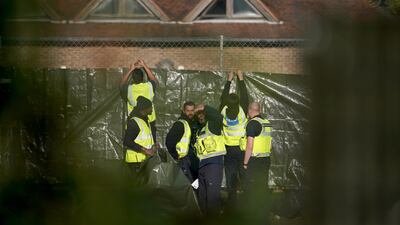
Security staff work to cover the view of people thought to be migrants in the Manston centre. PA -
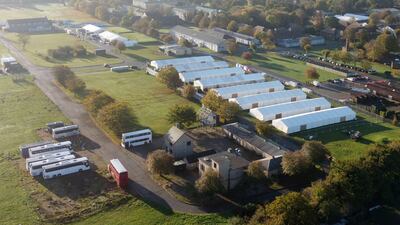
An aerial view of the facility in Manston. PA -

Seven hundred people were moved to the centre for safety reasons after incendiary devices were thrown at a Border Force migrant centre in Dover on Sunday. Reuters -

A man holds up a baby in the immigration processing centre. Reuters -

A woman at the Manston centre. Reuters -

A tent inside the processing centre. Reuters -
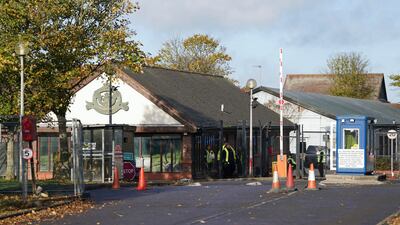
The entrance to the Manston immigration holding facility. AP


David Neal, a retired Royal Military Police officer, called the current backlog of cases “inexcusably high” and said it was “in the interests of everyone in this country” to get people out of the contingency asylum accommodation.
Writing in The Times, Mr Neal, who was appointed by Priti Patel when she was home secretary, acknowledged the Home Office was showing initiative in tackling the crisis, but decision-making was struggling to “strike a balance between more speed and quality”.
Low morale and unstable management within teams tasked with asylum-seeker casework was further undermining performance, he added.
“The reality of being housed in temporary accommodation, irrespective of the number of stars it may have, is grim,” Mr Neal said.
“The negative impact on mental health as well as the waste of human capital is upsetting.
“As numbers and costs increase by the day, speeding up decisions on asylum claims must be the medium-term objective of any government, providing hope to applicants with legitimate claims, and some level of certainty to the tens of thousands stuck in limbo.”
What's happening at Manston? — video
Mr Neal asked the government to increase productivity of approving asylum seekers’ claims and added that decision makers were currently averaging 1.3 approvals per week.
“It is in the interests of everyone in this country to give some certainty to asylum seekers, reduce the inexcusably high backlog of cases, get people out of contingency asylum accommodation and let them start to rebuild their lives.”
He previously told MPs the conditions he encountered at the Manston processing centre in Kent left him “speechless”.
There were about 4,000 migrants at the facility at the time — more than double its capacity.
As of 8am on Wednesday, the government said the number of people at the facility was down to 1,147.
Migrant children rescued in French waters — in pictures
-

Migrants are rescued by crew members of the 'Abeille Languedoc' ship after their boat's generator broke down in French waters as they were trying to cross the Channel illegally to Britain. All photos: AFP -
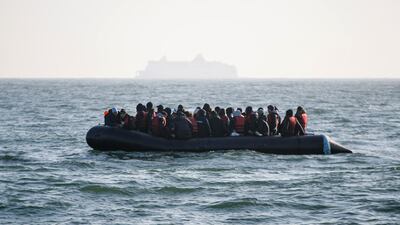
Migrants wait for help in the Channel. -

A child is rescued by crew members of the 'Abeille Languedoc'. -

The 'Abeille Languedoc' is an ocean-going tug specialising in the rescue of vessels in distress. -

Migrant children on the rescue boat. -

The 'Abeille Languedoc' has been moored in Cherbourg for 26 years, monitoring the Channel between the Cotentin and the Pas-de-Calais. -

Migrants sit on board the 'Abeille Languedoc' after being rescued. -

A rescuer carries a child as they disembark from the 'Abeille Languedoc'.


Home Secretary Suella Braverman has been under increased pressure to fix the UK’s “broken” asylum system, with the government currently spending £6.8 million ($8m) a day putting up migrants in hotels — at an average cost of £150 per person per night.
Home Office figures published in August show that spending on asylum rose to £2.1 billion in 2021-22 — the highest on record.
Prime Minister Rishi Sunak said he and the home secretary were working “day and night” to end “the unacceptable rise in Channel crossings” as he continued to face questions over her appointment.
Ms Braverman has faced criticism from some opposition MPs for inflaming the situation after she said the government is committed to “stopping the invasion on our southern coast”.
Almost 40,000 migrants have arrived in the UK after crossing the Channel so far this year. But there have yet to be any crossings in November amid bad weather, leaving the provisional total for 2022 to date at 39,913.

