

British Labour Party veteran Dame Margaret Hodge has welcomed the UK government's attempts to get to grips with dirty Russian money.
Four stages in the process of washing dirty money which form the focus of the legislation were set out by the Financial Times.
After spending several years stuck in legislative purgatory, the UK's Economic Crime (Transparency and Enforcement) Bill came into force in March, with Russia's invasion of Ukraine the force needed to get it over the line.
The bill seeks to establish a register of overseas entities and their beneficial owners, amend financial sanctions law, and reform the UK's Unexplained Wealth Orders to empower criminal investigators.
Ms Hodge said she was promised in 2015 by [former prime minister] David Cameron that it would become law.
However, the political climate was very different then, with Mr Cameron and his executive preoccupied first with a general election and then with referendum on the UK's membership of the EU.
A London awash with Russian money was not a pressing issue.
Even a year ago, when Ms Hodge raised the prospect of imposing sanctions on Chelsea owner Roman Abramovich in response to Moscow's alleged poisoning and imprisonment of opposition leader Alexei Navalny, the suggestion came to nothing.
“Navalny said that if the West really wanted to support democracy, we ought to take action by sanctioning Putin's cronies,” she said.

While London's reputation as a willing host for dirty money predates this century, its Londongrad nickname is well earned.
A significant factor was the UK's controversial golden visa scheme, which it scrapped in February this year.
The scheme was launched by the Labour government in 2008 and allowed people with a minimum of £2 million in investment funds and a UK bank account to apply for residency.
In essence, the more money an applicant possessed and intended to invest in the UK, the more their visa application was expedited. At the same time, the applicant was allowed to remain in the UK on indefinite leave.
The scheme effectively opened the floodgates to oligarch money. The problem was, the money often was not clean.
“In theory there were checks on this but, in practice, it didn't work,” Ms Hodge said.
“Of course, it was abused by oligarchs and kleptocrats who wanted to bring their dirty money into London and use the scheme to establish legitimacy and credibility in what was seen as a trusted jurisdiction.”
Illustrating the scale of the problem, 6312 golden visas — almost half of all those issued — were investigated by UK authorities for risks posed to national security, anti-corruption watchdog Spotlight said.
The four stages of money laundering
There are four stages in the process of washing dirty money: placement, layering, integration and defence. London provided a hospitable environment for all four.
Placement
The vehicles for placing dirty money into a financial system are shell companies.
In the UK, all companies should declare beneficial ownership on the government's Companies House register. Yet this process has been easy to exploit given the few statutory measures in place to check the veracity of the information concerned.
This has meant fake names could be entered with relative impunity: Mickey Mouse and Adolf Hitler were two noteworthy examples.
It has also led to some addresses in the UK having thousands of companies registered to them.
Applications have typically been approved within 24 hours.
It is this loophole that the government's new economic crime bill is intended to close.
Layering
With the dirty money placed in the system through shell companies, the next stage is to layer it, moving it around in a series of complicated economic transactions that distance the money from its source.
At this juncture the UK's pliant banking system comes into play. According to Transparency International, about 86 banks have been involved in moving corrupt wealth around the world. Tax haven British overseas territories such as the Virgin Islands are points on this pecuniary odyssey.
Integration
Once the money has gained some distance, the next stage is to integrate it. With the assistance of lawyers and property agents, procuring assets is the way to do this and property is the asset of choice.
Russian oligarchs like Abramovich, who in 2011 bought a £90 million Kensington mansion, have traditionally used Grade 1 or 2 listed mansions in the heart of London.

Not all oligarchs are as happy as Abramovich to put their name to their assets. Transparency International estimates about 84,000 homes in the UK are owned anonymously, and £6.7 billion worth of UK property has been bought with suspicious wealth.
Defence
The final stage is ring-fencing the wealth and its owner's reputation. The UK's libel laws are favourable to the wealthy, making high courts good places to bring headline but often vexatious claims.
It's not only levers of the state which have been oligarch friendly to this point — London has also served as the crucible for an entire industry to emerge which has the sole purpose of defending wealth from prying eyes.
Given the heft of those bankrolling it, it frequently outguns press and broadcasters who may have been thinking of investigating ill-gotten gains.
Ukraine invasion a tipping point?
The sanctions imposed on Russian oligarchs mark a short-term change in the war on dirty money, but how much impact Russia's invasion of Ukraine will have in the long term depends to a large degree on the success of the economic crime bill in casting light on opaque ownership.
If the legislation does have bite, then the war could well mark the point when Londongrad loses its “grad” suffix.
Oligarchs sanctioned by the UK — in pictures
-
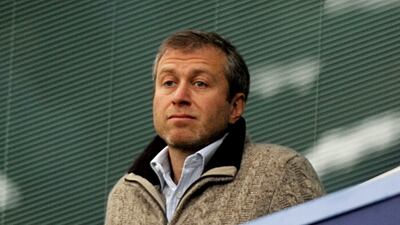
The UK has sanctioned more than 1,400 individuals and businesses, including 100 oligarchs and their relatives, since Russia invaded Ukraine in February. The list of oligarchs includes: Roman Abramovich, 55. PA -

Katerina Tikhonova, left, and Maria Vorontsova, unseen, also known as Maria Putina, daughters of Russia President Vladimir Putin. Reuters -
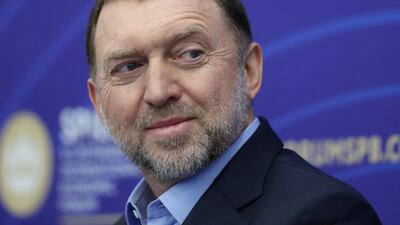
Oleg Deripaska, 54. The industrialist is worth £2 billion and has had close links with the British political establishment. He has a multimillion pound property portfolio in the UK. Reuters -

Igor Sechin, 61. Officials described Mr Sechin as Mr Putin's right-hand man and the second most important person in the country. Reuters -
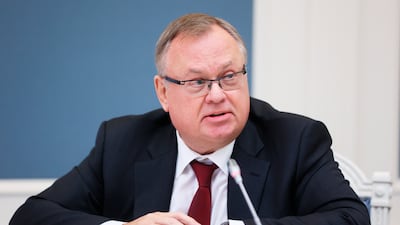
Andrey Kostin, 65. The chairman of VTB, a Russian state-owned bank. Mr Kostin is also a member of the supreme council of the United Russia political party and deemed a close associate of Mr Putin. AP Photo -
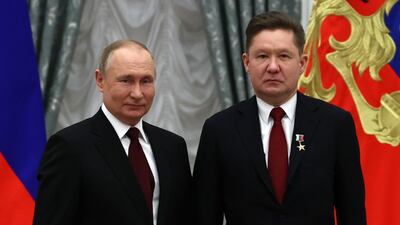
Alexei Miller, 60. The chief executive of energy company Gazprom, Russia's largest company and the world's biggest public energy supplier. AFP -
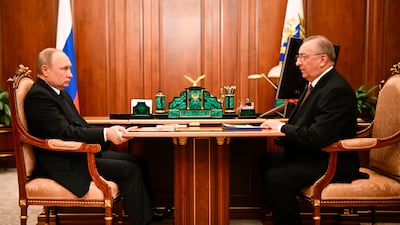
Nikolai Tokarev, 71, president of the Russia state-owned pipeline company Transneft. Mr Tokarev is a former KGB officer who served with Mr Putin in East Germany towards the end of the Cold War. AP Photo -

Kirill Shamalov, 39. He is Russia's youngest billionaire and the ex-husband of Mr Putin's daughter Katerina Tikhonova. Reuters -

Pyotr Fradkov, 43. He is head of the sanctioned Promsvyazbank, which finances Russian defence industries, and the son of Mikhail Fradkov, a former prime minister of Russia and chief of its foreign intelligence service. Reuters -
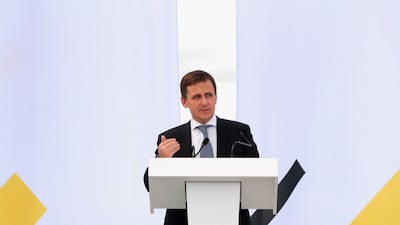
Denis Bortnikov, 47. The deputy president of government-affiliated VTB bank. His father, Alexander Bortnikov, is head of the Federal Security Service. Getty Images -
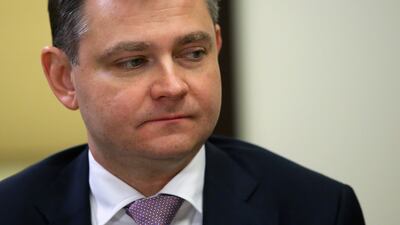
Yury Slyusar, 47. The director of United Aircraft Corporation, one of the major defence organisations that has also been sanctioned. Getty Images



