


Live updates: follow the latest news on Russia-Ukraine
The “serious weaknesses” of Russian radios have probably played a significant role in the stalled Ukraine offensive, leading military analysts have said.
Corruption among Russian military officials may have resulted in troops going to war with too few high-quality encrypted radios or sets fitted with faulty Chinese-made parts, according to a Rusi think tank paper.
Reports from prisoners of war also suggest that Russian officers fearful of being on the front line have withdrawn beyond 18 kilometres radio range of secure sets, forcing soldiers to use mobile phones.
The report’s findings point to “potentially serious weaknesses” in the Russian army allowing communications to be exploited by jamming as well as interception.
Previously Moscow’s military chiefs have remarked on the excellent performance of their latest “sixth generation” Azart tactical military radios, but it appears now that there are either not enough of them or they are inadequate.
“It seems bizarre that units advancing into Ukraine during this dangerous phase of the operation would not be outfitted with the best equipment, including radios, that Russia’s defence industry has to offer,” the report said.
It questioned whether radios were being delivered to the field piecemeal, “or worse, are these new military radios considered substandard?” wrote the authors Sam Cranny-Evans and Thomas Withington.
“That troops may feel more confident using a cheap Chinese hand-held radio would say much about the quality of Russian equipment,” they added.

In the early fighting around Kyiv a captured airborne soldier was found with one of the advanced R-187P Azart radios but this now appears rare. Soldiers have reportedly used Chinese hand-held radios, mobile phones and walkie-talkies that are undermining their ability to speak in secret.
In the last week the Russians have also lost three very senior officers, including two generals, whose precise locations were possibly tracked by their communications vulnerability, although this is not verifiable.
Before invading, commanders ignored communication needs “for the range and scale of operations conducted”, said the report, titled “Russian Comms in Ukraine: A World of Hertz".
“The current operations in Ukraine suggest that Russia does not have as many modern radios in service as it has claimed.”
The intensity of fighting, with western estimates putting Russians killed at 6,000, along with commanders being deliberately targeted by Ukrainian snipers, has apparently led to officers being absent on the front line.

The report quoted from a verified interview of a captured soldier who said: “The officers started stationing themselves further and further away from the fighting … they are out of radio range at this point, and no one can contact them’.
The Russian then explained that shortages in long-range radios had prevented contact with generals commanding the entire invasion.
This had resulted in troops using mobile phones to contact officers and “gain some situational awareness,” said the report.
The London-based institution stated that “one of the most striking images” of the war was the photograph of a civilian's hand-held radio captured from Russian forces. The device is a Chinese-made BaoFeng radio that lacks military-grade encryption.
“Open-source intelligence and Ukrainian reports suggest that radio communications across the Russian forces are poor, leading to makeshift solutions,” the report said.
While not as eye-catching as tanks, guns and helicopters, radios are key to the functioning of armies with clear communications allowing commanders to manoeuvre their troops effectively.
-
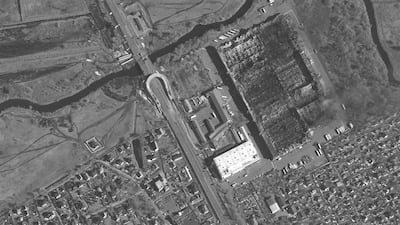
This satellite image provided by Maxar Technologies shows destroyed and burning warehouse buildings in Stoyanka, Ukraine, in the western Kyiv region, during the Russian invasion. AP -
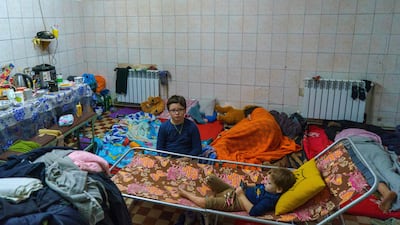
Children shelter in a metro station in Kharkiv. Moscow said on March 10, 2022, that it will open daily humanitarian corridors to allow civilians fleeing fighting in Ukraine to reach Russian territory, despite Kyiv insisting that no evacuation routes should lead to Russia. AFP -
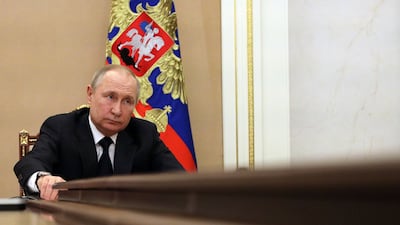
Russian President Vladimir Putin during a videoconference meeting with government members at the Kremlin in Moscow. The meeting focuses on minimising the effects of sanctions on the Russian economy. Russian troops entered Ukraine on February 24, prompting the country's president to declare martial law and triggering a series of severe economic sanctions imposed by western countries. EPA -
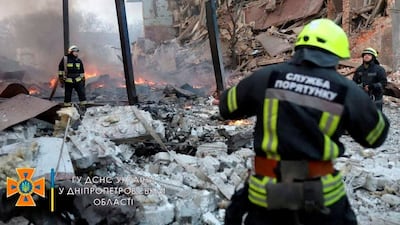
Rescuers work among remains of buildings damaged by an air strike in Dnipro, Ukraine, as Russia's attack on the country continues. Reuters -

Members of the National Guard of Ukraine, Oleksandr and Olena, listen to a priest at their wedding in Ukraine. Reuters -

People fleeing Russia's invasion of Ukraine warm up by a fire near the train station in Lviv, Ukraine. Reuters -
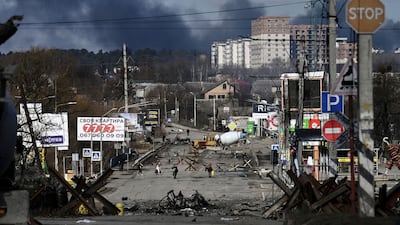
Russian forces rolled their armoured vehicles up to the northeastern edge of Kyiv, edging closer in their attempts to encircle the Ukrainian capital. AFP -
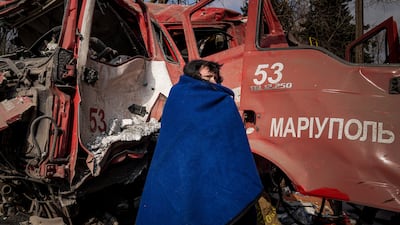
A woman covers herself with a blanket near a damaged fire truck after shelling in Mariupol, Ukraine. AP Photo -

A Ukrainian soldier hides from a helicopter air strike near Demydiv, Ukraine. Reuters -
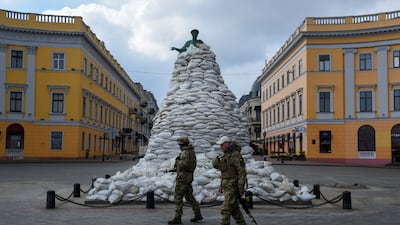
Ukrainian soldiers walk past a monument of the city founder Duke de Richelieu, covered with sand bags for protection, in Odessa, Ukraine. Reuters -
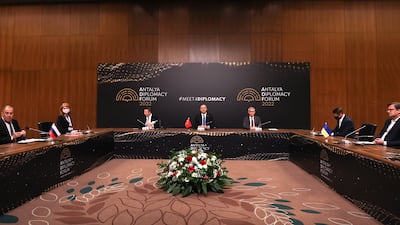
Russian Foreign Minister Sergey Lavrov, left, Turkish Foreign Minister Mevlut Cavusoglu, centre, and Ukranian Foreign Minister Dmytro Kuleba. EPA -
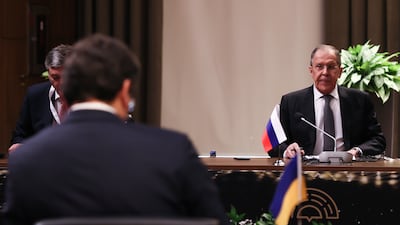
Russian Foreign Minister Sergey Lavrov in talks with Ukrainian counterpart Dmytro Kuleba during a tripartite meeting chaired by Turkish Foreign Minister Mevlut Cavusoglu, in Antalya, Turkey. AP -
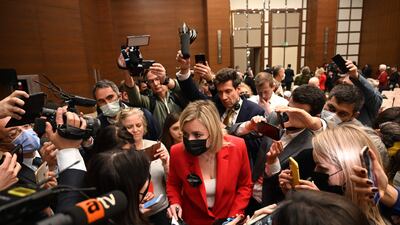
Russian Foreign Ministry spokeswoman Maria Zakharova speaks to the media as the foreign ministers of Ukraine, Russia and Turkey hold talks in Antalya, 15 days after Russia launched a military invasion on Ukraine. AFP -
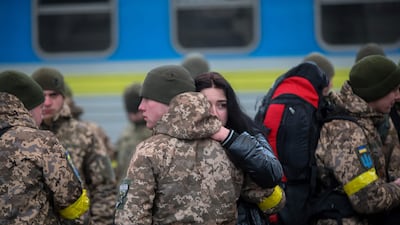
A Ukrainian serviceman says goodbye to his girlfriend before departing in the direction of Kyiv at the central train station in the western Ukrainian city of Lviv. AFP -
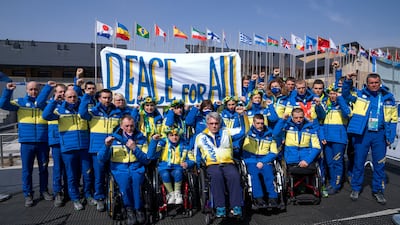
Valerii Sushkevych, president of the Ukraine National Paralympic Committee, and the Ukraine delegation raise their fists and pose with a banner at the Beijing 2022 Winter Paralympic Games. Reuters -

A member of the Ukrainian team cries during a moment of silence at the Zhangjiakou athletes village during the Beijing 2022 Winter Paralympic Games. AFP -
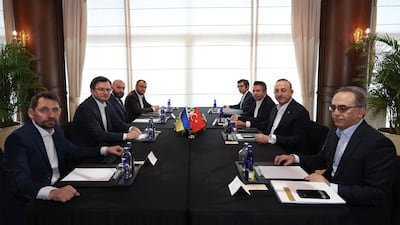
Turkish Foreign Minister Mevlut Cavusoglu, right, and Ukraine Foreign Minister Dmytro Kubela, second left, in Antalya, Turkey. AFP -
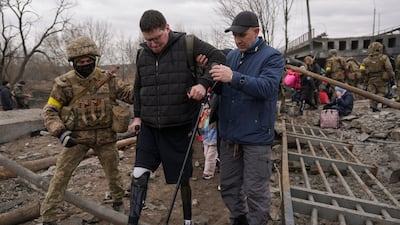
A man is supported after crossing the Irpin river while fleeing the town of Irpin, Ukraine. AP -
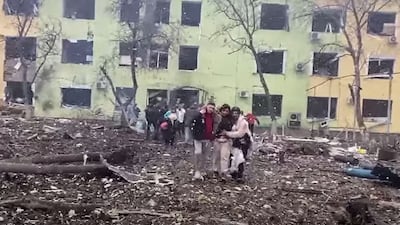
People are helped out of a damaged children's hospital following a Russian air strike in the southeastern city of Mariupol, Ukraine. AFP -

A man rides a bicycle in front of an apartment building that was damaged by shelling in Mariupol. AP -
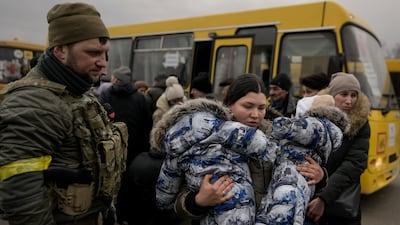
A woman carries two babies after arriving at a triage point in Kyiv, Ukraine. AP -
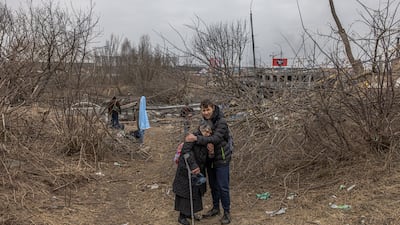
A man hugs an elderly woman after crossing a damaged bridge as they flee from the frontline town of Irpin, near the Ukrainian capital of Kyiv. EPA -
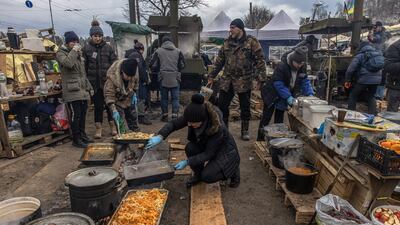
Local residents cook at a makeshift camp next to a checkpoint in Kyiv. EPA -
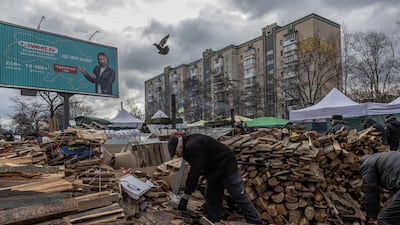
Ukrainian men chop wood at a makeshift camp next to a checkpoint in Kyiv. EPA -

A member of the Territorial Defence Forces learns how to use a Javelin missile during a training session in Kyiv. EPA -
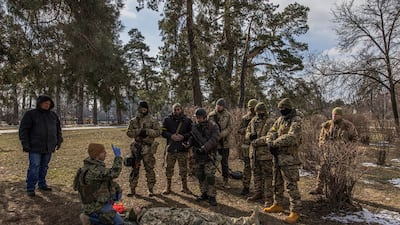
Members of the Territorial Defence Forces learn how to give first aid during the training session. EPA -
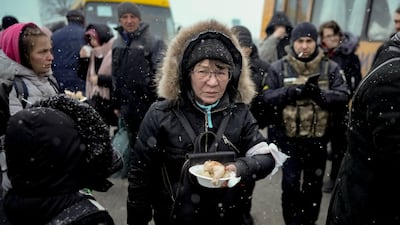
A woman rescued from the outskirts of Kyiv holds a plate of food after arriving at a triage point in the Ukrainian capital. AP -
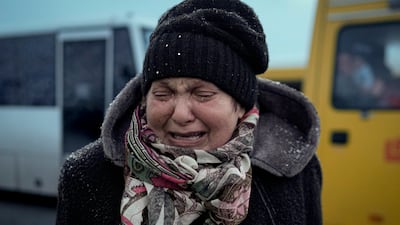
A woman cries after arriving at the triage point in Kyiv. AP -
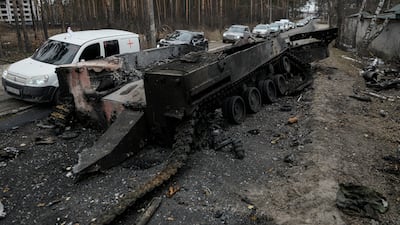
Civilian vehicles drive past a destroyed Russian tank as they leave Irpin. AP -
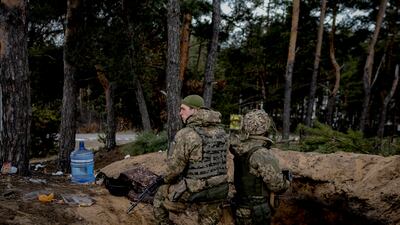
Ukrainian servicemen stand in a foxhole in Irpin. AP -
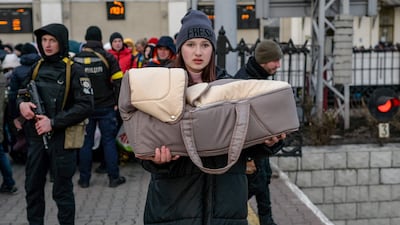
People gather on a platform to board a train leaving Odesa after the US said Russian troops are making preparations to attack the city. AFP -
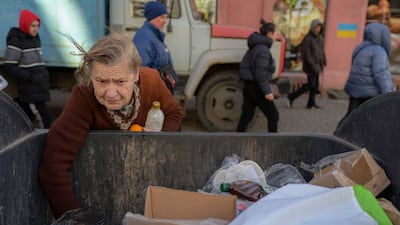
A Ukrainian woman looks for food in a bin in Odesa's city centre. AFP -
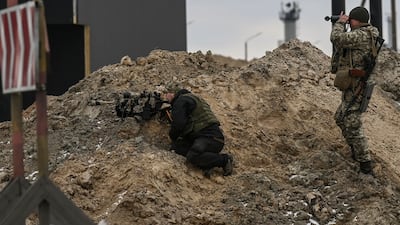
Ukrainian servicemen look towards Russian positions outside the city of Brovary, east of Kyiv. AFP -
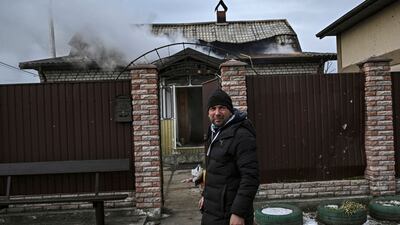
A man walks past a shelled house at the village of Velyka Dymerka, east of Kyiv. AFP -
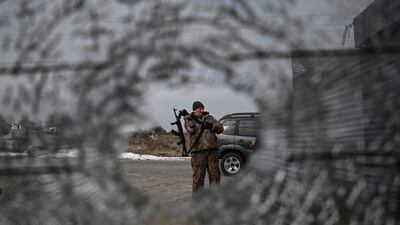
A Ukrainian serviceman stands at a check point in the vilage of Velyka Dymerka east of Kyiv. AFP -

A Ukrainian woman plays with her child in a temporary refugee shelter in Przemysl, Poland. Reuters -

A woman waits outside a maternity and children's hospital damaged by shelling in Mariupol, Ukraine. AP -
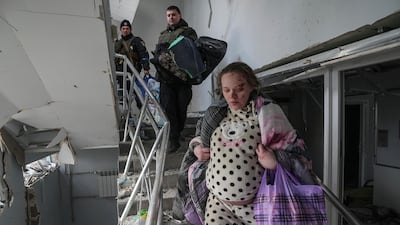
A pregnant woman leaves the hospital after she was wounded when it was bombed. AP -

A woman waits outside the damaged hospital in Mariupol. AP -

A man wounded by shelling in Mariupol. AP -
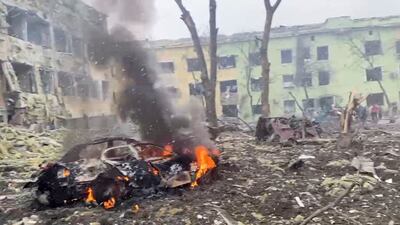
A car burns after the destruction of the children's hospital in Mariupol. Reuters -
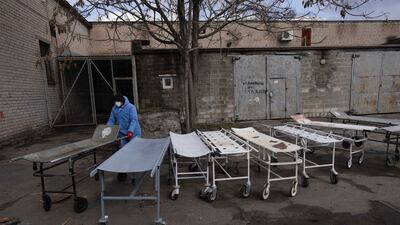
A mortuary worker wheels a stretcher used to move dead bodies before they are buried on the outskirts of Mariupol. AP


However, Russian-speaking Ukrainians might now be feeding “false or misleading traffic” that is allowing them to “sow disorganisation, doubt and demoralisation” among Russian units. Furthermore, it could allow interception of front line infantry chatter as they go into battle.
The paper also questioned whether Russia’s much revered electronic warfare capabilities had “refrained from a heavier weight of electronic attack to avoid friendly fire against the civilian communications” that their troops rely on.
The report concluded that the “seemingly parlous state” of Russia’s radios had created an opportunity for exploitation by Ukraine.
“While Ukrainian forces may be numerically inferior on the battlefield, they have an opportunity to be superior in the electromagnetic spectrum … Ukrainian forces can exploit Russian networks for intelligence and for battlefield deception.”

