


UK Prime Minister Boris Johnson will travel to Ukraine on Tuesday for talks with President Volodymyr Zelenskiy as tension on the country’s border with Russia continues to rise.
More than 100,000 Russian troops are amassed on Ukraine’s border and Russian President Vladimir Putin has made repeated demands to restrict Ukraine’s right to pursue Nato membership and self-defence.
The UK has long been a staunch supporter of Ukrainian sovereignty.
Mr Johnson's discussions with Mr Zelenskiy today will cover the full range of strategic UK support to Ukraine.
The UK is actively involved in defending rule of law in Ukraine and clamping down on corruption, steps that have strengthened Kiev’s ability to resist malign and anti-democratic influences.
New funding from the UK, of £88 million ($118m), is aimed at bolstering that work and aiding efforts to reduce Ukraine’s reliance on Russian energy supplies.
Mr Johnson has stressed, including directly to Mr Putin, the UK’s enduring and unwavering support for Ukrainian sovereignty.
Russia has been warned that any incursion would have a stark humanitarian cost and London continues to encourage Moscow to engage fully in discussions with Nato.
“It is the right of every Ukrainian to determine how they are governed," Mr Johnson said.
"As a friend and a democratic partner, the UK will continue to uphold Ukraine’s sovereignty in the face of those who seek to destroy it.
“We urge Russia to step back and engage in dialogue to find a diplomatic resolution and avoid further bloodshed.”
-
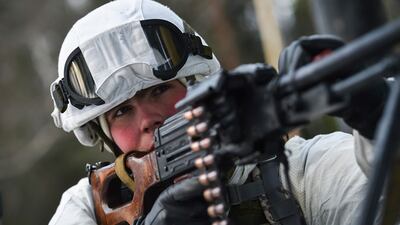
A Russian soldier attends a military exercise at the Golovenki training ground in the Moscow region, Russia. AP Photo -
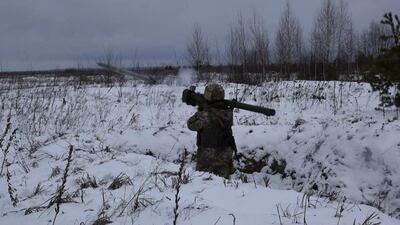
A member of the 14th Separate Mechanised Brigade of the Ukrainian Armed Forces takes part in anti-aircraft military drills in the Volyn region, Ukraine. Reuters -
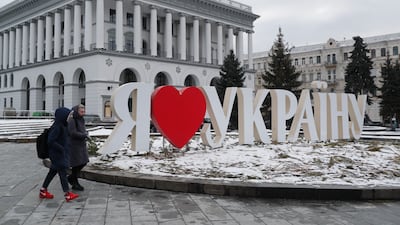
People walk past a sign reading 'I Love Ukraine' in the central square in Kiev. EPA -
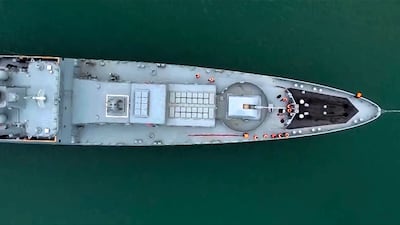
Russian naval frigate 'Admiral Essen' sails during an exercise in the Black Sea. AP -
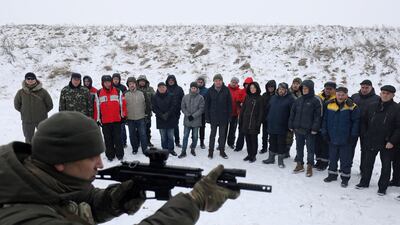
Employees of essential city industries and services attend a military training session outside Lviv, Ukraine. Reuters -
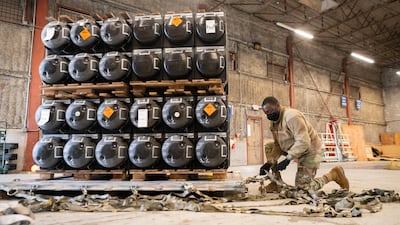
Airman 1st Class Olabode Igandan organises ammunition, weapons and other equipment bound for Ukraine during a foreign military sales mission at Dover Air Force Base, Delaware. AP -
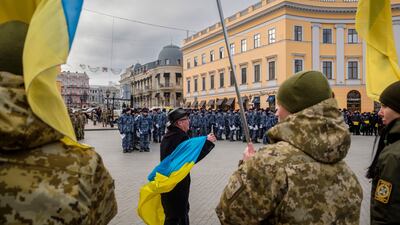
A member of the public waves a Ukrainian flag at a rally attended by soldiers and police in Odessa, Ukraine. Bloomberg -
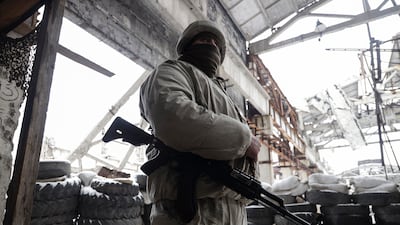
A Ukrainian serviceman patrols the front line near Avdiivka village, not far from the pro-Russian militant-controlled city of Donetsk, Ukraine. EPA -
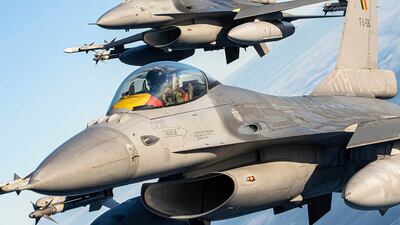
A Belgian Air Force F-16 fighter jet participates in Nato's Baltic Air Policing Mission in Lithuanian airspace. AP


Mr Johnson was supposed to be joined on the visit by Foreign Secretary Liz Truss, but she announced on Monday that she had received a positive Covid-19 test result and had to go into isolation.
He welcomed Mr Zelenskiy to Downing Street in October 2020, when they agreed to strengthen the relationship between the UK and Ukraine in areas including defence, trade and political co-operation.
As part of the meeting they launched a continuing strategic dialogue, which will continue on this visit.
The leaders last spoke on January 13 when they agreed to continue to work closely alongside international partners to deter Russian aggression.
On Monday, Ms Truss announced an unprecedented strengthening of the UK’s sanctions regime, which will give the UK the power to target any company that is linked to the Russian state, engages in business of economic significance to the state, or operates in a sector of strategic significance to it.
Following instructions by Mr Johnson, the UK is in discussions with Nato about what support can be offered to support the alliance’s eastern flank.
The UK is also expected to bolster military presence in eastern Europe as part of Nato’s efforts to secure the region.
But British and Nato combat forces are not expected to be sent to Ukraine, which is not a member of the alliance.
About 100 British personnel are involved in a training mission in the country.
Mr Putin has denied he is planning an attack but is demanding guarantees that Ukraine will never join Nato, while calling on the western alliance to draw back its forces in Eastern Europe.

