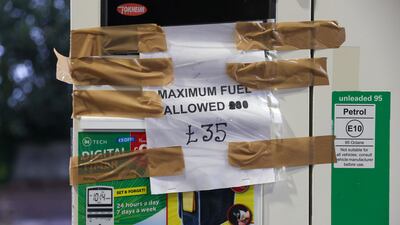
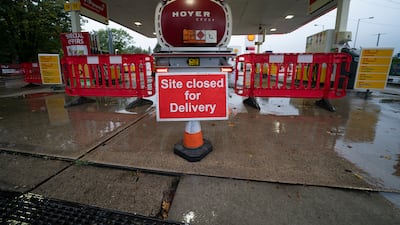
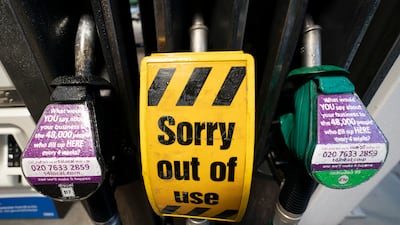
Britain’s Prime Minister Boris Johnson has put army tanker drivers on standby to ease the chaos at petrol stations across the country.
Following mounting pressure from industry figures to alleviate the crisis, the UK government confirmed it had alerted the armed forces and said military drivers would get special training.
After cars queued at stations on Monday for the fifth day running, ministers made another announcement to say certain driving licences for heavy goods vehicles would be extended.
The UK is suffering from a shortage of 100,000 qualified HGV drivers, according to the Road Haulage Association.
Many European drivers who had worked in Britain returned to their homelands during the pandemic and failed to come back to the UK.
The coronavirus crisis also caused major disruption to driving tests, which delayed the process for many would-be HGV drivers to obtain their licence.
In recent days the government has come under intense pressure to solve the problem. On Saturday it announced a three-month visa scheme for 5,000 HGV drivers from overseas.
An extension to ADR licences, which allow drivers to maximise their available capacity instead of being taken out of circulation for refresher training, was also announced.
Defence Secretary Ben Wallace said: “The men and women of our armed forces stand ready to alleviate the transport pressures where they are felt most.
“That is why I have authorised their increased preparedness so they are ready to respond if needed.”
The army drivers will deliver fuel to where it is needed most and provide reassurance that supplies remain strong, the government said.
The decision comes after Environment Secretary George Eustice said on Monday that the government was not planning to bring in army drivers.
UK drivers are also being hit by rising prices at the pumps.
The average price of a litre of petrol jumped from 135.87p ($1.85) on Friday to 136.59p on Sunday, according to the RAC, an automotive services company.
Prices at the pumps have not been that high since September 2013.
On Tuesday, Dr David Wrigley, deputy chairman of the British Medical Association, called for health and social care workers to be allowed to skip the queues at petrol stations.
Dr Wrigley urged the government to use whatever means necessary to alleviate the crisis, including the option of bringing in soldiers to drive fuel tankers.
“We can’t dither and wait and just see and hope that this settles down. We have to act today,” he told Sky News.
“We can’t continue like this day to day. We’re told it’s going to be over in a day or two but we can’t risk that.
“We’re talking today about health and social care workers wanting to get on and do their job.
“We can’t be waiting in queues for petrol or diesel when we have patients to see.
“We do need a system in place today. There’s no information at all about how we get around this problem, how we deal with it if our fuel is running very low and we have patients to see.
“So we need urgent action today from the government.”
The government’s announcement came after Business Secretary Kwasi Kwarteng issued a request for military aid to the civil authorities.
He said ministers expect demand for fuel to return to normal levels this week, but added “it’s right that we take this sensible, precautionary step”.
“If required, the deployment of military personnel will provide the supply chain with additional capacity as a temporary measure to help ease pressures caused by spikes in localised demand for fuel."
Transport Secretary Grant Shapps announced the extension to ADR licences, which allow drivers to transport goods such as fuel.
The measure will apply to licences expiring between Monday and December 31, and extend their validity until January 31 next year.
“We are starting to see panic buying moderate, with more grades of fuel now available at more petrol stations,” Mr Shapps said.
“Even though the current network of tanker drivers is capable of delivering all the fuel we need, we have taken the additional step of asking the army to help plug the gap, while new HGV drivers come on stream thanks to all the other measures we’ve already taken.”
But shadow defence secretary John Healey, of the opposition Labour Party, said the move was an “admission of failure from a government that continues to rely on the army to bail it out”.

Switching%20sides
%3Cp%3EMahika%20Gaur%20is%20the%20latest%20Dubai-raised%20athlete%20to%20attain%20top%20honours%20with%20another%20country.%0D%3C%2Fp%3E%0A%3Cp%3E%3Cstrong%3EVelimir%20Stjepanovic%20(Serbia%2C%20swimming)%20%3C%2Fstrong%3E%0D%3Cbr%3EBorn%20in%20Abu%20Dhabi%20and%20raised%20in%20Dubai%2C%20he%20finished%20sixth%20in%20the%20final%20of%20the%202012%20Olympic%20Games%20in%20London%20in%20the%20200m%20butterfly%20final.%20%0D%3C%2Fp%3E%0A%3Cp%3E%3Cstrong%3EJonny%20Macdonald%20(Scotland%2C%20rugby%20union)%20%3C%2Fstrong%3E%0D%3Cbr%3EBrought%20up%20in%20Abu%20Dhabi%20and%20represented%20the%20region%20in%20international%20rugby.%20When%20the%20Arabian%20Gulf%20team%20was%20broken%20up%20into%20its%20constituent%20nations%2C%20he%20opted%20to%20play%20for%20Scotland%20instead%2C%20and%20went%20to%20the%20Hong%20Kong%20Sevens.%20%0D%3C%2Fp%3E%0A%3Cp%3E%3Cstrong%3ESophie%20Shams%20(England%2C%20rugby%20union)%20%3C%2Fstrong%3E%0D%3Cbr%3EThe%20daughter%20of%20an%20English%20mother%20and%20Emirati%20father%2C%20Shams%20excelled%20at%20rugby%20in%20Dubai%2C%20then%20after%20attending%20university%20in%20the%20UK%20played%20for%20England%20at%20sevens.%20%0D%3C%2Fp%3E%0A
Our family matters legal consultant
Name: Hassan Mohsen Elhais
Position: legal consultant with Al Rowaad Advocates and Legal Consultants.
THE BIO
Bio Box
Role Model: Sheikh Zayed, God bless his soul
Favorite book: Zayed Biography of the leader
Favorite quote: To be or not to be, that is the question, from William Shakespeare's Hamlet
Favorite food: seafood
Favorite place to travel: Lebanon
Favorite movie: Braveheart
THE%C2%A0SPECS
%3Cp%3EEngine%3A%204-cylinder%202.5-litre%20%2F%202-litre%20turbo%0D%3Cbr%3EPower%3A%20188hp%20%2F%20248hp%0D%3Cbr%3ETorque%3A%20244Nm%20%2F%20370Nm%0D%3Cbr%3ETransmission%3A%207-speed%20auto%0D%3Cbr%3EOn%20sale%3A%20now%0D%3Cbr%3EPrice%3A%20From%20Dh110%2C000%0D%3C%2Fp%3E%0A
Mercer, the investment consulting arm of US services company Marsh & McLennan, expects its wealth division to at least double its assets under management (AUM) in the Middle East as wealth in the region continues to grow despite economic headwinds, a company official said.
Mercer Wealth, which globally has $160 billion in AUM, plans to boost its AUM in the region to $2-$3bn in the next 2-3 years from the present $1bn, said Yasir AbuShaban, a Dubai-based principal with Mercer Wealth.
“Within the next two to three years, we are looking at reaching $2 to $3 billion as a conservative estimate and we do see an opportunity to do so,” said Mr AbuShaban.
Mercer does not directly make investments, but allocates clients’ money they have discretion to, to professional asset managers. They also provide advice to clients.
“We have buying power. We can negotiate on their (client’s) behalf with asset managers to provide them lower fees than they otherwise would have to get on their own,” he added.
Mercer Wealth’s clients include sovereign wealth funds, family offices, and insurance companies among others.
From its office in Dubai, Mercer also looks after Africa, India and Turkey, where they also see opportunity for growth.
Wealth creation in Middle East and Africa (MEA) grew 8.5 per cent to $8.1 trillion last year from $7.5tn in 2015, higher than last year’s global average of 6 per cent and the second-highest growth in a region after Asia-Pacific which grew 9.9 per cent, according to consultancy Boston Consulting Group (BCG). In the region, where wealth grew just 1.9 per cent in 2015 compared with 2014, a pickup in oil prices has helped in wealth generation.
BCG is forecasting MEA wealth will rise to $12tn by 2021, growing at an annual average of 8 per cent.
Drivers of wealth generation in the region will be split evenly between new wealth creation and growth of performance of existing assets, according to BCG.
Another general trend in the region is clients’ looking for a comprehensive approach to investing, according to Mr AbuShaban.
“Institutional investors or some of the families are seeing a slowdown in the available capital they have to invest and in that sense they are looking at optimizing the way they manage their portfolios and making sure they are not investing haphazardly and different parts of their investment are working together,” said Mr AbuShaban.
Some clients also have a higher appetite for risk, given the low interest-rate environment that does not provide enough yield for some institutional investors. These clients are keen to invest in illiquid assets, such as private equity and infrastructure.
“What we have seen is a desire for higher returns in what has been a low-return environment specifically in various fixed income or bonds,” he said.
“In this environment, we have seen a de facto increase in the risk that clients are taking in things like illiquid investments, private equity investments, infrastructure and private debt, those kind of investments were higher illiquidity results in incrementally higher returns.”
The Abu Dhabi Investment Authority, one of the largest sovereign wealth funds, said in its 2016 report that has gradually increased its exposure in direct private equity and private credit transactions, mainly in Asian markets and especially in China and India. The authority’s private equity department focused on structured equities owing to “their defensive characteristics.”
How Apple's credit card works
The Apple Card looks different from a traditional credit card — there's no number on the front and the users' name is etched in metal. The card expands the company's digital Apple Pay services, marrying the physical card to a virtual one and integrating both with the iPhone. Its attributes include quick sign-up, elimination of most fees, strong security protections and cash back.
What does it cost?
Apple says there are no fees associated with the card. That means no late fee, no annual fee, no international fee and no over-the-limit fees. It also said it aims to have among the lowest interest rates in the industry. Users must have an iPhone to use the card, which comes at a cost. But they will earn cash back on their purchases — 3 per cent on Apple purchases, 2 per cent on those with the virtual card and 1 per cent with the physical card. Apple says it is the only card to provide those rewards in real time, so that cash earned can be used immediately.
What will the interest rate be?
The card doesn't come out until summer but Apple has said that as of March, the variable annual percentage rate on the card could be anywhere from 13.24 per cent to 24.24 per cent based on creditworthiness. That's in line with the rest of the market, according to analysts
What about security?
The physical card has no numbers so purchases are made with the embedded chip and the digital version lives in your Apple Wallet on your phone, where it's protected by fingerprints or facial recognition. That means that even if someone steals your phone, they won't be able to use the card to buy things.
Is it easy to use?
Apple says users will be able to sign up for the card in the Wallet app on their iPhone and begin using it almost immediately. It also tracks spending on the phone in a more user-friendly format, eliminating some of the gibberish that fills a traditional credit card statement. Plus it includes some budgeting tools, such as tracking spending and providing estimates of how much interest could be charged on a purchase to help people make an informed decision.
* Associated Press