

Several small earthquakes have rocked Spain’s Canary Islands as a new fissure emerged in the erupting Cumbre Vieja volcano on Tuesday.
Another 500 people were forced to flee as the vent blew the mountainside open, spewing smoke and fumes into the sky
Experts closely watched the lava’s unstoppable flow towards the sea.
Molten rock has swallowed homes, crops and warehouses on its downhill path to the ocean, after erupting near one of the island’s most fertile regions.
“You have practically your whole life there, then one day the volcano decides to erupt and puts an end to it all,” said Israel Castro Hernandez, whose home was destroyed.
“We keep looking over there and we just can’t believe it: we keep thinking that our house is underneath that volcano,” his wife, Yurena Torres Abreu, said.
Traffic jams packed the winding, narrow roads on La Palma island, where residents and visitors snapped photos of the Cumbre Vieja volcano furiously erupting.
A total of 6,000 people have fled the area. Lava has destroyed 166 buildings and covered 103 hectares of land.
Farmers, mostly growing bananas or grapes, were stunned by the volcano’s violence.
“This is no joke,” said Pedro Jose Alegria, 70. He had returned to La Laguna, on the border of an evacuated area, to feed his donkey.
-

Lava flows next to a house after the eruption of a volcano on the Canary Island of La Palma. Reuters -
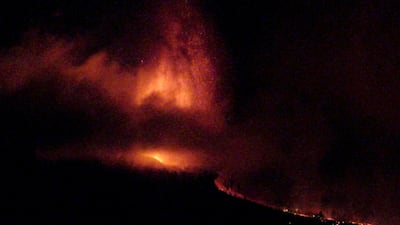
The volcano erupts in the Cumbre Vieja national park at El Paso, La Palma. Reuters -

La Palma, with a population of 85,000, is one of eight islands in Spain's Canary Islands archipelago. Reuters -

The volcano had been dormant for 50 years. Reuters -
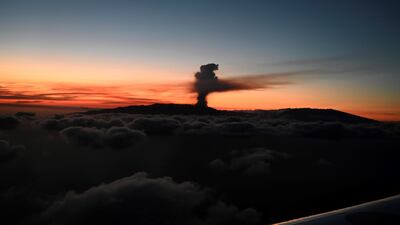
Huge plumes of black-and-white smoke shoot out of the volcano. EPA -

The area experienced hundreds of small earthquakes during the week as magma pressed the subsoil on its way out. AFP -
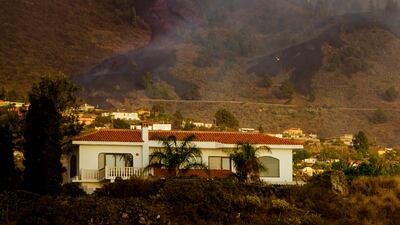
Authorities ordered thousands of residents to leave as lava flows destroyed isolated houses and threatened to reach the coast. AP -
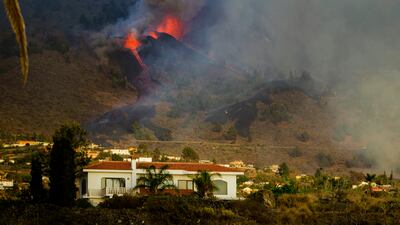
New eruptions continued into the night. AP -

The area near the southern tip of the island is sparsely populated. AP -
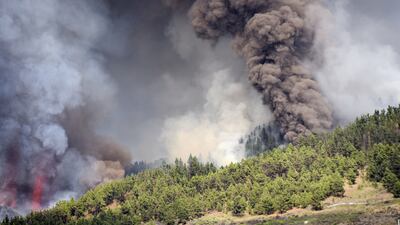
Part of the island's south-west coast was at risk of landslides and rock falls, authorities said. EPA


Matthias and Anette Fuchs moved to La Palma to build their dream home, complete with mosaic floor and swimming pool, as a place to work and throw parties. All of it is now buried by lava.
Mr Fuchs said rebuilding is not an option for him and his wife, now in their mid-sixties. “I will only return to close this chapter,” he said.
Volcanologist Stavros Meletlidis, from Spain’s National Geographic Institute, said the opening of new fissures made the lava flow “somewhat unpredictable”.
“It can accelerate very quickly, especially when the topography changes … or it can stop on a plain for several hours. You have to see how both the main flow and the secondary flow are developing,” he said.

When the lava reaches the sea, experts warn it will generate clouds of toxic gas into the air. They say this will affect the marine environment, and the authorities have set up a no-go zone to head off curious onlookers.
The Canary Islands are in the Atlantic Ocean, and at their nearest point to Africa are about 100 kilometres from Morocco.
Cumbre Vieja had been dormant since 1971, when an eruption continued for slightly more than three weeks.
The last eruption on any of the Canary Islands occurred underwater, off the coast of El Hierro island in 2011. It lasted five months.

