
US president-elect Joe Biden nominated retired four-star general Lloyd Austin as his defence secretary, adding an experienced Middle East hand with knowledge of regional uncertainties to his Cabinet.
Mr Austin, 67, if confirmed by the Senate, will be the first black secretary of defence and the third retired general since 1947 to take the position.
But his military past is a point of contention – some Democrats said they would prefer a civilian.
Mr Biden announced his choice on Tuesday afternoon. "Gen Austin shares my profound belief that our nation is at its strongest when we lead not only by the example of our power, but by the power of our example," the president-elect said. He emphasised that rebuilding US alliances, co-operating in facing threats and revitalising the military would be part of his nominee's mission.
To take up the position, Mr Austin will require a waiver from Congress, because he left the military only four years ago. According to the rules, an officer must be out of the military for seven years before taking up a civilian government position.
If confirmed as the 28th head of the Department of Defence, Mr Austin would bring years of experience in the Middle East.
He served as the commander of US Central Command between 2013 and 2016 and as the commanding general of US forces in Iraq between 2010 and 2011, overseeing the US withdrawal from the country under the administration of Barack Obama.
During his time in Iraq, he reportedly became close to Beau Biden, the late son of Joe Biden. Beau Biden, at the time holding the rank of Major, served on the staff of Gen Austin, and the two men often attended Catholic Mass together, remaining friends after their Iraq deployment. Beau Biden died of a brain tumor in 2015.
These shared experiences helped forge a working relationship between Mr Biden, who was vice president at the time, and Mr Austin.
It also exposed him to criticism for underestimating ISIS – the extremists took Mosul under his watch in Iraq in 2014 – and for the Obama administration’s unsuccessful efforts to train a rebel force in Syria.
But experts see Mr Austin as a trusted hand for Mr Biden and someone who understands the Middle East’s military situation as possible engagement between the US and Iran on a new nuclear deal advances.
Nicholas Heras, a defence analyst and director of government relations at the Institute for the Study of War, expected Iraq to be of crucial importance for the nominee.
"Gen Austin understands Iraq's role in Middle East policy like few other national security professionals, which is important because Iraq is a flashpoint between the US and Iran that if not managed properly could torpedo the Biden team's grand goal to reset with Iran," Mr Heras told The National.
He said that as the Biden administration prepares to negotiate with Iran over the nuclear deal, which President Donald Trump abandoned in 2015, Mr Austin would bring stability to the US military presence in the region.
“Gen Austin understands the strategic dilemma that Iran presents to the US in the Middle East," Mr Heras said.
"He saw first hand in Iraq how Iran's regional activities threaten the US and its partners, but also how the US can prioritise and execute a nuclear non-proliferation policy process towards Iran at the same time.”
Ryan Bohl, a Middle East and North Africa analyst at the US intelligence company Stratfor, said Mr Austin would bring restraint and balance to US military activity.
“He's likely to help hone the mission in Syria, which requires both restraint and nuance, and to shore up America's goals in Iraq and Afghanistan with what remaining forces the Trump administration leaves,” Mr Bohl said.
The Trump administration has ordered the withdrawal of 2,500 troops from Afghanistan, 500 from Iraq and nearly 700 from Somalia in recent weeks.
But Mr Austin, having seen the damage caused by rushed withdrawals from Iraq, is likely to show restraint.
Mr Bohl said, however, that too much restraint might embolden Tehran.
-
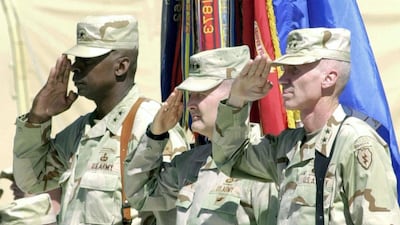
Commander of the U.S 25th Infantry Division Major General Eric T. Olson, Major General Lloyd Austin, commander of 10th Mountain Division and US commander General David Barno salute during a ceremony marking the change of authority from the 10th Montain Division to the newly arrived 25th Infantry Division at the coalition's Bagram Air Base headquarters north of Kabul, 15 April 2004. AFP -
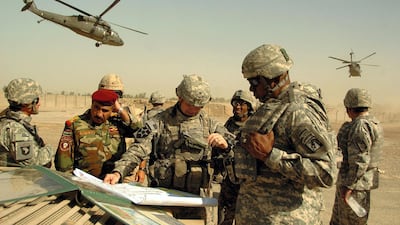
US army Lt. General Lloyd J. Austin III commander of the XVIII Airborne Corps, Col. Jeffrey L. Bannister, commander of the 2nd Infantry Brigade Combat Team and Iraqi Brigadier General Abdulah, discussing troop progress during a field meeting outside Baghdad, Iraq, 11 September 2007. Iraqi special forces backed by US troops launched a raid 25 September 2007 against Iraq's largest military academy detaining "20 criminals". AFP -
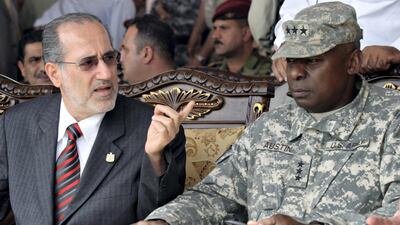
Iraq's National Security Adviser Muwaffaq al-Rubaie gestures next to US army Lt General Lloyd Austin, commander of US-led forces in Diwaniyah province, during a handover ceremony in Diwaniyah, 181 kms south of Baghdad, on July 16, 2008. Iraq took control of security in the Shiite province of Diwaniyah today and said it hoped to regain control of the entire country from US-led forces by end of the year. AFP -

US Democratic presidential candidate Barack Obama talking with US General David Petraeus and Lt. Gen. Lloyd Austin upon the former's arrival at Baghdad International Airport on July 21, 2008. Obama welcomed today the security gains achieved by Baghdad in battling Al-Qaeda and Shiite militias, an Iraqi government statement said. AFP -
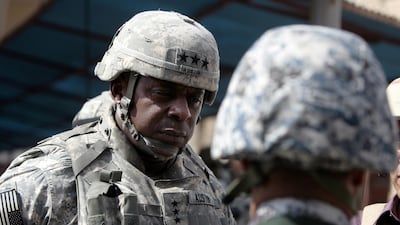
US Lieutenant General Lloyd James Austin arrives at the site of an explosion in a Christian market in Baghdad's Dora district on October 15, 2008. Two bombs exploded near a Sahwa (Awakening) building during a meeting between Sahwa members and Iraqi police. AFP -

Iraqi governor of the central Shiite province of Wasit, Latif Ham al-Tarfa, and US Lieutenant General Lloyd Austin, the number two commander of US forces in Iraq, sign the official transfer of security files from the US to the Iraqi army in the provincial capital Kut on October 29, 2008. Iraq took over from US forces today control of Wasit, which US commanders say is often used by Iranian groups to smuggle weapons to launch attacks in Iraq. Wasit became the 13th of Iraq's 18 provinces to be handed over by US-led forces to Baghdad amid an overall improvement in security across the violence-wracked country. AFP -
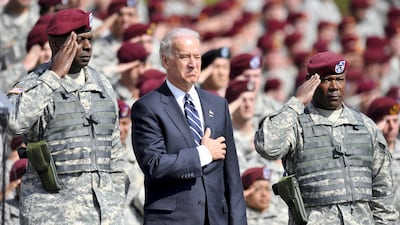
US Vice President Joe Biden stands between Lieuteneant General Lloyd J. Austin III and Command Sergeant Major Joseph Allen during the US national anthem during a special ceremony at Fort Bragg outside Fayetteville, North Carolina 08 April 2009. The XVIII Airborne Corps just completed their second deployment to Iraq since 2006. EPA -

Command Sgt. Maj. Joseph Allen, left, salutes to Vice President Joe Biden and Lt. General Lloyd Austin during a welcome home ceremony for the XVIII Airborne Corps at Fort Bragg, North Carolina Wednesday, April 8, 2009. Getty Images -
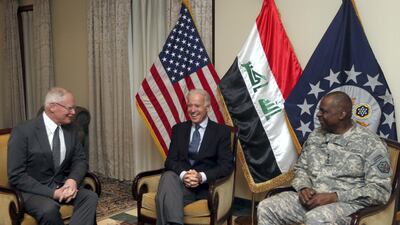
US Vice President Joe Biden meets with US ambassador James Jeffrey and General Lloyd Austin, the commander of United States Forces - Iraq (USF-I), at the US embassy upon arrival at Baghdad on a surprise visit on November 29, 2011, during which he is due to meet top Iraqi officials, as American troops depart Iraq ahead of a year-end deadline. AFP -

US Army handout image shows Vice Chief of the Army, General Lloyd J. Austin III. The Pentagon announced December 31, 2012 that Gen. Austin will take over the top post at US Central Command, succeeding Marine Corps Gen. James N. Mattis, upon Senate approval. AFP -
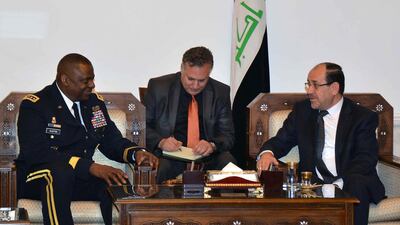
Iraqi Prime Minister Nuri al-Maliki meeting US Vice Chief of the Army, General Lloyd J. Austin III in Baghdad on May 14, 2013. AFP -

US President Barack Obama takes part in a briefing at US Central Command with Commander of US Central Command, General Lloyd Austin at MacDill Air Force Base in Tampa, Florida on September 17, 2014. AFP -
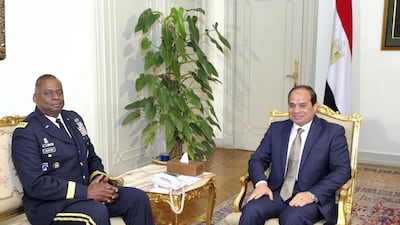
Egyptian President Abdel Fattah al-Sisi meeting with General Lloyd Austin, Commander of US Central Command, at the presidential palace in Cairo, May 20, 2015. AFP -
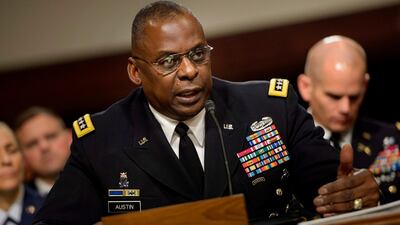
Army General Lloyd Austin III, commander of the US Central Command, speaks during a hearing of the Senate Armed Services Committee in Washington, DC, March 8, 2016. AFP


“Iran is highly likely to try some harassment tactics as the Biden administration takes power to test US resolve and pressure it to make concessions,” he said.
Mr Bohl said Mr Austin's mission for Gulf security would be unclear.
He said the Biden team “would push for GCC reconciliation between Saudi, the UAE, Bahrain, Egypt and Qatar to shore up the Gulf Arab side.
"But how they would respond to Iranian provocations is less clear.”
Mr Austin is on the advisory board for Raytheon, one of the world’s largest defence contractors.
It is a position he would relinquish, but it provides another reason for progressives to grill him during his nomination hearings.

