


The coronavirus is an objective reality. The threat that any of us faces of infection is best represented as a balance of risks. The consequence of this mismatch is that societies facing lockdown and other restrictions are now deeply divided.
Many have warned that the response to the pandemic could ultimately be more dangerous, even deadlier, than the disease. The interplay between these factors is becoming harder to track and the fallout more unpredictable.
After a series of similar announcements around Europe, Britain went into its second lockdown on Thursday. There was despair that the move was necessary. After sacrifices in the first half of the year, most were glum that the virus is again circulating at an uncontrolled velocity.
Businesses had restarted but have pulled down the shutters again. The short evenings of the northern hemisphere winters mean that the dark hours close in very early, a significant psychological hammer blow. Yet on Thursday, evening more than 100 people were arrested in central London for participating in a mass protest.
It was a variation on a theme. A rising number of anti-vaxxer, anti-face mask protests have flared up in the West in recent months.
Confusingly the massed crowds marching and chanting "freedom" on Thursday were wearing masks. Not medical barriers but plastic face masks. That was because the demonstrations took place on November 5, the date of an annual Guy Fawkes demonstration in commemoration of the 1605 Gunpowder Plot, a failed assassination attempt against King James I by a group of provincial English Catholics.
The numbers on the march were much bigger this year. The event has evidently been co-opted into the globally growing revolt. “We are here on an educational tour: the purpose of these controls is not to control the virus, they are here to control you,” a bullhorn-using pensioner shouted.

-
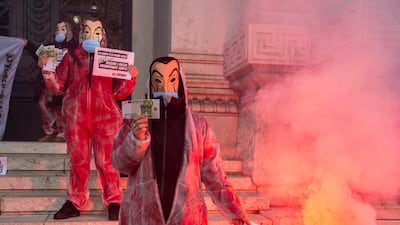
Protesters gather for a flashmob demonstration to demand emergency income and financing in front of the Milan branch of the Bank of Italy. EPA -
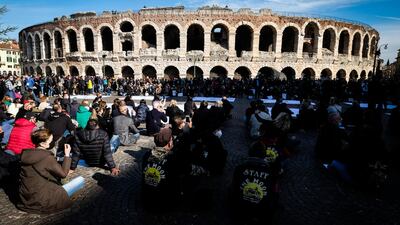
Owners of restaurants and event organisers gather to protest at rally in front of the colosseum in Verona. EPA -

Italian chefs and restaurant owners gather near place settings positioned on the street as they participate in a protest at Pantheon Square in Rome. AFP -
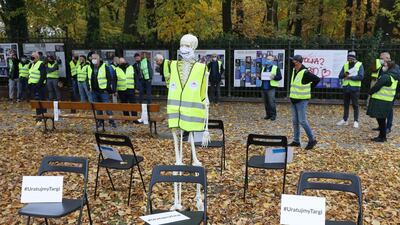
People take part in a protest organised by fairs and events workers in Warsaw, Poland. EPA -
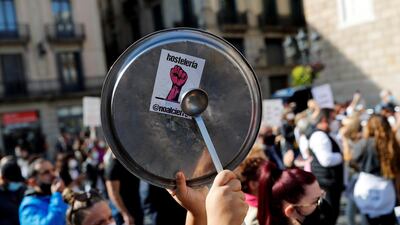
A sticker reading "Hospitality not at closing" is pictured during a protest in Barcelona, Spain. Reuters -
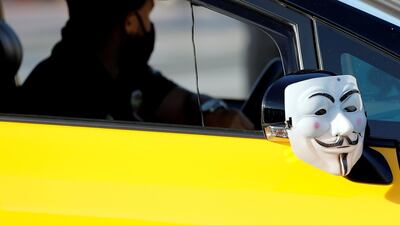
A Guy Fawkes mask hangs on a wing mirror as taxi drivers protest in Barcelona, Spain. Reuters -
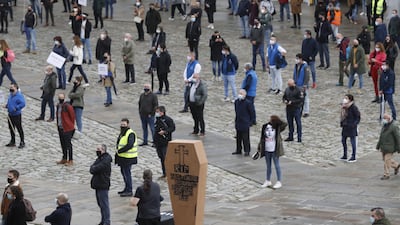
Owners of bars and restaurants in Santiago de Compostela, Spain, protest against the new restrictions imposed to stop the coronavirus spread. EPA -
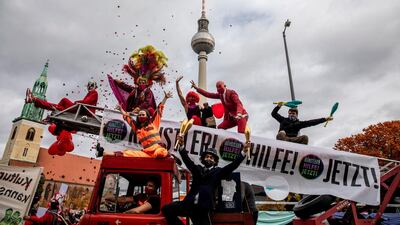
Artists and employees of events companies protest at Alexanderplatz in Berlin, Germany. Getty Images -
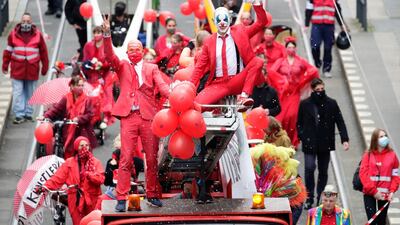
Protesters demonstrate in support of the event sector in Berlin, Germany. Reuters -
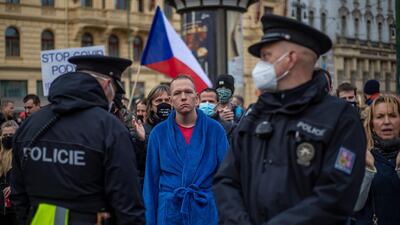
Demonstrators protest against the Czech government's measures in Prague, Czech Republic. EPA -
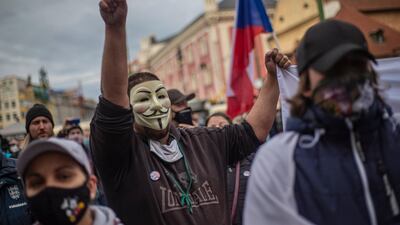
The Czech Republic recorded a rise in Covid-19 cases, resulting in the government imposing a series of new restrictive measures. EPA


That the lockdown regulations were used to arrest the protesters has been seized on to fuel grievances. To the suspicious, it seems that the authoritarian state is using emergency powers to quash legitimate political dissent. Justification for their protest is, therefore, granted by the arrests for breaking the quarantine conditions. The narrative is bolstered by the existence of very large fines for breaking the new laws on quarantine.
Over time the loss of jobs and the degradation of economic prospects are bound to provide the kindling for a burgeoning revolt.
Resentments are rife across all social classes. Why else would the phenomenon of the "shy Donald Trump voter" play such a significant role in the recent American election? The polls had Joe Biden leading by 15 percentage points in some of the states that President Trump is now projected to win.
The pandemic restrictions fuel this trend because the rules on staying at home takes away autonomy from the individual. These rules might be necessary but they also have an arbitrary impact.
The legacy will be altered politics in many countries.

Protest vehicle parties have a patchy record of changing politics but these are already starting to feed off the lockdown discontent. The populist politician Nigel Farage is the man who did more than anyone else to engineer the Brexit revolution in the UK. With a nose for when a single political message can hit the jackpot, Mr Farage has re-entered politics with a new Reform Party.
Its proposition is simple. More harm than good comes from the Covid-19 response. Again that discounts the objective reality of a new disease but exploits the range of risk factors that determine attitudes towards the crisis. As he claimed in an email at the launch of his movement, the response means "more life-years lost than it hopes to save, as non-Covid patients with cancer, cardiac, lung and other illnesses have treatments delayed or cancelled again. Suicides are soaring. Businesses and jobs are being destroyed".
The choice of name is instructive. The Reform Party has echoes of another political intervention by the actor Laurence Fox who has promoted the Reclaim Party. A former television star and member of a well-known acting dynasty, Mr Fox takes his stand against thought control and the “woke” politics of recent years.
-

Democratic presidential nominee Joe Biden addresses the nation at the Chase Center in Wilmington, Delaware. AFP -

Vice presidential nominee Kamala Harris looks on as US Democratic presidential nominee Joe Biden speaks about election results in Wilmington, Delaware. Reuters -
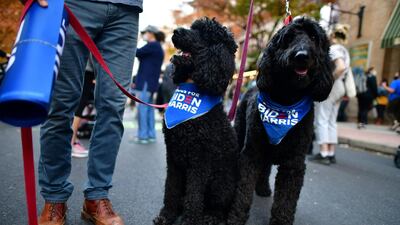
Dogs with bibs supporting Democratic presidential nominee Joe Biden are seen across the street from where ballots are being counted in Philadelphia, Pennsylvania. Reuters -
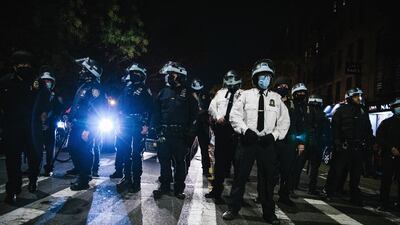
Police stand guard during a demonstration held by supporters of democrat presidential candidate Joe Biden in New York. EPA -

People cheer after Democratic presidential nominee Joe Biden overtook President Donald Trump in the Pennsylvania general election vote count. Reuters -

Activists celebrate after Democratic presidential nominee Joe Biden overtook President Donald Trump in the Pennsylvania general election vote count, in Philadelphia, Pennsylvania. Reuters -

Journalists from all over the world wait for the result of the US Presidential elections on Black Lives Matter Plaza in front of the White House in Washington. AFP -
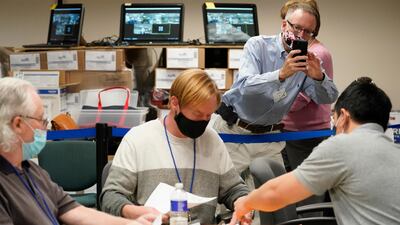
Republican canvas observer Ed White, takes photos with his smart phone as Lehigh County workers count ballots as vote counting continues in Allentown Pennsylvania. AP Photo -

Supporters of President Donald Trump demonstrate outside of the TCF Centre in Detroit, Michigan. AFP -
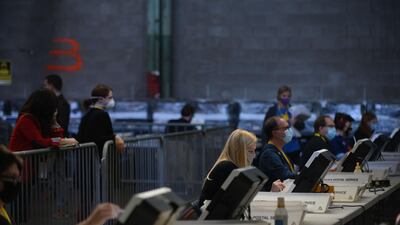
Election officials proceed with the counting of ballots at the Allegheny County elections warehouse in Pittsburgh, Pennsylvania. AFP -

House of Representatives Speaker Nancy Pelosi holds a news conference during the presidential election in Washington. Reuters -
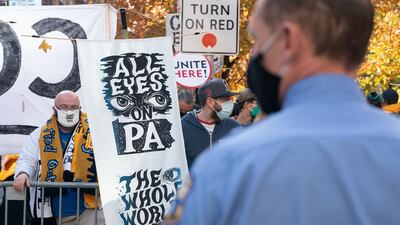
Protesters urge vote counting outside the Pennsylvania Convention Center. AFP -
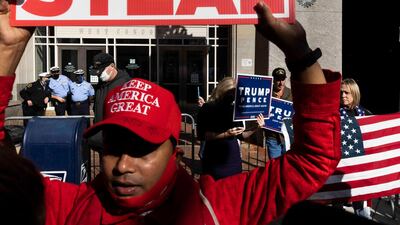
Supporters of President Trump, who are questioning the legitimacy of the state's vote counting, gather outside of the Pennsylvania Convention Centre in Philadelphia. EPA -

A police officer stands watch near a stage set up by the campaign of Democratic presidential nominee Joe Biden in Wilmington, Delaware. Reuters -
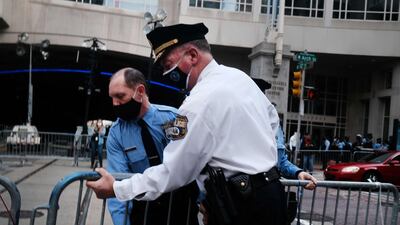
Protesters, police, members of the media and others converge outside of the Convention Centre as the counting of ballots continues in the state in Philadelphia, Pennsylvania. AFP -
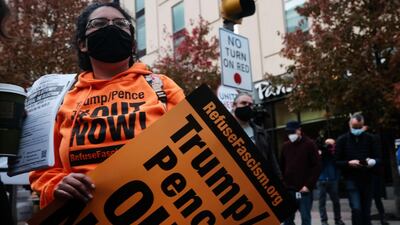
Protesters gather outside of the Philadelphia Convention Centre. AFP -

Protesters outside of the Philadelphia Convention Centre. Joe Biden took the lead in the vote count on Friday morning from President Trump, bringing him one step closer to winning the election. AFP -
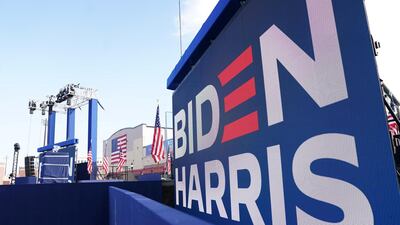
A stage set up by the campaign of Joe Biden sits ready in Wilmington. Reuters


Again this tells us something: that the lockdown plays into the splintering of politics into minority obsessions. There is an imagined pool of voters, who may not always be outwardly discontented but are ripe for radicalisation on the basis of how they feel about the situation.
One study by the US-based Cato Institute found that 62 per cent of Americans felt they were prevented from saying what they believe by the political climate. The libertarian think tank said that only self-described "strong liberals" really felt free to express their opinions.
The further tilting towards the right of the political spectrum, the more participants in the study felt vulnerable for their views. One-third of them worried that their private views could harm their future employment prospects. This fear increased with educational attainment, rising to 44 per cent in post-graduates.
The Covid-19 lockdown is one big reason that the politics of division is here to stay.
Damien McElroy is the London bureau chief of The National

