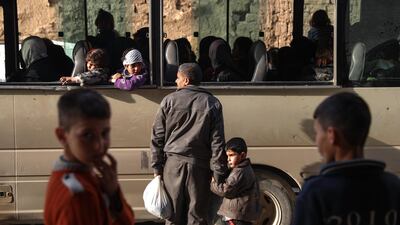
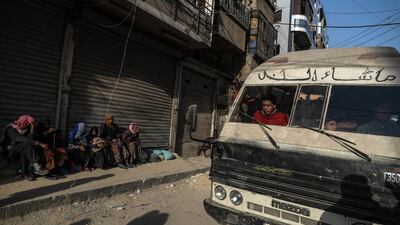
A Syrian man looks on as buses with Jaish Al Islam fighters and their families on board arrive from their former rebel bastion of Douma in Eastern Ghouta at the Abu Al Zindeen checkpoint on April 14, 2018. Nazeer Al Khatib / AFP
A Syrian man looks on as buses with Jaish Al Islam fighters and their families on board arrive from their former rebel bastion of Douma in Eastern Ghouta at the Abu Al Zindeen checkpoint on April 14,

Syrian army hails full recapture of Ghouta rebel enclave


  • English
  • Arabic

The Syrian army has declared that all anti-regime forces have left Eastern Ghouta, after a blistering two month offensive on the rebel enclave on the outskirts of the capital.

The announcement, which represents a key strategic victory for President Bashar Al Assad, came just hours after US-led strikes pounded Syrian government targets in response to a chemical attack on the enclave's main town of Douma.

"All terrorists have left Douma, the last of their holdouts in Eastern Ghouta," state news agency SANA quoted an army spokesman as saying Saturday, using the regime's usual term for rebels.

"Areas of Eastern Ghouta in rural Damascus have been fully cleansed of terrorism," an army spokesman also said in a statement delivered on state television.

At the start of the year Eastern Ghouta was a sprawling semi-rural area just east of Damascus, home to almost 400,000 inhabitants, which had already endured several years under a government siege that slashed access to food, medicine and other goods.

The Syrian government and allied forces launched a massive assault on February 18 to retake the enclave, which had been out of regime control since 2012.

The intense bombardment killed some 1,700 civilians according to the Syrian Observatory for Human Rights, a Britain-based monitor, and pulverised the area, reducing many neighbourhoods to rubble.

Damascus has been accused of carrying out an April 7 chemical weapons attack on Douma, the final part of the enclave where rebels were balking at a Russian-brokered deal to evacuate them to northern Syria.

The United States, France and Britain responded on Saturday with pre-dawn strikes on regime chemical weapons sites.

The allies have since signalled their resolve to return to diplomacy, launching a new bid at the United Nations to investigate chemical weapons attacks in the country.

A team of experts from the Organisation for the Prohibition of Chemical Weapons is in Damascus and expected to investigate the site of the suspected chemical attack.

______________

Read more

Syrian regime flag raised in Douma: Russian military

Faisal Al Yafai: Chemical warfare might just be one of the worst legacies of the Syrian war

______________

Mr Assad had made the reconquest of Eastern Ghouta a strategic goal.

The rebel group Jaish Al Islam, which was in control of Douma, has said it only agreed to leave because of the Syrian government's use of toxic chemicals on Douma, which medics said killed more than 40 people.

The group has slammed the Western strikes as insufficient, as Mr Assad maintains his grip on the war-ravaged country.

"Punishing the instrument of the crime while keeping the criminal — a farce," wrote Mohammad Alloush, a key member of Jaish Al Islam.

Syria and Russia have both denied using chemical weapons and said the claims were fabrications used to justify Western military action.

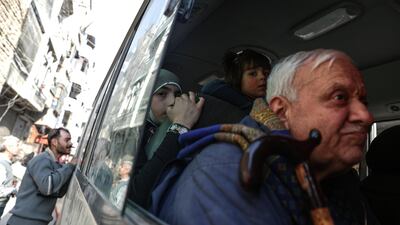
  • A man talks with his relatives seated inside a bus during the evacuation in rebel-held Douma, Syria, on March 17, 2018. Mohammed Badra / EPA
    A man talks with his relatives seated inside a bus during the evacuation in rebel-held Douma, Syria, on March 17, 2018. Mohammed Badra / EPA
  • A man talks with his relatives seated inside a bus during the evacuation in rebel-held Douma, Syria, on March 17, 2018. Mohammed Badra / EPA
    A man talks with his relatives seated inside a bus during the evacuation in rebel-held Douma, Syria, on March 17, 2018. Mohammed Badra / EPA
  • An elderly man waves to relatives from inside a bus during the evacuation in rebel-held Douma, Syria on March 17, 2018. Mohammed Badra / EPA
    An elderly man waves to relatives from inside a bus during the evacuation in rebel-held Douma, Syria on March 17, 2018. Mohammed Badra / EPA
  • An elderly man with two girls sit inside a bus during the evacuation in rebel-held Douma, Syria, on March 17, 2018. Mohammed Badra / EPA
    An elderly man with two girls sit inside a bus during the evacuation in rebel-held Douma, Syria, on March 17, 2018. Mohammed Badra / EPA
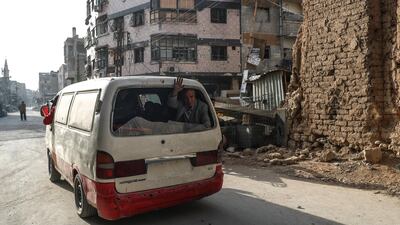
  • An elderly man waves from inside of a van as it departs during the evacuation in rebels-held Douma, Syria, on March 17, 2018. Mohammed Badra / EPA
    An elderly man waves from inside of a van as it departs during the evacuation in rebels-held Douma, Syria, on March 17, 2018. Mohammed Badra / EPA
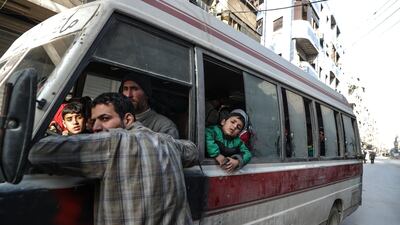
  • A boy looks out from a bus during the evacuation in rebels-held Douma, Syria, on March 17, 2018. Mohammed Badra / EPA
    A boy looks out from a bus during the evacuation in rebels-held Douma, Syria, on March 17, 2018. Mohammed Badra / EPA
  • People wait for the bus to be evacuated in rebel-held Douma, Syria, on March 2018. Mohammed Badra / EPA
    People wait for the bus to be evacuated in rebel-held Douma, Syria, on March 2018. Mohammed Badra / EPA
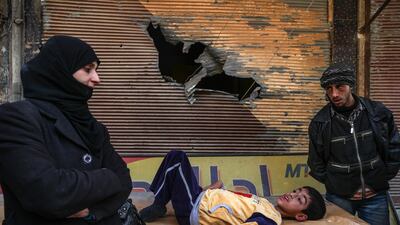
  • Locals stand next to a physically challenged boy who was not able to leave with the medical convoy due to paperwork formalities after the evacuation in rebels-held Douma, Syria, on March 17, 2018. Mohammed Badra / EPA
    Locals stand next to a physically challenged boy who was not able to leave with the medical convoy due to paperwork formalities after the evacuation in rebels-held Douma, Syria, on March 17, 2018. Mohammed Badra / EPA
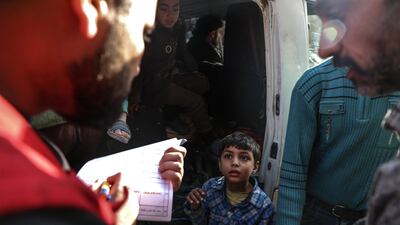
  • A boy prepares to enter the ambulance during the evacuation in rebel-held Douma, Syria, on March 17, 2018. Mohammed Badra / EPA
    A boy prepares to enter the ambulance during the evacuation in rebel-held Douma, Syria, on March 17, 2018. Mohammed Badra / EPA

The two-month assault on Eastern Ghouta sparked an international outcry, with the head of the United Nations describing the conditions endured by civilians there as "hell on Earth".

Few convoys of humanitarian aid were allowed in while rights groups and aid organisations also condemned the targeting of medical facilities across the besieged territory.

Dozens of civilians in government-controlled central Damascus were also killed by rockets and mortar rounds fired from Eastern Ghouta by the rebel groups that held it.

On Saturday Syria's internal security forces entered Douma, after the last convoy of buses transporting members of Jaish Al Islam and their relatives left the town.

The Syrian army said a clean up operation was under way in the battered enclave.

"Engineering units are starting to clear the mines and explosives sewn by the terrorists in the town to allow the rest of the units to secure the liberated areas and prepare them for the return of civilians to their homes," the army spokesman said.

Thousands of civilians who fled the offensive have already returned to areas previously retaken by the army and allied forces.

A large number of Eastern Ghouta residents were bussed to the northern province of Idlib, which is largely outside government control and hosts several extremist and other rebel groups.

The civil war started in 2011 with the brutal repression of anti-government protests.

Mr Assad has managed to cling on to power, retaking swathes of territory with the help of ally Russia.


Ms Yang's top tips for parents new to the UAE
  1. Join parent networks
  2. Look beyond school fees
  3. Keep an open mind
The five pillars of Islam

1. Fasting 

2. Prayer 

3. Hajj 

4. Shahada 

5. Zakat 

HAJJAN
%3Cp%3EDirector%3A%20Abu%20Bakr%20Shawky%C2%A0%3C%2Fp%3E%0A%3Cp%3E%3Cbr%3EStarring%3A%20Omar%20Alatawi%2C%20Tulin%20Essam%2C%20Ibrahim%20Al-Hasawi%C2%A0%3C%2Fp%3E%0A%3Cp%3E%3Cbr%3ERating%3A%204%2F5%3C%2Fp%3E%0A
Global state-owned investor ranking by size

1.

United States

2.

China

3.

UAE

4.

Japan

5

Norway

6.

Canada

7.

Singapore

8.

Australia

9.

Saudi Arabia

10.

South Korea

The candidates

Dr Ayham Ammora, scientist and business executive

Ali Azeem, business leader

Tony Booth, professor of education

Lord Browne, former BP chief executive

Dr Mohamed El-Erian, economist

Professor Wyn Evans, astrophysicist

Dr Mark Mann, scientist

Gina MIller, anti-Brexit campaigner

Lord Smith, former Cabinet minister

Sandi Toksvig, broadcaster


Mercer, the investment consulting arm of US services company Marsh & McLennan, expects its wealth division to at least double its assets under management (AUM) in the Middle East as wealth in the region continues to grow despite economic headwinds, a company official said.

Mercer Wealth, which globally has $160 billion in AUM, plans to boost its AUM in the region to $2-$3bn in the next 2-3 years from the present $1bn, said Yasir AbuShaban, a Dubai-based principal with Mercer Wealth.

Within the next two to three years, we are looking at reaching $2 to $3 billion as a conservative estimate and we do see an opportunity to do so,” said Mr AbuShaban.

Mercer does not directly make investments, but allocates clients’ money they have discretion to, to professional asset managers. They also provide advice to clients.

“We have buying power. We can negotiate on their (client’s) behalf with asset managers to provide them lower fees than they otherwise would have to get on their own,” he added.

Mercer Wealth’s clients include sovereign wealth funds, family offices, and insurance companies among others.

From its office in Dubai, Mercer also looks after Africa, India and Turkey, where they also see opportunity for growth.

Wealth creation in Middle East and Africa (MEA) grew 8.5 per cent to $8.1 trillion last year from $7.5tn in 2015, higher than last year’s global average of 6 per cent and the second-highest growth in a region after Asia-Pacific which grew 9.9 per cent, according to consultancy Boston Consulting Group (BCG). In the region, where wealth grew just 1.9 per cent in 2015 compared with 2014, a pickup in oil prices has helped in wealth generation.

BCG is forecasting MEA wealth will rise to $12tn by 2021, growing at an annual average of 8 per cent.

Drivers of wealth generation in the region will be split evenly between new wealth creation and growth of performance of existing assets, according to BCG.

Another general trend in the region is clients’ looking for a comprehensive approach to investing, according to Mr AbuShaban.

“Institutional investors or some of the families are seeing a slowdown in the available capital they have to invest and in that sense they are looking at optimizing the way they manage their portfolios and making sure they are not investing haphazardly and different parts of their investment are working together,” said Mr AbuShaban.

Some clients also have a higher appetite for risk, given the low interest-rate environment that does not provide enough yield for some institutional investors. These clients are keen to invest in illiquid assets, such as private equity and infrastructure.

“What we have seen is a desire for higher returns in what has been a low-return environment specifically in various fixed income or bonds,” he said.

“In this environment, we have seen a de facto increase in the risk that clients are taking in things like illiquid investments, private equity investments, infrastructure and private debt, those kind of investments were higher illiquidity results in incrementally higher returns.”

The Abu Dhabi Investment Authority, one of the largest sovereign wealth funds, said in its 2016 report that has gradually increased its exposure in direct private equity and private credit transactions, mainly in Asian markets and especially in China and India. The authority’s private equity department focused on structured equities owing to “their defensive characteristics.”

The specs

Engine: 1.4-litre 4-cylinder turbo

Power: 180hp at 5,500rpm

Torque: 250Nm at 3,00rpm

Transmission: 5-speed sequential auto

Price: From Dh139,995

On sale: now

Our legal columnist

Name: Yousef Al Bahar

Advocate at Al Bahar & Associate Advocates and Legal Consultants, established in 1994

Education: Mr Al Bahar was born in 1979 and graduated in 2008 from the Judicial Institute. He took after his father, who was one of the first Emirati lawyers

Who's who in Yemen conflict

Houthis: Iran-backed rebels who occupy Sanaa and run unrecognised government

Yemeni government: Exiled government in Aden led by eight-member Presidential Leadership Council

Southern Transitional Council: Faction in Yemeni government that seeks autonomy for the south

Habrish 'rebels': Tribal-backed forces feuding with STC over control of oil in government territory

Wonka
%3Cp%3E%3Cstrong%3EDirector%3A%3C%2Fstrong%3E%C2%A0Paul%20King%3C%2Fp%3E%0A%3Cp%3E%3Cstrong%3EStarring%3A%C2%A0%3C%2Fstrong%3ETimothee%20Chalamet%2C%20Olivia%20Colman%2C%20Hugh%20Grant%3C%2Fp%3E%0A%3Cp%3E%3Cstrong%3ERating%3A%3C%2Fstrong%3E%202%2F5%3C%2Fp%3E%0A
Paatal Lok season two

Directors: Avinash Arun, Prosit Roy 

Stars: Jaideep Ahlawat, Ishwak Singh, Lc Sekhose, Merenla Imsong

Rating: 4.5/5

'The Batman'

Stars:Robert Pattinson

Director:Matt Reeves

Rating: 5/5

Infiniti QX80 specs

Engine: twin-turbocharged 3.5-liter V6

Power: 450hp

Torque: 700Nm

Price: From Dh450,000, Autograph model from Dh510,000

Available: Now

David Haye record

Total fights: 32
Wins: 28
Wins by KO: 26
Losses: 4

Timeline

2012-2015

The company offers payments/bribes to win key contracts in the Middle East

May 2017

The UK SFO officially opens investigation into Petrofac’s use of agents, corruption, and potential bribery to secure contracts

September 2021

Petrofac pleads guilty to seven counts of failing to prevent bribery under the UK Bribery Act

October 2021

Court fines Petrofac £77 million for bribery. Former executive receives a two-year suspended sentence 

December 2024

Petrofac enters into comprehensive restructuring to strengthen the financial position of the group

May 2025

The High Court of England and Wales approves the company’s restructuring plan

July 2025

The Court of Appeal issues a judgment challenging parts of the restructuring plan

August 2025

Petrofac issues a business update to execute the restructuring and confirms it will appeal the Court of Appeal decision

October 2025

Petrofac loses a major TenneT offshore wind contract worth €13 billion. Holding company files for administration in the UK. Petrofac delisted from the London Stock Exchange

November 2025

180 Petrofac employees laid off in the UAE