
It's a strangely unnerving experience, seeing your name in an official account going back 26 years.
The BBC has released, in a response to a Freedom of Information request, its log of events after the Martin Bashir interview for Panorama in 1995 with Princess Diana.
There I am, the first journalist to call, to ask if it was true that Bashir had secured his world scoop by convincing the princess that she and her brother, Earl Spencer, were being tracked by the security service MI5.
Except I'm described as Chris Pankhurst. I was an investigative reporter on The Independent.
I’d received a tip-off that Bashir was researching a programme about MI5 and the British royal family, and that he had produced material that seemed to show the security service was targeting Spencer and Diana.
My source could not provide any corroborative evidence and without that or a second source the story could not be written. It required further research.
This was in November 1995, immediately after the programme, in which the princess famously claimed there were “three of us in this marriage”, a reference to her then husband Prince Charles’s relationship with Camilla Parker Bowles.
The second occasion I called, the account spells my name right. That was in April 1996, when a story broke that Bashir had forged a bank statement to suggest that MI5 was paying Spencer’s former head of security for information.
The fake bank statement indicated a payment from Penfolds, a small, obscure, Channel Islands-registered company, to Spencer’s former security chief.
Colleagues of Bashir had been alerted by the use of the name "Penfolds", which had featured in a previous Panorama, also researched and presented by him, into the business dealings of Terry Venables, the former England football manager. It was too coincidental, they thought.
The BBC confirmed they had looked into the document “two or three months ago” but said it played no part in securing the interview and a “thorough investigation” had been held.
The BBC press officer admitted the statement was false but had been made in connection with another programme.
The BBC will shortly publish a report from a former judge, Lord Dyson, appointed to investigate what happened. Panorama is also due to air its own “special” investigation into what went on.

I've given evidence to Dyson and I've been filmed for Panorama. The latter was scheduled to be aired on Monday this week but was postponed because of concerns that the corporation owed a "duty of care" to Bashir, who last month resigned on health grounds as the BBC's religion editor.
In some ways, this appears highly commendable: the BBC appointing a former senior judge to hold an inquiry and commissioning its flagship programme to investigate.
But it also carries echoes of previous BBC controversies in which the organisation ended up becoming entwined in trying to explain and justify its own poor behaviour and subsequent cover-up – Jimmy Savile springs to mind.
The fact is that Bashir, a young, little-known, relatively inexperienced journalist, had beaten some of the world’s most celebrated interviewers, among them David Frost and Barbara Walters, to the princess.
No one in authority at the BBC seemingly thought to ask how.
Quite the reverse: the internal log is full of congratulations from senior figures in the corporation, including from Tony Hall, now Lord Hall, then its head of news and current affairs, and later, BBC director general.
When reporters started questioning, the BBC claimed Hall had looked into it, found nothing unduly untoward, and the shutters came down.
What’s telling about the log is that Hall reported as much to the BBC board of governors, saying to them that he was going to launch a leak inquiry to find who had been informing journalists.
It took a flurry of 25th anniversary documentaries and a complaint from Spencer, and an indication from Kensington Palace that Prince William was also keen to know what had transpired, for the BBC, finally, to act.
It’s bad enough that the BBC was forging someone’s bank statement. It’s clear too that Diana, who was vulnerable, was influenced and impressionable.
But she is dead, as is Bashir's boss at the time, the Panorama editor, Steve Hewlett. Without them, Bashir may be able to mount some sort of defence, or at least, vital questions must remain unanswered.
Imagine, though, if what Dyson and Panorama now disclose was known back then. Imagine, too, if it was not the BBC that had behaved in this manner but a tabloid newspaper. Consider the row that would have ensued.
For decades, UK newspapers, especially the tabloids, were put under scrutiny for their conduct – and in some cases, rightly so.
Much of the finger-pointing came from the BBC, which regarded itself as above such activity.
Yet here we have an interview with a tormented senior member of the royal family being obtained by deception.
Let us, too, remind ourselves of what took place after the Panorama interview. In early 1996, Queen Elizabeth ordered Diana and Charles to speed up their divorce, which they did.
Diana left the royal family and the security blanket it afforded her.
She rejected the offer of maintaining extensive personal protection, partly because she could not trust the royal family or the security service – a feeling presumably exacerbated by Bashir.
The following year she died in the Paris car crash.
That chain of events was prompted by the Panorama interview. It's some statement to make, I know, but it is true.
-
Ten-year-old Lady Diana Spencer during a summer holiday in Itchenor, West Sussex, in 1971. Here 'The National' takes a look back through Princess Diana's life in pictures. Getty -
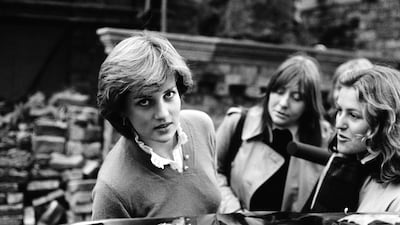
Lady Diana Spencer, 19 at the time, responds to the press while getting into a car in London, in 1980. Getty -
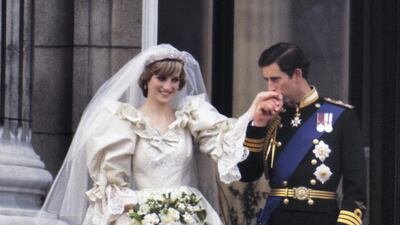
The Prince and Princess of Wales on the balcony of Buckingham Palace on their wedding day, on July 29, 1981. Getty -
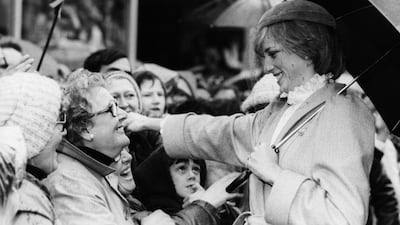
Princess Diana smiling as she prepares to embrace a woman in the crowd, on the streets of Carmarthen, Wales, in 1981. Getty -
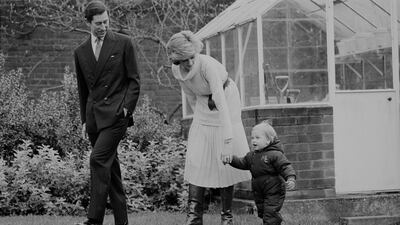
Princess Diana and Prince Charles with their son, Prince William, in December 1983. Getty Images -
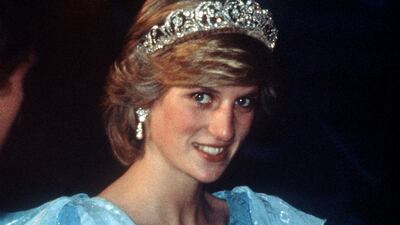
Princess Diana wearing the Spencer family tiara at state dinner in Saint John, New Brunswick, Canada, in 1983. PA -
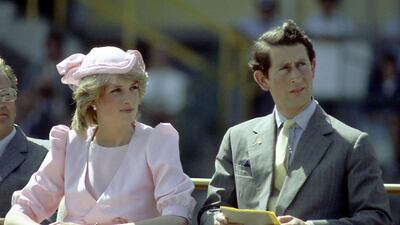
Princess Diana And Prince Charles watch an official event during their first royal Australian tour in 1983. Getty -
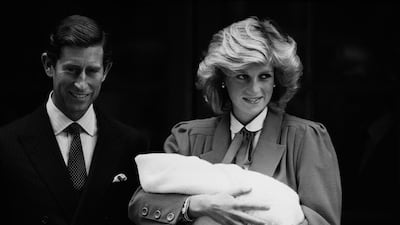
Princess Diana and Prince Charles with newborn Prince Harry, leave St Mary's Hospital in Paddington, London, in 1984. Getty -
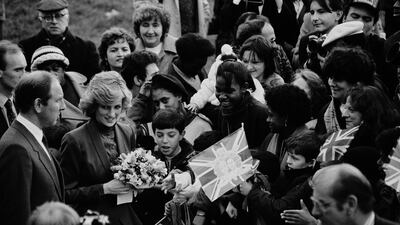
Princess Diana meets members of the public during a visit to a community centre in north London in 1985. Getty -
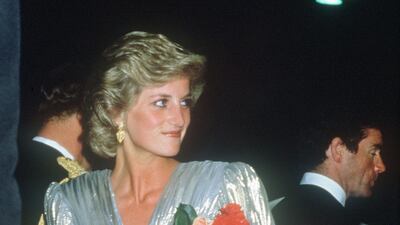
Princess Diana arrives at a dinner during a visit to Australia in 1985. AFP -
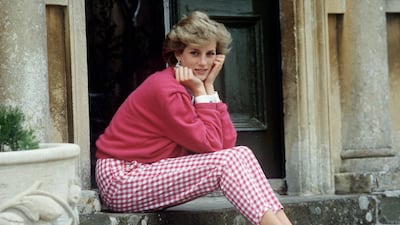
Princess Diana sits on a step at her home, Highgrove House, in Doughton, Gloucestershire, in 1986. Getty -
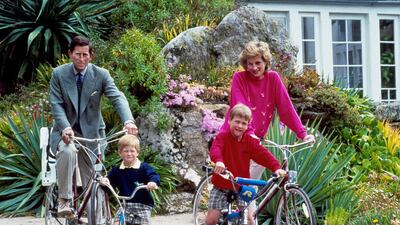
Prince Charles and Princess Diana and their sons, Princes William and Harry, on a cycle ride around the island of Tresco, Italy, in 1989. AP -
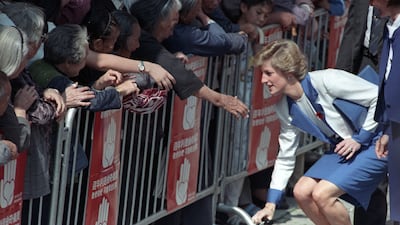
Princess Diana stoops down to pick up a walking stick after a woman she dropped it over the crowd barrier, during a walkabout in Hong Kong in 1989. Reuters -
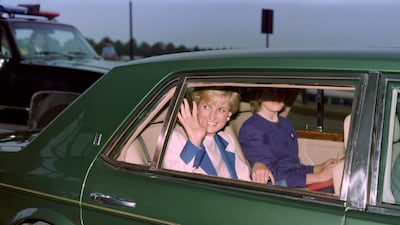
Princess Diana waves on her way to visit US first lady Barbara Bush at the White House in Washington, in 1990. AFP -
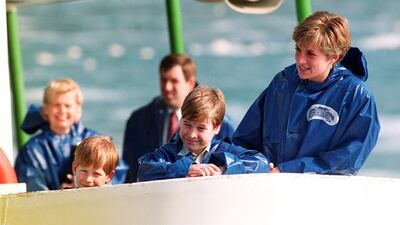
Princess Diana and her sons onboard the 'Maid of Mist' ship as they take a close look at the Niagara Falls, Canada, in 1991. PA -
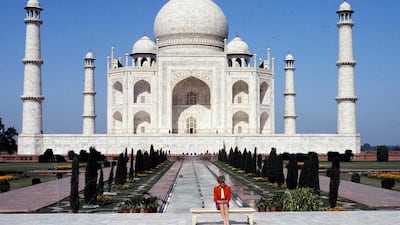
Princess Diana poses alone at the Taj Mahal during her visit to India in 1992. Getty -
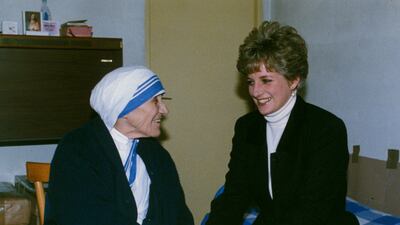
Princess Diana holds the hands of Mother Teresa during their first meeting at the Missionary Sisters of Charity residence in Rome, Italy, in 1992. Reuters -
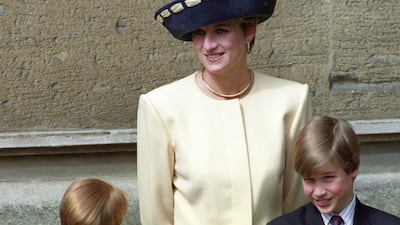
Princess Diana with her sons outside St George's Chapel, Windsor Castle, in 1992. PA -
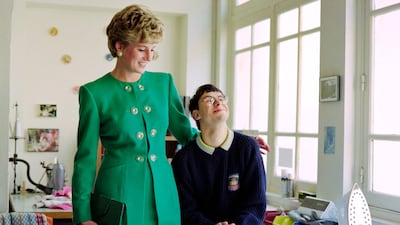
Princess Diana listens to a young boy during her visit to a home for children in Paris, France, in 1992. AFP -
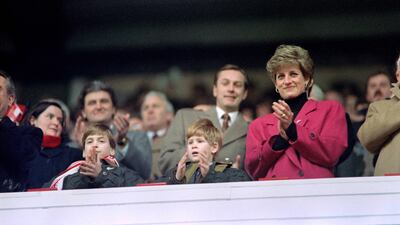
Princes William and Harry applaud alongside their mother, Princess Diana, during a Five Nations rugby match between Wales and France in 1992. AFP -
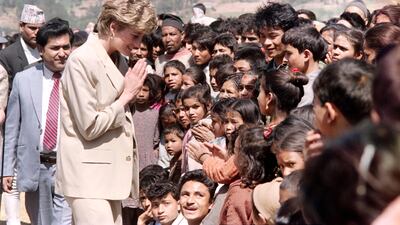
Princess Diana speaks to Nepali children while touring a Red Cross project in the Himalayan foothills in 1993. AFP -
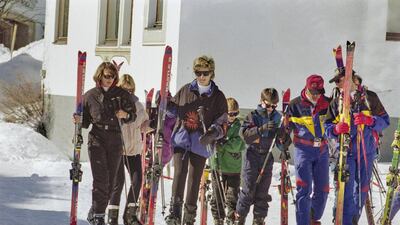
Princess Diana, Prince Harry and Prince William carrying their skis during a skiing holiday in Lech am Arlberg, Austria, in 1994. Getty -
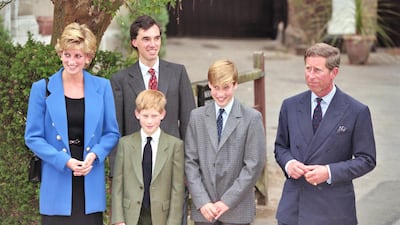
Princess Diana, Prince Harry, Prince William and Prince Charles outside Manor House, on Prince William's first day at Eton College in 1995. Getty -
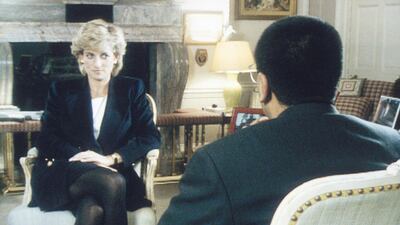
Martin Bashir speaking to Princess Diana in Kensington Palace during the infamous 'Panorama' interview that was aired by the BBC in 1995. Getty -
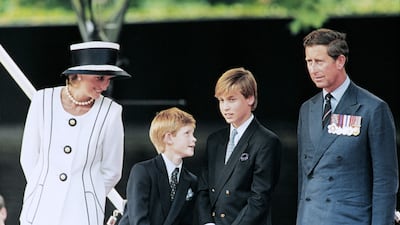
Prince Charles, Princess Diana and their children watch the march past on the mall as part of the commemorations of VJ Day in London in 1995. AFP -
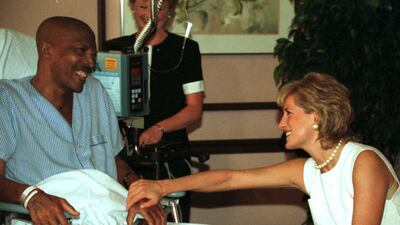
Princess Diana meets with John Collins, a 51-year-old lung cancer patient, while visiting Chicago's Northwestern Memorial Hospital's Hospice in 1996. AFP -
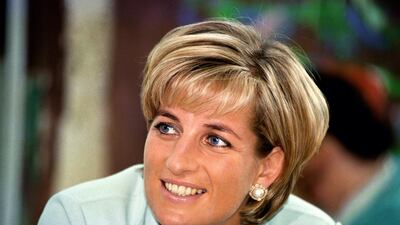
Princess Diana during a visit to Leicester, to formally open The Richard Attenborough Centre for Disability and Arts, in May 1997. Getty -
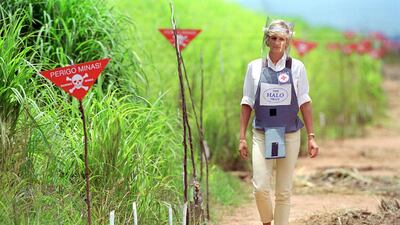
Princess Diana, wearing protective body armour, visits a minefield being cleared by the charity, Halo, in Huambo, Angola, in 1997. Getty -
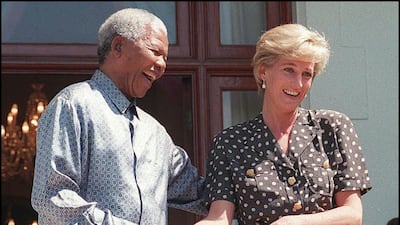
South African President Nelson Mandela and Princess Diana speak with the press after meeting in Cape Town, South Africa, in 1997. AFP -
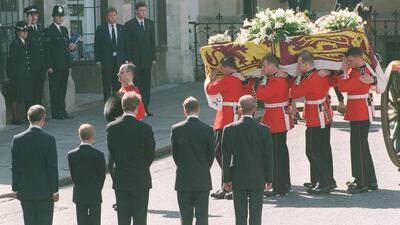
Prince Charles, Prince Harry, Earl Spencer, and Prince William watch as the coffin of Princess Diana is carried into Westminster Abbey, London, in September 1997. AFP -
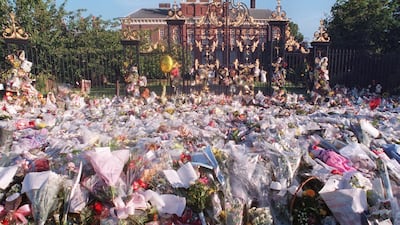
Floral tributes for Princess Diana in front of Kensington Palace in London, in 1997. AFP -
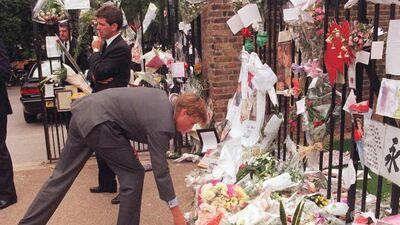
Prince William places a bunch of flowers with the hundreds tributes already laid outside his mother's official residence at Kensington Palace, in 1997. AFP -
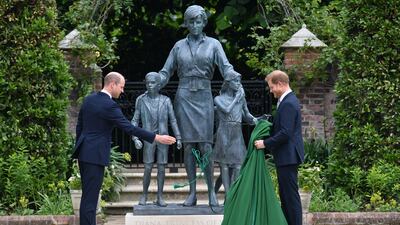
Prince William and Prince Harry unveil a statue they commissioned of their mother, at Kensington Palace in 2021, on what would have been her 60th birthday. PA


Roll forward to this year and the Meghan and Harry interview with Oprah Winfrey. Harry referred more than once to wishing to protect Meghan, to ensure that history was not repeated.
Bashir is claiming ill-heath, hence the BBC owes him a duty of care. That in itself is odd, since the BBC ordered this latest Panorama knowing full well the likely outcome.
His health was also said to be poor then, so a duty of care now does not make sense. Unless, of course, this is another attempt to hide and to obfuscate.
It’s to be hoped not. The BBC has an awful lot of explaining to do, even if it is 26 years late.
Chris Blackhurst is a former editor of The Independent, based in London
UPDATE: BBC report finds journalist Martin Bashir used deceit to land Princess Diana interview

