• A firefighter truck is seen as smoke rises from shells fired from Israel in the border village of Maroun Al Ras village in southern Lebanon on September 1, 2019. Reuters
    A firefighter truck is seen as smoke rises from shells fired from Israel in the border village of Maroun Al Ras village in southern Lebanon on September 1, 2019. Reuters
  • A Lebanese demonstrator burns wood and debris during a protest in Beirut on October 17, 2019, when hundreds took to the streets across Lebanon to protest against dire economic conditions. AFP
    A Lebanese demonstrator burns wood and debris during a protest in Beirut on October 17, 2019, when hundreds took to the streets across Lebanon to protest against dire economic conditions. AFP
  • Demonstrators carry Lebanese flags as riot police stand guard behind barbed wire during an anti-government protest in Beirut on October 19, 2019. Reuters
    Demonstrators carry Lebanese flags as riot police stand guard behind barbed wire during an anti-government protest in Beirut on October 19, 2019. Reuters
  • Demonstrators stand around a fire lit during protests in Beirut on October 18, 2019. Reuters
    Demonstrators stand around a fire lit during protests in Beirut on October 18, 2019. Reuters
  • Lebanon's Prime Minister Saad Hariri hands his government's resignation to President Michel Aoun, left, at the Baabda presidential palace on October 29, 2019. Dalati and Nohra / AFP
    Lebanon's Prime Minister Saad Hariri hands his government's resignation to President Michel Aoun, left, at the Baabda presidential palace on October 29, 2019. Dalati and Nohra / AFP
  • A member of the Lebanese security forces helps an injured man during clashes between demonstrators and counter-protesters in the centre of Beirut on October 29, 2019. AFP
    A member of the Lebanese security forces helps an injured man during clashes between demonstrators and counter-protesters in the centre of Beirut on October 29, 2019. AFP
  • A woman carries a cat and a Lebanese flag during a demonstration in the centre of Beirut on October 26, 2019. AFP
    A woman carries a cat and a Lebanese flag during a demonstration in the centre of Beirut on October 26, 2019. AFP
  • Lebanese security forces surround protesters in the southern port city of Sidon on October 18, 2019. AFP
    Lebanese security forces surround protesters in the southern port city of Sidon on October 18, 2019. AFP
  • Lebanese Prime Minister Saad Hariri announces his government's resignation on October 29, 2019. Dalati and Nohra / AFP
    Lebanese Prime Minister Saad Hariri announces his government's resignation on October 29, 2019. Dalati and Nohra / AFP
  • Anti-government protesters celebrate the resignation of Prime Minister Saad Hariri in Beirut on October 29, 2019. AFP
    Anti-government protesters celebrate the resignation of Prime Minister Saad Hariri in Beirut on October 29, 2019. AFP
  • Lebanese demonstrators burn tyres to block a highway between Beirut and the northern city of Tripoli on October 18, 2019. AFP
    Lebanese demonstrators burn tyres to block a highway between Beirut and the northern city of Tripoli on October 18, 2019. AFP
  • French President Emmanuel Macron hugs Beirut blast blast victim Tamara Tayah as he attends a ceremony to plant a cedar with members of the NGO Jouzour Loubnan in Jaj on September 1, 2020. Reuters
    French President Emmanuel Macron hugs Beirut blast blast victim Tamara Tayah as he attends a ceremony to plant a cedar with members of the NGO Jouzour Loubnan in Jaj on September 1, 2020. Reuters
  • Demonstrators take part in an anti-government protest in Tripoli on October 20, 2019. Reuters
    Demonstrators take part in an anti-government protest in Tripoli on October 20, 2019. Reuters
  • A youth inspects damage at a bank branch which was vandalised by protesters in Al Nour Square in Tripoli on June 12, 2020. AFP
    A youth inspects damage at a bank branch which was vandalised by protesters in Al Nour Square in Tripoli on June 12, 2020. AFP
  • Riot police fire tear gas to disperse demonstrators during a protest near the government palace in Beirut on October 18, 2019. Reuters
    Riot police fire tear gas to disperse demonstrators during a protest near the government palace in Beirut on October 18, 2019. Reuters
  • Protesters celebrate the resignation of Prime Minister Saad Hariri in the southern city of Sidon on October 29, 2019. AFP
    Protesters celebrate the resignation of Prime Minister Saad Hariri in the southern city of Sidon on October 29, 2019. AFP
  • President Emmanuel Macron meets UN representatives and NGOs mobilised for the reconstruction of Beirut's port aboard the Tonnerre helicopter carrier on September 1, 2020. ABACAPRESS.COM
    President Emmanuel Macron meets UN representatives and NGOs mobilised for the reconstruction of Beirut's port aboard the Tonnerre helicopter carrier on September 1, 2020. ABACAPRESS.COM
  • Demonstrators force their way past barricades around the Lebanese parliament during French President Emmanuel Macron's visit to Beirut on September 1, 2020. Karine Pierre / Hans Lucas
    Demonstrators force their way past barricades around the Lebanese parliament during French President Emmanuel Macron's visit to Beirut on September 1, 2020. Karine Pierre / Hans Lucas
  • Lebanese doctor Nada Jabbour displays the image of a patient's skull who was hit in the eye with a projectile fired by security forces during an anti-government protest, on August 16, 2020 in Beirut. AFP
    Lebanese doctor Nada Jabbour displays the image of a patient's skull who was hit in the eye with a projectile fired by security forces during an anti-government protest, on August 16, 2020 in Beirut. AFP
  • A man sits at the entrance of a damaged bank in the aftermath of the blast at Beirut's port on August 4, 2020. AFP
    A man sits at the entrance of a damaged bank in the aftermath of the blast at Beirut's port on August 4, 2020. AFP
  • Demonstrators wave flags during a protest outside the government palace in Beirut against a government decision to tax calls made on messaging applications, on October 17, 2019. AFP
    Demonstrators wave flags during a protest outside the government palace in Beirut against a government decision to tax calls made on messaging applications, on October 17, 2019. AFP
  • An anti-government protester holds a placard with a cartoon of Lebanese President Michel Aoun, left, Parliament Speaker Nabih Berri, centre, and the leader of Hezbollah Hassan Nasrallah sitting on a national flag during a demonstration against the lack of progress in the Beirut blast investigation, on September 12, 2020. AFP
    An anti-government protester holds a placard with a cartoon of Lebanese President Michel Aoun, left, Parliament Speaker Nabih Berri, centre, and the leader of Hezbollah Hassan Nasrallah sitting on a national flag during a demonstration against the lack of progress in the Beirut blast investigation, on September 12, 2020. AFP
  • Demonstrators clash with police outside the government palace in Beirut on October 17, 2019. AFP
    Demonstrators clash with police outside the government palace in Beirut on October 17, 2019. AFP
  • Lebanese soldiers roll a flaming tyre away from the fence surrounding the local branch of the Lebanese Central Bank in the northern city of Tripoli on June 11, 2020. AFP
    Lebanese soldiers roll a flaming tyre away from the fence surrounding the local branch of the Lebanese Central Bank in the northern city of Tripoli on June 11, 2020. AFP
  • Lebanon's Parliament Speaker Nabih Berri, right, meets with US envoy David Schenker, centre, and US ambassador to Algeria John Desrocher in Beirut on October 15, 2020. AFP
    Lebanon's Parliament Speaker Nabih Berri, right, meets with US envoy David Schenker, centre, and US ambassador to Algeria John Desrocher in Beirut on October 15, 2020. AFP
  • A Lebanese protester hurls rocks at security forces across a burning barrier amid clashes in downtown Beirut on August 11, 2020. AFP
    A Lebanese protester hurls rocks at security forces across a burning barrier amid clashes in downtown Beirut on August 11, 2020. AFP
  • A protester draped in the Lebanese flag sits on the rooftop of the 'Egg' building overlooking the Mohammed Al Amin mosque and the Martyrs square in Beirut on November 14, 2019. AFP
    A protester draped in the Lebanese flag sits on the rooftop of the 'Egg' building overlooking the Mohammed Al Amin mosque and the Martyrs square in Beirut on November 14, 2019. AFP

Lebanon uprising anniversary: peaceful struggle undermined by violence


Khaled Yacoub Oweis
  • English
  • Arabic

Lebanese took to the streets of Beirut, Tripoli and other cities en masse one year ago to reject a political model that treated them as clients reliant on handouts from the country’s denominational leaders.

They were crushed in stages, with the acquiescence of most of the political class, and nature, in the form of the coronavirus, putting them at a disadvantage.

Violence by the authorities and allied gunmen, as well as political scheming by the elite, made the protests fizzle out.

But some political and social fundamentals may have transformed in Lebanon, separating October 2019 and its aftermath from every movement demanding change in the country since the 2005 assassination of statesman Rafik Hariri in Beirut.

Entrenched sectarian differences faded among demonstrators demanding the removal of every senior member of the political class. Women marched in large numbers at peaceful rallies and led demonstrations.

Hope rose for an end of an oligarchical system many see as having bedevilled a resilient nation whose economy collapsed after rising from civil war, partly due to contradictions in the peace arrangements that ended the conflict.

Citizens from all walks of life had had enough of corruption and creeping repression. Arbitrary arrests were increasing and disregard for rule of law spread, although Lebanon traditionally has been among the most open societies in the Middle East and produced some its most distinguished legal scholars.

In the three decades since the end of the civil war, daily life has been disrupted by massive electricity shortages. Private generator networks thrived on the misery. Tens of billions of dollars spent since 1990 on the state-owned Electricite du Liban would have comfortably paid for a whole new electricity grid for the country’s 5.5 million inhabitants.

Another absent response from the state, this time to forest fires in Mount Lebanon and the Chouf Mountains, sparked the demonstrations on October 17, 2019.

The fires were ravaging what was left of Lebanon’s natural beauty, which has been at the heart of the nation’s celebrated literature and arts.

When Lebanon was the playground of the Middle East and a destination for the jet set in the 1960s and 1970s, the world’s who’s who marvelled at its deep green gorges and tree covered mountains straddling a coastline dotted with beaches with names similar to the French Riviera.

Greedy developers destroyed much of those irreplaceable assets since the civil war, often in partnership with the ruling elite.

As the anniversary of the uprising approached, forest fires were raging again in parts of Lebanon, with the same nonchalant response by the state, and former prime minister Saad Hariri is on the verge of forming a new government.

Mr Hariri, the son of Rafik Hariri, was the only senior politician to resign in response to the popular pressure. But he rejoined an old guard mostly impervious to the uproar at home and pressure by European countries, in particular France, for reform.

In the 12-month interval, the Lebanese economy and currency collapsed. The financial system melted as the markets, and regular depositors, lost confidence in the government’s ability to repay its debt, which mostly went to covering state salaries and the non-existent electric supply.

The security forces countered the demonstrations with the acquiescence of Hezbollah, the only militia from the civil war officially allowed to hold arms. Supporters of Amal, a smaller Shiite group allied with Hezbollah and headed by parliament speaker Nabih Berri, actively took part in the violent suppression.

Human Rights Watch said parliament guards were among security forces who used "excessive and at times lethal force against mostly peaceful protesters in downtown Beirut on August 8, 2020, causing hundreds of injuries”.

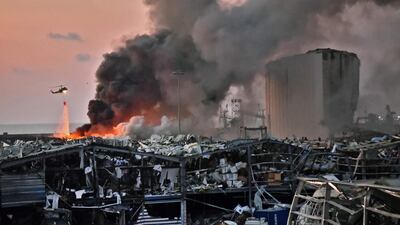
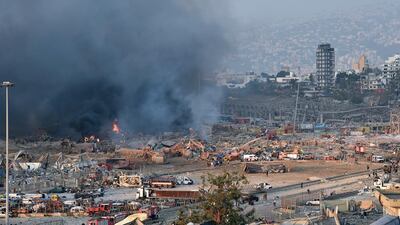
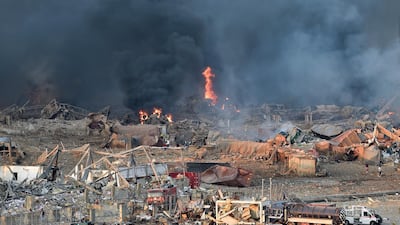
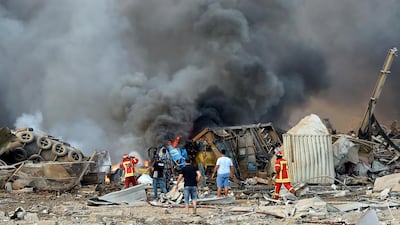
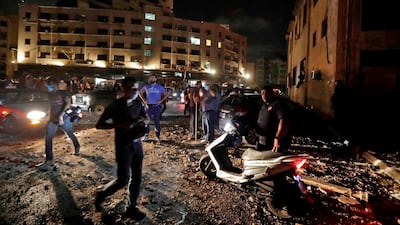
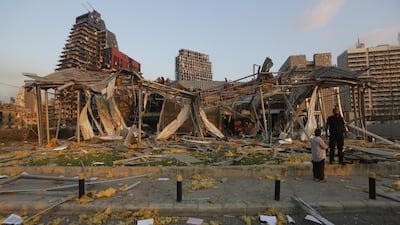
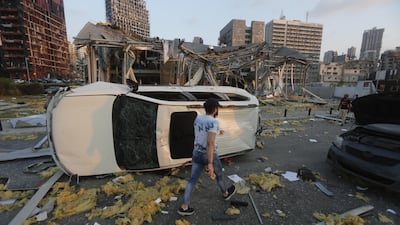
The demonstration near parliament occurred after an explosion on August 4 of ammonium nitrate stored at the Beirut port that killed more than 200 people, exposing stratospheric levels of corruption and mismanagement.

  • A helicopter puts out a fire at the scene of the explosion at the port of Lebanon's capital Beirut on August 4, 2020. AFP
    A helicopter puts out a fire at the scene of the explosion at the port of Lebanon's capital Beirut on August 4, 2020. AFP
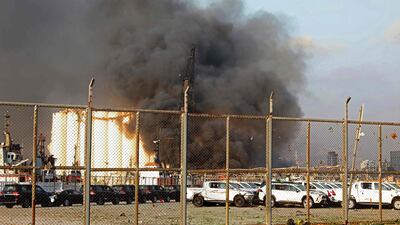
  • Smoke billows from an area of a large explosion that rocked the harbour area of Beirut, Lebanon. EPA
    Smoke billows from an area of a large explosion that rocked the harbour area of Beirut, Lebanon. EPA
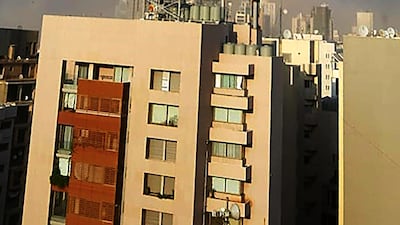
  • The aftermath of blast in Beirut. Sunniva Rose / The National
    The aftermath of blast in Beirut. Sunniva Rose / The National
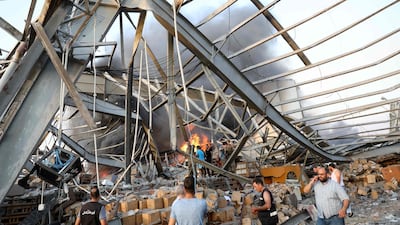
  • The scene of the explosion that rocked Beirut. AFP
    The scene of the explosion that rocked Beirut. AFP
  • The harbour area with smoke billowing from an area of the explosion, Beirut, Lebanon. EPA
    The harbour area with smoke billowing from an area of the explosion, Beirut, Lebanon. EPA
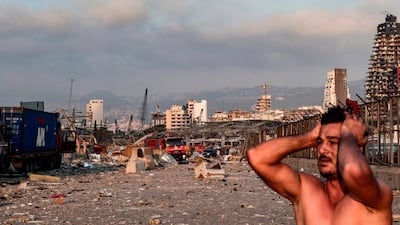
  • A man reacts at the scene of an explosion at the port in Lebanon's capital Beirut. AFP
    A man reacts at the scene of an explosion at the port in Lebanon's capital Beirut. AFP
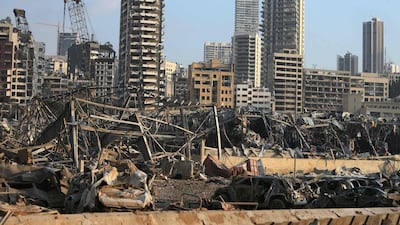
  • The scene of the explosion at the port in Beirut. AFP
    The scene of the explosion at the port in Beirut. AFP
  • The scene of the explosion at the port in Beirut. AFP
    The scene of the explosion at the port in Beirut. AFP
  • The scene of the explosion in Beirut. AFP
    The scene of the explosion in Beirut. AFP
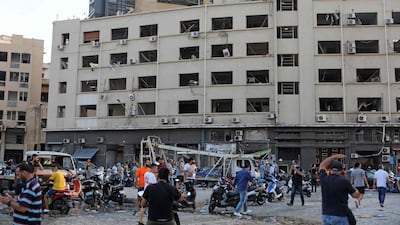
  • People gather near the scene of the explosion in Beirut. AFP
    People gather near the scene of the explosion in Beirut. AFP
  • The scene of the blast in Beirut. AFP
    The scene of the blast in Beirut. AFP
  • The scene of the explosion in Beirut. AFP
    The scene of the explosion in Beirut. AFP
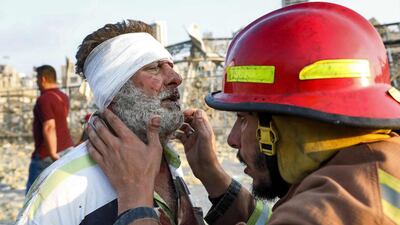
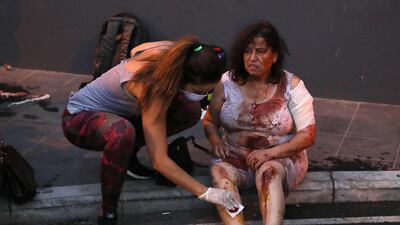
  • A wounded man is checked by a fireman near the scene of the explosion in Beirut. AFP
    A wounded man is checked by a fireman near the scene of the explosion in Beirut. AFP
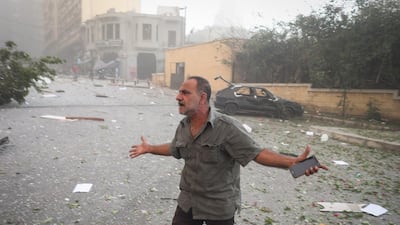
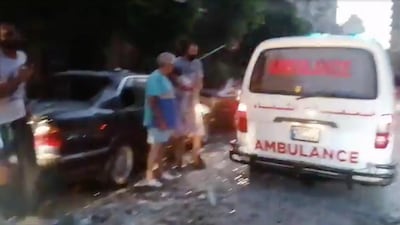
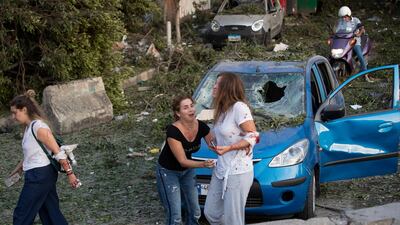
  • A resident stands in the street by a destroyed car, following the explosion near by at the port of Beirut. Bloomberg
    A resident stands in the street by a destroyed car, following the explosion near by at the port of Beirut. Bloomberg
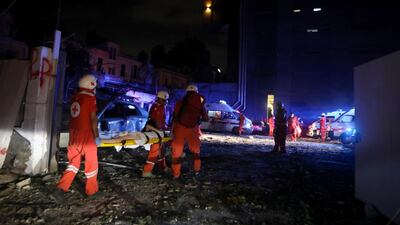
  • Lebanese Red Cross officers carry an injured woman following an explosion at the port of Beirut on August 4, 2020. AFP
    Lebanese Red Cross officers carry an injured woman following an explosion at the port of Beirut on August 4, 2020. AFP
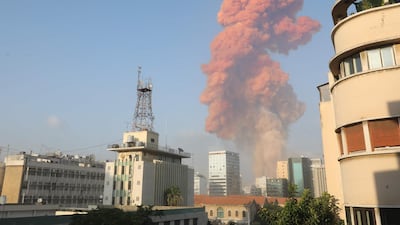
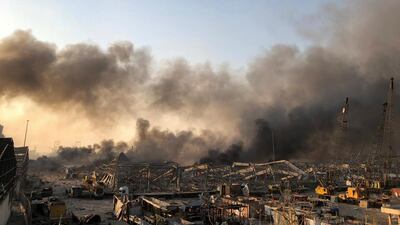
  • Smoke rises after the explosion was heard in Beirut. Reuters
    Smoke rises after the explosion was heard in Beirut. Reuters
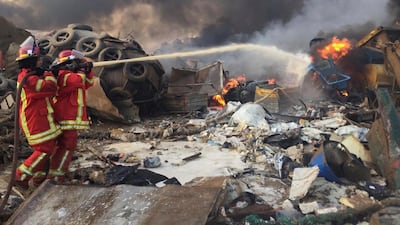
  • Firefighters spray water at a blaze after the explosion in Beirut. Reuters
    Firefighters spray water at a blaze after the explosion in Beirut. Reuters
  • People walk at scene of the explosion in Beirut. AFP
    People walk at scene of the explosion in Beirut. AFP
  • The blast at Beirut port. Twitter/ @borzou
    The blast at Beirut port. Twitter/ @borzou
  • Army personnel around entrance to port.
    Army personnel around entrance to port.
  • The aftermath of the blast in Beirut. Sunniva Rose / The National
    The aftermath of the blast in Beirut. Sunniva Rose / The National
  • The aftermath of the blast in Beirut. Sunniva Rose / The National
    The aftermath of the blast in Beirut. Sunniva Rose / The National
  • The aftermath of the blast in Beirut. Sunniva Rose / The National
    The aftermath of the blast in Beirut. Sunniva Rose / The National
  • The aftermath of blast in Beirut. Sunniva Rose / The National
    The aftermath of blast in Beirut. Sunniva Rose / The National
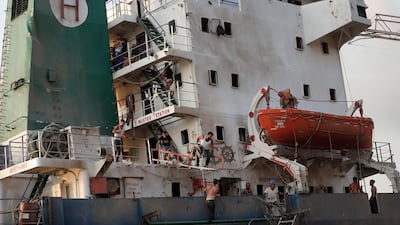
  • Sailors leave their damaged ship near the explosion in Beirut. AP Photo
    Sailors leave their damaged ship near the explosion in Beirut. AP Photo
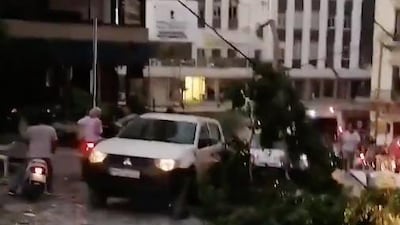
  • A vehicle stands damaged on a road following a large explosion at the port area of Beirut. Bloomberg
    A vehicle stands damaged on a road following a large explosion at the port area of Beirut. Bloomberg
  • Firefighters try to extinguish flames after a large explosion rocked the harbour area of Beirut. EPA
    Firefighters try to extinguish flames after a large explosion rocked the harbour area of Beirut. EPA
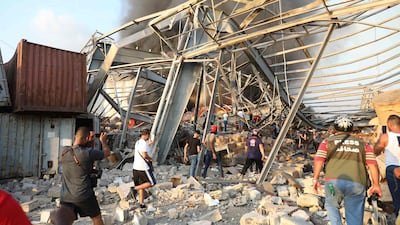
  • People and journalists gather at the scene of an explosion at the port of Lebanon's capital Beirut. AFP
    People and journalists gather at the scene of an explosion at the port of Lebanon's capital Beirut. AFP
  • An injured man sits outside American University of Beirut medical centre on August 5, 2020. Reuters
    An injured man sits outside American University of Beirut medical centre on August 5, 2020. Reuters
  • Men stand before wrecked buildings near the port. Getty Images
    Men stand before wrecked buildings near the port. Getty Images
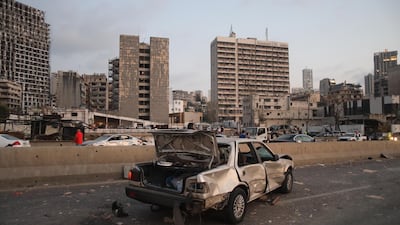
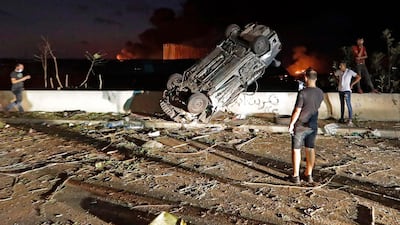
  • A man walks by an overturned car and destroyed buildings. Getty Images
    A man walks by an overturned car and destroyed buildings. Getty Images
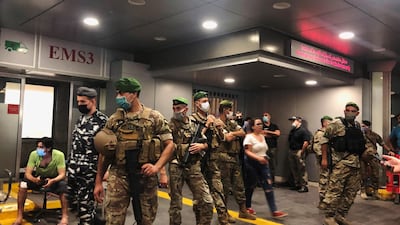
  • Lebanese soldiers stand outside American University of Beirut medical centre. Reuters
    Lebanese soldiers stand outside American University of Beirut medical centre. Reuters
  • Injured people stand after the explosion. AP Photo
    Injured people stand after the explosion. AP Photo
  • People gather by cars destroyed following an explosion at the port of Lebanon's capital Beirut. AFP
    People gather by cars destroyed following an explosion at the port of Lebanon's capital Beirut. AFP
  • Wounded people wait to receive treatment outside a hospital following an explosion near the Beirut port. AFP
    Wounded people wait to receive treatment outside a hospital following an explosion near the Beirut port. AFP

Shiites traditionally supportive of the Hezbollah initially marched in the streets along with the rest of the demonstrators, until Shiite gunmen intervened, in particular to clear the streets of their coreligionists.

Lebanese political commentator Abdulwahab Badrakhan said Hezbollah cowed its Shiite constituency, making it clear that it regards its alliance with Michel Aoun, the Maronite Christian president and the oldest hate figure for the protest movement, as unbreakable.

“Hezbollah forbade anyone from jumping off the sinking ship,” Mr Badrakhan said from London.

The CIA World Factbook shows Shiites making up 30 .5 per cent of Lebanon’s population. Sunnis comprise 30.6 per cent and Christians 33.7 per cent while the Druze are 5.2 per cent.

A revolutionary civil society has been born and the era of impunity is over

Georges Ghanem, co-ordinator for Rally for the Revolution, said that although violence largely cleared the demonstrators from the street, an unshakeable, denomination-based belief in the political leaders as supreme caregivers has been broken.

“The equation of violence versus non-violence has not been to our advantage, but a revolutionary civil society has been born and the era of impunity is over,” said Mr Ghanem, who is a professor of medicine in Beirut.

The Rally for the Revolution, known by its Arabic acronym TMT, comprises of lawyers, academics, business people and other professionals working on unifying the protest movement.

Members of the organisation met two weeks ago with the foreign affairs committee the French parliament to discuss a path for a civilian alternative to the existing oligarchy.

French President Emanuel Macron visited Beirut two days after the port explosion, and again in September, presenting politicians in Beirut with a reform plan that read to many observers as a laundry list. The Lebanese political class mostly responded with ambivalence.

In leaks to Lebanese media, former foreign minister Gibran Bassil told Mr Macron that boat people would be heading to Europe if France lets Lebanon sink.

Mr Bassil is the most powerful Christian politician in Lebanon and a main ally of the Iran-backed Hezbollah.

His warning was designed to strike a raw nerve in a continent reeling from the influx of Arab and African refugees five years ago.

It also showed the ability of an entrenched elite to play political hardball, even with a figure as crucial as Mr Macron if Lebanon is ever to receive a financial lifeline.

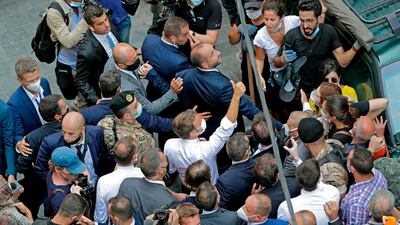
  • A Lebanese youth hugs French President Emmanuel Macron during a visit to the Gemmayzeh neighbourhood, which has suffered extensive damage due to a massive explosion in the Lebanese capital. AFP
    A Lebanese youth hugs French President Emmanuel Macron during a visit to the Gemmayzeh neighbourhood, which has suffered extensive damage due to a massive explosion in the Lebanese capital. AFP
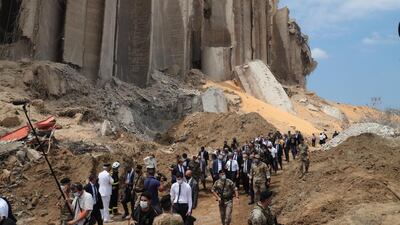
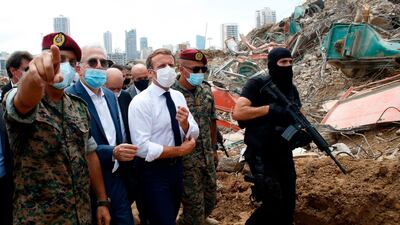
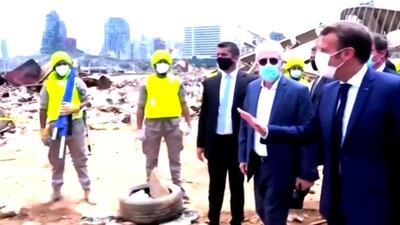
  • French President Emmanuel Macron (C) visiting the devastated site of the explosion at the port of Beirut, Lebanon. Macron arrived to Lebanon to show support after a massive explosion on 04 August
    French President Emmanuel Macron (C) visiting the devastated site of the explosion at the port of Beirut, Lebanon. Macron arrived to Lebanon to show support after a massive explosion on 04 August
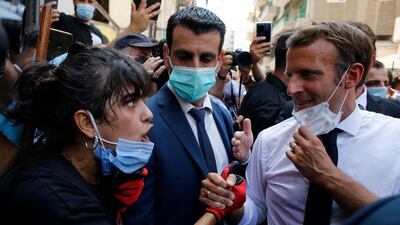
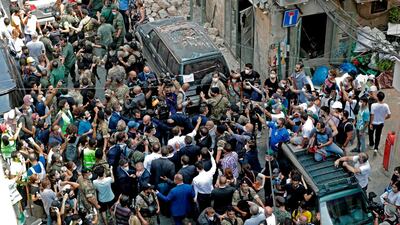
  • French President Emmanuel Macron listens to a resident as he visits a devastated street of Beirut. AP Photo
    French President Emmanuel Macron listens to a resident as he visits a devastated street of Beirut. AP Photo
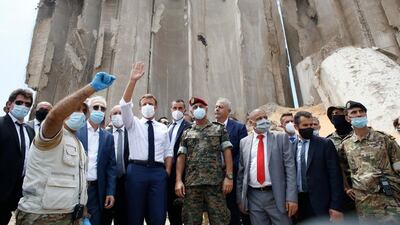
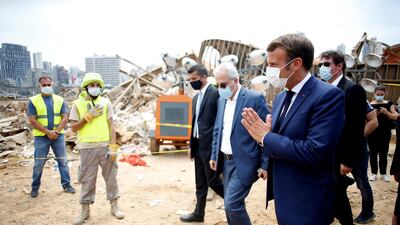
  • French President Emmanuel Macron gestures as he visits the devastated site of the explosion at the port of Beirut. EPA
    French President Emmanuel Macron gestures as he visits the devastated site of the explosion at the port of Beirut. EPA
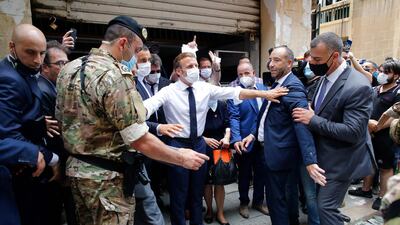
  • French President Emmanuel Macron gestures as he visits a devastated street of Beirut. AFP
    French President Emmanuel Macron gestures as he visits a devastated street of Beirut. AFP
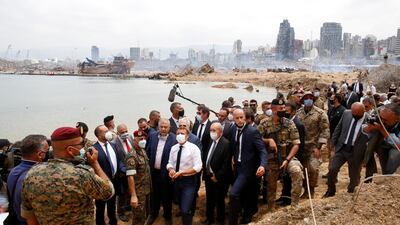
  • French President Emmanuel Macron surrounded by Lebanese servicemen, visits the devastated site of the explosion at the port of Beirut. AFP
    French President Emmanuel Macron surrounded by Lebanese servicemen, visits the devastated site of the explosion at the port of Beirut. AFP
  • French President Emmanuel Macron, speaks with a woman as he visits the Gemayzeh neighborhood, which suffered extensive damage from an explosion on Tuesday. AP Photo
    French President Emmanuel Macron, speaks with a woman as he visits the Gemayzeh neighborhood, which suffered extensive damage from an explosion on Tuesday. AP Photo
  • French President Emmanuel Macron visits the Gemayzeh neighborhood, which suffered extensive damage from an explosion on Tuesday that hit the seaport of Beirut. AP Photo
    French President Emmanuel Macron visits the Gemayzeh neighborhood, which suffered extensive damage from an explosion on Tuesday that hit the seaport of Beirut. AP Photo
  • French President Emmanuel Macron gestures as he arrives at the devastated site of the explosion at the port of Beirut. REUTERS
    French President Emmanuel Macron gestures as he arrives at the devastated site of the explosion at the port of Beirut. REUTERS
  • French President Emmanuel Macron visits the devastated site of the explosion at the port of Beirut. REUTERS
    French President Emmanuel Macron visits the devastated site of the explosion at the port of Beirut. REUTERS
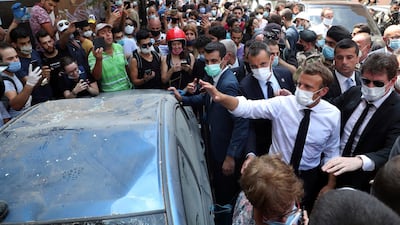
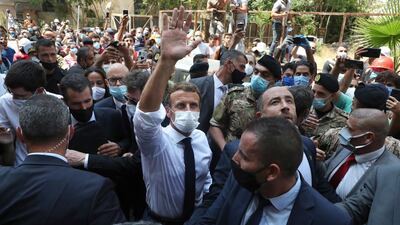
  • French President Emmanuel Macron greets people during a visit to the Gemmayzeh neighbourhood, which has suffered extensive damage due to a massive explosion in the Lebanese capital. AFP
    French President Emmanuel Macron greets people during a visit to the Gemmayzeh neighbourhood, which has suffered extensive damage due to a massive explosion in the Lebanese capital. AFP
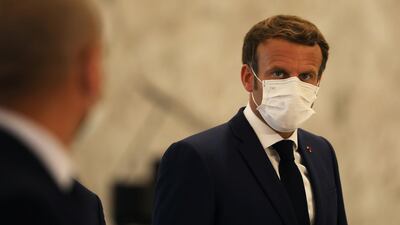
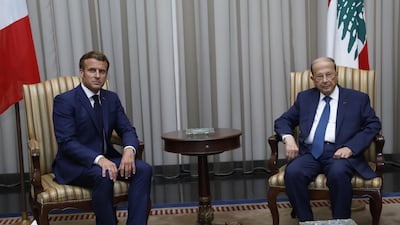
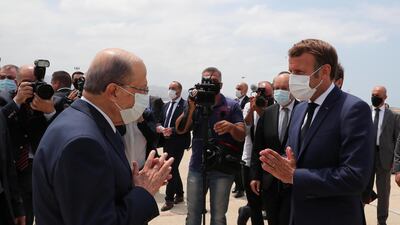
  • French President Emmanuel Macron wears a protective face mask as he meets Lebanon's President Michel Aoun following Tuesday's blast in Beirut's port area, at the presidential palace in Baabda, Lebanon. Reuters
    French President Emmanuel Macron wears a protective face mask as he meets Lebanon's President Michel Aoun following Tuesday's blast in Beirut's port area, at the presidential palace in Baabda, Lebanon. Reuters
  • French President Emmanuel Macron greets people during a visit to the Gemmayzeh neighbourhood, which has suffered extensive damage due to a massive explosion in the Lebanese capital, on August 6, 2020. French President Emmanuel Macron visited shell-shocked Beirut, pledging support and urging change after a massive explosion devastated the Lebanese capital in a disaster that has sparked grief and fury. / AFP / ANWAR AMRO
    French President Emmanuel Macron greets people during a visit to the Gemmayzeh neighbourhood, which has suffered extensive damage due to a massive explosion in the Lebanese capital, on August 6, 2020. French President Emmanuel Macron visited shell-shocked Beirut, pledging support and urging change after a massive explosion devastated the Lebanese capital in a disaster that has sparked grief and fury. / AFP / ANWAR AMRO
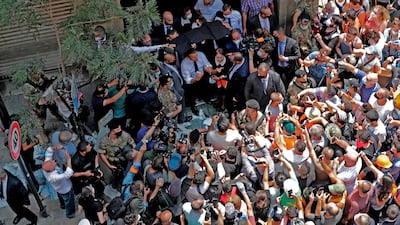
  • French President Emmanuel Macron speaks to the crowd during a visit to the Gemmayzeh neighbourhood, which has suffered extensive damage due to a massive explosion in the Lebanese capital, on August 6, 2020. French President Emmanuel Macron visited shell-shocked Beirut, pledging support and urging change after a massive explosion devastated the Lebanese capital in a disaster that has sparked grief and fury. / AFP / ANWAR AMRO
    French President Emmanuel Macron speaks to the crowd during a visit to the Gemmayzeh neighbourhood, which has suffered extensive damage due to a massive explosion in the Lebanese capital, on August 6, 2020. French President Emmanuel Macron visited shell-shocked Beirut, pledging support and urging change after a massive explosion devastated the Lebanese capital in a disaster that has sparked grief and fury. / AFP / ANWAR AMRO
  • French President Emmanuel Macron, center, gestures as he visits the Gemayzeh neighborhood, which suffered extensive damage from an explosion on Tuesday that hit the seaport of Beirut, Lebanon, Thursday, Aug. 6, 2020. (AP Photo/Bilal Hussein)
    French President Emmanuel Macron, center, gestures as he visits the Gemayzeh neighborhood, which suffered extensive damage from an explosion on Tuesday that hit the seaport of Beirut, Lebanon, Thursday, Aug. 6, 2020. (AP Photo/Bilal Hussein)
  • French President Emmanuel Macron gestures as he visits a devastated street of Beirut, Lebanon, on August 6, 2020 a day after a massive explosion devastated the Lebanese capital in a disaster that has sparked grief and fury. French President Emmanuel Macron visited shell-shocked Beirut Thursday, pledging support and urging change after a massive explosion devastated the Lebanese capital in a disaster that has sparked grief and fury. / AFP / POOL / Thibault Camus
    French President Emmanuel Macron gestures as he visits a devastated street of Beirut, Lebanon, on August 6, 2020 a day after a massive explosion devastated the Lebanese capital in a disaster that has sparked grief and fury. French President Emmanuel Macron visited shell-shocked Beirut Thursday, pledging support and urging change after a massive explosion devastated the Lebanese capital in a disaster that has sparked grief and fury. / AFP / POOL / Thibault Camus
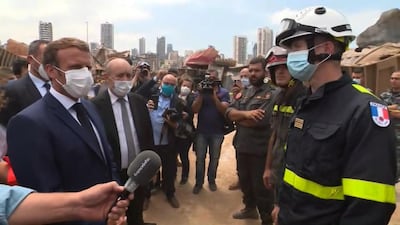
  • A video grab shows French President Emmmanuel Macron, left, speaking with a member of a French rescue team which arrived overnight to support relief efforts at the port of Lebanon's capital Beirut. AFP
    A video grab shows French President Emmmanuel Macron, left, speaking with a member of a French rescue team which arrived overnight to support relief efforts at the port of Lebanon's capital Beirut. AFP
  • French President Emmanuel Macron visits the site of Tuesday's blast in Beirut. Tele Liban / Reuters
    French President Emmanuel Macron visits the site of Tuesday's blast in Beirut. Tele Liban / Reuters
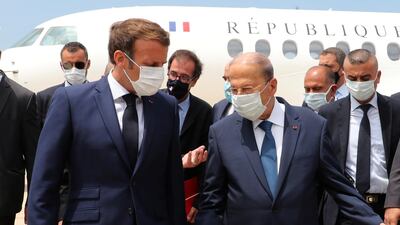
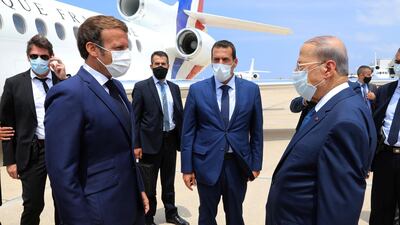
  • Lebanon's President Michel Aoun meets French President Emmanuel Macron on his arrival at the airport in Beirut. Dalati Nohra/Reuters
    Lebanon's President Michel Aoun meets French President Emmanuel Macron on his arrival at the airport in Beirut. Dalati Nohra/Reuters
  • Lebanon's President Michel Aoun welcomes French President Emmanuel Macron on his arrival at the airport in Beirut. Dalati Nohra/Reuters
    Lebanon's President Michel Aoun welcomes French President Emmanuel Macron on his arrival at the airport in Beirut. Dalati Nohra/Reuters
  • "Lebanon is not alone," Mr Macron tweeted shortly after landing. Dalati Nohra/Reuters
    "Lebanon is not alone," Mr Macron tweeted shortly after landing. Dalati Nohra/Reuters
  • The French president is the first foreign leader to visit the Lebanese capital since an explosion on Tuesday killed at least 137 people. Dalati Nohra / Reuters
    The French president is the first foreign leader to visit the Lebanese capital since an explosion on Tuesday killed at least 137 people. Dalati Nohra / Reuters
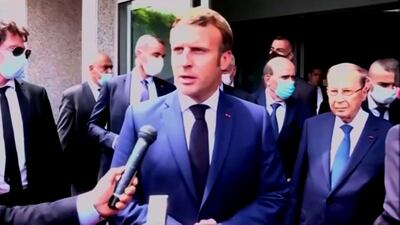
  • Mr Macron said Lebanon was facing a political and economic crisis, and that it would continue to suffer unless it enacted reforms. Reuters
    Mr Macron said Lebanon was facing a political and economic crisis, and that it would continue to suffer unless it enacted reforms. Reuters

Malte Gaier, head of the Konrad Adenauer Foundation in Beirut, said “there is still the tendency among Lebanese political leaders to overestimate the importance of Lebanon”, despite the high-profile diplomacy of Mr Macron.

Mr Gaier said “from a German and a European point of view it could become increasing problematic” to support a government whose security forces use violence against civilians, pointing out that most emergency aid from Europe after the port explosion went to grass-root organisations.

The politicians have made it clear that they are playing the long game, waiting for France and other European countries to budge and deal with them again, even if the economy and society further deteriorate.

Former Lebanese parliamentarian Ghassan Moukheiber said although the politicians the uprising wants removed have coalesced, they face limits in their strategy to resist the pressure.

The real impact of the uprising will be if alternative voices are heard within parliament

Mr Moukheiber, who has a law degree from Harvard, painted a possible doomsday scenario.

He told The National that with "the breakdown of everything at the same time" a plethora of armed groups could form, and that although Hezbollah has the most fire power, many Lebanese have individual weapons.

In this case, Hezbollah would be “on top of the magma of armed groups” amid a chaos “beyond the capacity of anyone to know the result”.

But the veteran lawyer also sees possibility for positive political developments, mainly consisting of a new government implementing gradual reforms and representatives of the protest movement scoring significant wins in the next parliamentary elections, due in 2022.

“They will have to get better organised and play the technical game of elections. The real impact of the uprising will be if alternative voices are heard within parliament,” Mr Moukheiber said.

Mr Moukheiber participated in civilian efforts to safeguard Lebanon’s environment after the civil war, undermined by a political class he sees as “having reached the extreme limits of its survival”.

Lebanese President Michel Aoun, left, and Parliament speaker Nabih Berri, centre, with then prime minister Saad Hariri at the presidential palace in November 2017. AFP Photo

Throughout history, invaders were so awestruck by the intense beauty of the Lebanese landscape that they left inscriptions commemorating their feat on a rocky bridgehead at the mouth of Nahr Al Kalb (Dog River) north of Beirut.

The stelae of Nahr Al Kalb bear the names of ancient Egyptian, Assyrian, Babylonian and later Mamlouk and Western commanders. Nondescript modern buildings encroach on the site, and part of the rubbish-strewn hill was blown away to expand the “highway of death”, the main road along the sea linking Beirut to the north.

There are no plaques by those who conquered Lebanon from within.