

“How did we fall apart this fast?” Ali Baroudi wondered aloud, reflecting on the crises that have befallen Lebanon in the year since huge anti-government protests swept the country.
Mr Baroudi, 29, a wine importer turned political activist. is speaking in the small garden of his father’s flat in an upscale neighbourhood of Beirut.
The building’s high glass doors and windows were blown out by the August 4 explosion at the city’s port that devastated large areas of the capital, killing at least 190 people and wounding thousands.
In the days and weeks after the blast, he was one of the many volunteers who drove victims to hospital, shovelled rubble off the streets and helped to organise food donations.
Mr Baroudi and his friends could respond quickly to the disaster because they were part of a solidarity network that had been a year in the making, born from the protests that took the country by surprise on October 17, 2019.

What was initially a small group of protesters who bonded over similar goals, such as ending sectarianism and increasing social rights, evolved into a youth-led political movement with 110 members.
Its name, Mintashreen, is a play on words. It means both “from October” and “spreading out” in Arabic. It hopes to launch officially in coming months.
“After October 17, I got to meet fantastic people," Mr Baroudi said. "I realised I was not an alien in my country. So many young people are fighting for our rights."
The protests were attended largely by young, middle-class Lebanese calling for change after decades of mismanagement by a sectarian political elite that has held power since the end of the 15-year civil war in 1990.
A year later, many have been discouraged by the lack of results. But others, such as Mr Baroudi, have committed themselves to political change, with an eye on the 2022 parliamentary and municipal elections.
They hope that the protests were a first step towards a change in mindset, and that a significant number of Lebanese will stop voting for the traditional, sectarian-based political parties.
-
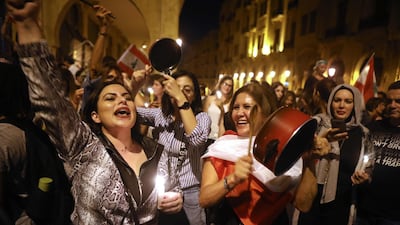
Lebanese anti-government protesters bang on pots and pans during a demonstration in the capital Beirut. AFP -
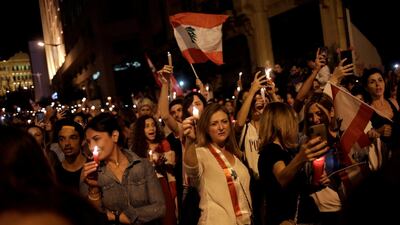
Women carry candles and Lebanese flags as they march during ongoing anti-government protests in Beirut, Lebanon. Reuters -

A woman uses a mobile phone as she takes part in a march during ongoing anti-government protests in Beirut, Lebanon. Reuters -

Lebanese women lit candles in support of the anti-government protests at the Martyrs' square in Beirut, Lebanon. EPA -
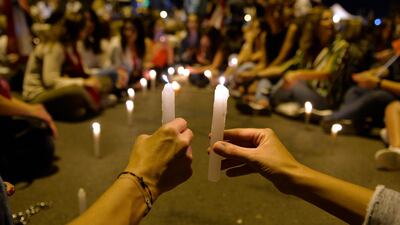
Lebanese women lit candles in support of the anti-government protests at Martyrs' square in Beirut, Lebanon. EPA -
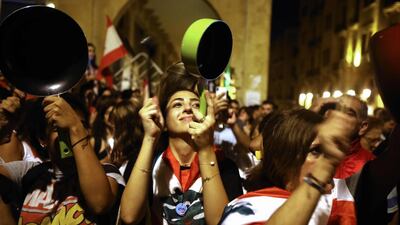
Lebanese protesters bang on pots and pans during an anti-government demonstration in the capital Beirut. AFP -
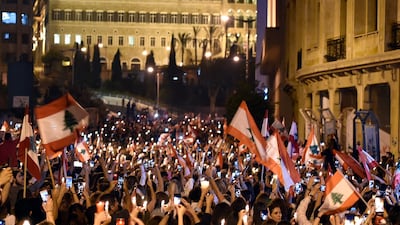
Lebanese women carry national flags and lighted candles in support of the anti-government protests, in front of the Lebanese Government palace in downtown Beirut, Lebanon. EPA -
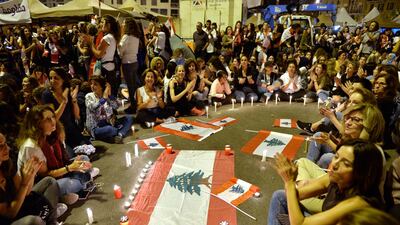
Lebanese women lit candles in support of the anti-government protests at the Martyrs' square in Beirut, Lebanon. EPA -

Lebanese women lit candles in support of the anti-government protests at the Martyrs' square in Beirut, Lebanon. EPA -
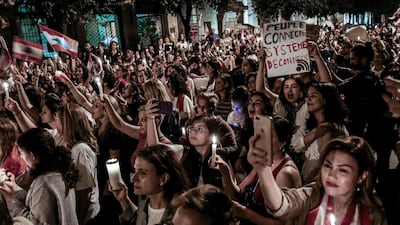
Lebanese women light candles in support of the anti-government protests at Martyrs' square in Beirut, Lebanon. EPA -

Lebanese women light candles in support for the anti-government protests at Martyrs' square in Beirut, Lebanon. EPA -
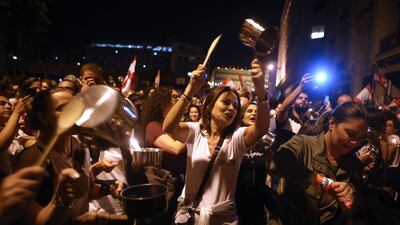
Lebanese protesters bang on pots and pans during an anti-government demonstration in the capital Beirut. AFP


"I think the Lebanese are in doubt of their political leaders but they're still afraid of coming out of the closet because there is no clear alternative yet," Mr Baroudi said.
“These political parties are perceived by the people as the only safety net available."
Since its independence in 1943, Lebanon has been governed by a consensus-based, sectarian power-sharing system.
Political parties, which represent the country's various religious groups, rarely campaign on socio-economic programmes. They thrive on sectarian fears and a weak state.
But changing old mentalities while addressing the country's current problems is a huge task.
Lebanon’s economy is in freefall, with soaring inflation and poverty rates.
The same old political elite remained in power and has refused so far to implement reforms that would unlock international aid.
Young Lebanese are seeking to leave the country in even greater numbers to find work or study abroad.
But that is not a solution for Mr Baroudi.
“If you are educated to the point where you realise there is a better world out there, then you may leave Lebanon, but that perpetuates the never-ending cycle of political stagnation,” he said.
Feyrouz Abou Hassan, 28, an actress, poured her heart and soul into the first few weeks of the protests and her giant flag became a fixture of the demonstrations in central Beirut.
But today she finds it difficult to muster the same passion as she prepares to commemorate the first anniversary of the protests.
“I wish I could be as enthusiastic as at the beginning but the gut feeling is not there any more,” Ms Abou Hassan said.

She knows the exact moment she lost hope. It was three days after the explosion at the port, as thousands were protesting in downtown Beirut.
“A soldier aimed his weapon to my face,” Ms Abou Hassan said. “I’m peaceful. I walk with my flag all the time. Everybody knows me. I was like, ‘No, I’m not willing to die’.
“Something good needs to happen to make me enthusiastic again."
But with Lebanon’s continuing social and economic collapse, nobody knows exactly what that could be.
“Us people on the street, we were not trained to go down and beat the system,” said Perla Joe Maalouli, 28, another prominent participant in the first weeks of protest.
The artist rode her bicycle from protest to protest and was active in galvanising others. Mintashreen members still remember how she organised their first informal meeting.
“Honestly, there were points when we felt that victory was so close, but we forgot that this all related to huge networks of interests that we don’t even know about,” Ms Maalouli said.

Exactly 13 days after protests started, Prime Minister Saad Hariri resigned.
Many hoped this would lead to powerful former warlords such as President Michel Aoun and parliamentary Speaker Nabih Berri also stepping down.
That never happened and the situation grew worse. Confrontations between protesters and security troops became increasingly violent.
In late February, the coronavirus pandemic hit, dealing another blow to the economy.
The government of prime minister Hassan Diab resigned soon after the port blast and the diplomat Mustapha Adib was appointed prime minister designate.
When he stepped down after three weeks because of political infighting, Mr Hariri announced that he was willing to assume the post.
“We’re back at the same point where we started,” said Ms Maalouli. “We started this revolution by bringing down Hariri and now he’s coming back.”
She pulled back several months into protests, after local media accused her of collaborating with Israel.
Security forces questioned her because of an old tweet she had sent in response to one from an Israeli news platform about guns being smuggled from Lebanon to Israel.
“I commented by saying that 'Some people don’t want your planes on top of their head, and some people don’t want weapons to be smuggled. Some of us just want to live in peace and prosperity',” Ms Maalouli said.
Security forces tried to imply that she had links with Israel – a serious offence in Lebanon.
One of Lebanon’s most powerful parties, the Iran-backed Hezbollah, fought a war with Israel in 2006, which is technically still going.
Such accusations are a common tactic to silence activists and journalists, and the consequences can be disastrous.
Comedian Ziad Itani was arrested and tortured in 2018 on charges of spying for Israel, before he was exonerated and released five months later.
He has never received a public apology. Those responsible for his torture were never arrested and recently filed a lawsuit against him for defamation.
“I was in a march with university students when I received the call from the military calling me in,” Ms Maalouli said.
“I started shaking. The plots they can create are scary. They can put my life at risk.”
But she will be back in the streets to celebrate October 17.
“I just won’t be screaming my lungs out like before,” she said. “I want to maintain my well-being.”

Other familiar figures from the start of the protests will not be there. Taymour Jreissati, 33, moved to France six days before the August 4 explosion at the port.
There were many reasons for his departure. His company, which produces furniture, needed to expand its client base because of the economic collapse in Lebanon.
Mr Jreissati was also worried about the safety of his two young children.
And he received threats from Hezbollah and its local ally Amal, also backed by Iran, which both publicly accused protesters of being manipulated by "foreign embassies".
Mr Jreissati was also harassed by the security forces, who told him they were tired of his activism, while party members called him with death threats.
“They said, 'We know where you live',” he said.
Mr Jreissati does not know when he will return to Lebanon.
“I didn’t give up. But there’s a lot of disappointment,” he said.

