
When Lebanon was swept by protests on October 17, 2019, Melissa Fathallah had been unemployed for exactly a week.
With no idea what to do next, the 42-year-old former wedding planner began volunteering alongside thousands of others to help extinguish uncontrollable bushfires that destroyed over 1,000 hectares of forest in Lebanon that month.
As the fires raged, Lebanon’s three firefighting helicopters remained grounded due to lack of upkeep, causing an outcry. Local politicians were already deeply unpopular for their inability to tackle the looming financial crisis and now huge swathes of the countryside were burning.
On October 17, one minister’s proposal to tax WhatsApp calls was the last straw. Hundreds of thousands of Lebanese took to the streets in protest.
Ms Fathallah was one of them. She has not stopped protesting since.
What became known as the "October revolution" changed her life by giving her a renewed sense of purpose.
-
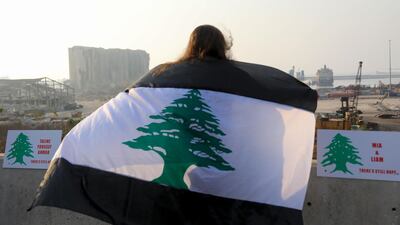
A woman, draped in a black-striped Lebanese flag, looks at the site of the massive explosion at Beirut's port area, during a demonstration to mark one month since the cataclysmic August 4 explosion that killed 191 people, in the Lebanese capital Beirut. AFP -
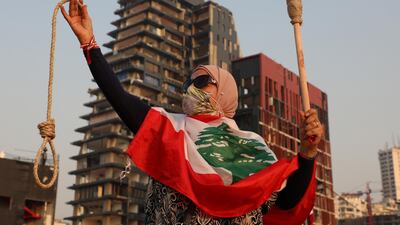
A woman holds a noose as she observes a minute of silence to mark one month since the massive explosion at Beirut's port area. Reuters -
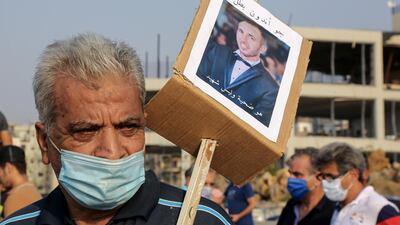
Families of Beirut port explosion victims carry their pictures during a minute of silence and prayer to mark one month of Beirut port explosion. EPA -
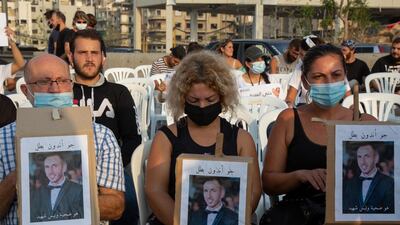
Families of Beirut port explosion victims carry their pictures during a minute of silence and prayer to mark one month of Beirut port explosion. EPA -
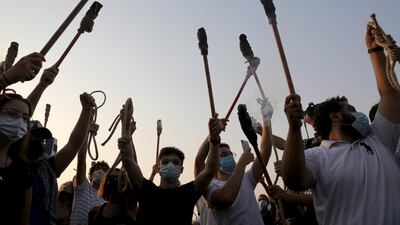
Protesters carry torches and hangman noose as they demand the punishment of those responsible for the port explosion during a moment of silence to mark one month of Beirut port explosion. EPA -
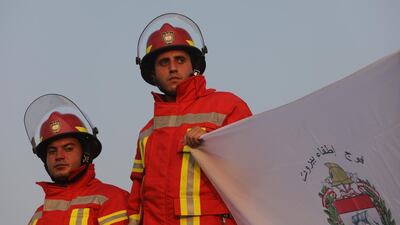
Firefighters hold a flag as they commemorate a month since Beirut's deadly explosion. Getty Images -
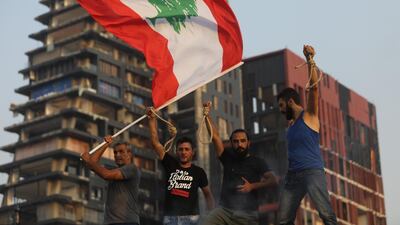
Protesters wave a Lebanese flag and hold nooses, which have become symbols of public anger against the Lebanese government, as they commemorate a month since the city's deadly explosion. Getty Images -
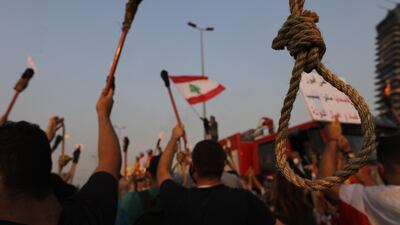
Protesters hold torches and nooses as they commemorate a month since the city's deadly explosion. Getty Images -
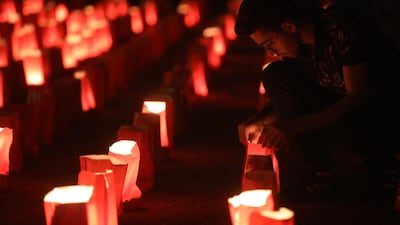
Paper lanterns in the shape of a Lebanese flag mark one month since the city's deadly explosion. Getty Images -
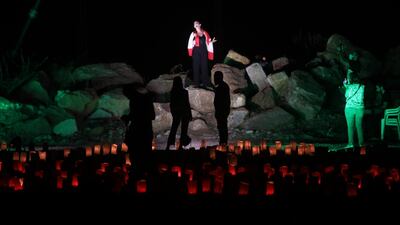
A woman sings on a pile of rubble near paper lanterns arranged in the shape of a Lebanese flag to mark one month since the city's deadly explosion. Getty Images -

Families of Beirut port explosion victims carry their pictures during a minute of silence and prayer to mark one month of Beirut port explosion. EPA


During the first few months of demonstrations, she was on the ground every day, yelling at soldiers and riot police when they beat up protesters. When the coronavirus pandemic hit Lebanon in late February, she diverted her energy towards supporting medical workers. As the country sank deeper into poverty, she participated, with other activists, in distributing food boxes.
“I’m finally doing something I want to do. I’m putting my expertise into something more beneficial, as opposed to just doing pretty weddings. I’m putting my skills that I’ve had to use for 28 years for hospitality, planning and organising into rebuilding a country,” she said.
Last September, Ms Fathallah garnered media attention for supporting the rescue efforts of a Chilean team as they dug through rubble in search of a survivor, one month after a deadly blast at Beirut port that killed at least 191 people.
CNN correspondent Tamara Qiblawi tweeted a picture of the moment Ms Fathallah, wearing a hard hat and holding her mobile phone in one hand with her other arm in a cast, called a crane owner with a determined look on her face. Dozens of activists watching the search were demanding that it continue despite the army saying late in the evening that they had to stop for the night because they could not locate a crane.
The tweet went viral, an illustration of the widely held belief that the Lebanese can only count on themselves and not on their government.
In the end, the Chilean team did not find anyone. But Ms Fathallah remained upbeat, telling The National at the time that one positive outcome from the search would be that the collapsed building, which was in danger of collapsing further, would at least be cleared.
Today, Ms Fathallah is a busy woman who is currently in the process of visiting over 700 apartments fixed by the NGO she co-founded, Baytna Baytak, after the blast.
“I don’t like this popularity thing, I just want to do my work,” she said last week, sitting in a warehouse that has been converted into an office and a food donation storage area in the badly damaged neighbourhood of Gemmayze.

Pinning her down is not easy. “She could be there, she could be elsewhere,” answered an acquaintance standing in the street below when asked where Ms Fathallah was. “It’s Melissa,” she added with a shrug.
Ms Fathallah's list of demands is long and ranges from 24/7 electricity to gender equality and the transition from Lebanon’s sectarian power-sharing system to a civil state – things she describes as "basic".
“I can’t believe I’m asking for what I want because it’s something I should have,” she said.
The first time Ms Fathallah's picture appeared in a newspaper, she was 18 years old and protesting in downtown Beirut. An Israeli airstrike in the southern town of Qana had just killed dozens of civilians, including many children, causing a furore Lebanon.
In the Fathallah family, politics is a family affair.
Like most Lebanese of his generation, the life of Melissa's late father Moustafa, as well as that of his children, was shaped by the 1975-1990 civil war.
Shortly after fighting started, Moustafa Fathallah, aged 25 at the time, joined Palestinian party Fatah and then-Nasserite movement Al Mourabitoune. They threatened to kill him when he left them in 1980, so the family moved to Saudi Arabia while Ms Fathallah was still a toddler. In 1991, the family of five returned before moving to the United States for more than a decade a few years later.
“Before he died, we had a very long conversation. He asked me to never be involved in that [politics]. He told me that if I was ever involved in anything, it better be something for the better of the country,” said Ms Fathallah, who moved back to Lebanon in 2009 and holds both Lebanese and American citizenship.
She showed a sepia-tinted picture on her phone of her father, who is carrying what looks like a Kalashnikov in one hand and Ms Fathallah as a two-year-old child in the other. “I’m counting the bullets,” she pointed out.
Asked if she saw herself taking on a political role in the parliamentary and municipal elections scheduled for 2022, Ms Fathallah marked a short pause. “You know? Yes. But not politics, politics. Because I don’t understand politics,” she answered. “Like, minister of social affairs. And if I’m feeling really ambitious, I want to be minister of labour.”
Why not prime minister? By tradition, Lebanon's premier is always Sunni Muslim, like Ms Fathallah. "Oh no, that's getting deleted. All this hierarchy of religions, that's no longer going to exist," she responded dismissively. Mixing Arabic and English, she added: "If the government is still sectarian, Maronite and Shiite … then, khalas [stop]. No."

