
Iran surpassed 20,000 confirmed deaths from the coronavirus on Wednesday, the health ministry said – the highest death toll for any Middle East country so far in the pandemic.
The announcement came as the Islamic Republic, which has been struggling with both the region’s largest outbreak and the highest number of fatalities, went ahead with university entrance exams for over one million students. Iran is also preparing for mass Shiite commemorations later this month.
Iran suffered the region’s first major outbreak, seeing top politicians, health officials and religious leaders in its Shiite theocracy stricken with the virus. It has since struggled to contain the spread of the virus across this nation of 80 million people, initially beating it back only to see it spike again beginning in June.
Still, international experts remain suspicious of Iran’s case counts. Even researchers in the Iranian parliament in April suggested the death toll is likely nearly double the officially reported figures, due to undercounting and because not everyone with breathing problems has been tested for the virus.
Iran reported its first coronavirus cases and deaths on the same day in February – the Mideast’s first outbreak of the virus – yet it only saw its highest single-day spike in reported cases in June. The highest daily death toll was reported in July.
-

Florists at Florette prepare flowers and bouquets for delivery with Covid-19 prevention measures in place, Dubai. Chris Whiteoak / The National -

Florists at Florette prepare flowers and bouquets for delivery with Covid-19 prevention measures in place, Dubai. Chris Whiteoak / The National -

People wearing protective masks wait to board a bus at a station in Kuwait City, as businesses such as barbershops, beauty salons, gyms and spas, reopen after a 5-month shutdown due to the spread of the novel coronavirus (COVID-19). AFP -

People have lunch at a restaurant in Kuwait City as businesses such as barbershops, beauty salons, gyms and spas, reopen after a 5-month shutdown due to the spread of the novel coronavirus (COVID-19). AFP -

People get a hair cut in a barber shop following the easing of lockdown restrictions amid the Covid-19 pandemic, in Kuwait, Kuwait City. Kuwait on 18 August began the second phase of resumption to normal life which was disrupted due to coronavirus. EPA -

An empty class room with stickers on chairs reading "leave this chair empty please for your safety" at Cankaya primary school, in Ankara. Students will return to classrooms in Turkey in late September, nearly a month after the start of the new academic year, the government announced on August 12, as daily coronavirus cases remain above 1,000. AFP -

A child wearing a face mask runs at the school playground at Cankaya primary school, on August 18, 2020, in Ankara. AFP -

Palestinian cooks prepare food at a restaurant's kitchen to be delivered to a centre where people returning from Israel and Egypt are quarantined as a precaution against the COVID-19 coronavirus pandemic, in Gaza City. AFP -

Palestinian cooks and other staff members prepare food at a restaurant's kitchen to be delivered to a centre where people returning from Israel and Egypt are quarantined as a precaution against the COVID-19 coronavirus pandemic, in Gaza City. AFP -

An Iraqi carpenter wears a protective mask, following the outbreak of the coronavirus disease (COVID-19), as he works at his shop in Mosul, Iraq. REUTERS -
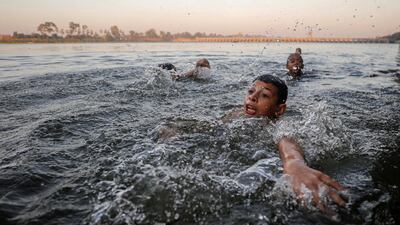
Boys swim in the river Nile during hot weather on the outskirts of Cairo, following the outbreak of the coronavirus disease (COVID-19), Egypt. REUTERS -

Boys swim in the river Nile during hot weather on the outskirts of Cairo, following the outbreak of the coronavirus disease (COVID-19), Egypt. REUTERS -

Members of Morocco's Interior Ministry Auxiliary Forces patrol a neighbourhood to enforce the reimposed lockdown due to a spike in coronavirus (COVID-19) cases, in the capital Rabat's district of Takadoum. AFP -

A policeman distributes protective masks as a preventive measure against the spread of COVID-19 coronavirus, in the Moroccan city of Marrakesh. AFP -

Students wear masks as they take final school exams amid the ongoing coronavirus pandemic, at a school in Sana'a, Yemen. EPA


In February, before Iran reported its first cases, authorities for days denied the virus had reached the country, allowing the virus time to spread as the nation marked the 41st anniversary of its 1979 Islamic Revolution with mass demonstrations and then held a parliamentary election in which authorities desperately sought to boost turnout.
On Wednesday, Iran reported over 350,200 confirmed cases, with 20,125 deaths, Health Ministry spokeswoman Sima Sadat Lari said.
Meanwhile, some 1.4 million Iranian students began taking their hours-long university entrance exams, which typically see large groups of applicants sitting for the exam in big testing centres. Each applicant usually remains in the testing centre for nearly four hours.
Ali Reza Zali, who is leading the campaign against the pandemic in Tehran, said Iran’s capital still faced the country’s highest level of alert over the virus. Authorities would disinfect testing centres to “guarantee the health of the applicants in the highest level,” he insisted.
Dozens of applicants will have to take the exam from their hospital beds as they have already been sickened by the virus.
Then later this month, Iran will mark the Ashoura, a major Shiite commemoration mourning the 7th century death of Prophet Muhammad’s grandson Hussein, one of Shiite Islam’s most beloved saints.
Nine days before the Ashoura, daily mass processions see men beating their backs with chains or their chests – a symbolic expression of regret for not being able to help Hussein before his martyrdom. Many distribute free food and soft drinks among mourners.
On Monday, a society of clerics said the Ashoura should go on “under any circumstances,” while still demanding that participants follow health guidance measures. However, authorities complain that mask usage and other measures have remained lower than expected, likely due to fatigue among Iranians months into the crisis.
The Iranian Psychiatric Association wrote a letter to Health Minister Saeed Namaki, demanding the “complete ban of any gatherings, especially communal mourning ceremonies” when people mark the Ashoura. It cited near-daily death tolls of 200 from the virus in Iran.
“We are on the verge of a much bigger disaster,” the association warned.

