
Thousands of Indians are rushing to join a volunteer effort to save lives from a devastating wave of coronavirus infections, as a more contagious strain of the virus spreads.
Record rates of infection overwhelmed hospitals, leading to horrific scenes as wards ran out of oxygen and patients died while waiting for assistance.
For more than a week, city after city reported shortages of life-saving medicine and hospital beds as hundreds of patients gasped for breath outside overwhelmed clinics.
Several hospitals across the country had to plead before courts to refill empty oxygen tanks as shortages meant the nation was unable to tackle the devastating second wave of the pandemic.
Some hospitals even sent out SOS alerts on social media platforms, where thousands of desperate families begged for life-saving drugs and hospital beds.
Many were lulled into a false sense of security because at the start of the year, case numbers were seemingly in free fall. But the rate of infection increased sharply last month and continued to rise.
More than 60 patients died this week in Delhi and Mumbai after several hospitals reported a "low pressure" of oxygen at critical care beds.
Hospitals across the country are facing a deluge of patients, with more than two million cases recorded this week as the country's total caseload passed 17 million on Sunday, the second highest after the US.
The country reported nearly 350,000 fresh infection cases on Saturday and 2,761 deaths in the previous 24 hours.
The government is being criticised for being unprepared to deal with the second wave after it declared victory over the pandemic.
That claim was made only a few weeks before a surge in late March.
Many people blamed the government for the deaths and misery during a quickly deteriorating situation.
But amid the gloom and doom, hundreds of social media users, non-profit organisations and community groups are chipping in to tackle the crisis and help distressed families hit by the disease.
These groups are directly providing resources such as money, oxygen cylinders, medical supplies, hospital beds and even food to families and vulnerable patients.
At a high-rise apartment building in Greater Noida, a city on the outskirts of the capital New Delhi, residents formed a "task force" to help Covid-19 patients with oxygen cylinders and pulse oximeters, to keep a check of their oxygen levels.
The task force obtained 10 oxygen cylinders, 10 disposable cardboard beds and oximeters.

The group also checks the availability of beds in hospitals and seeks medical advice from doctors to ease the pressure on anxious family members.
"There are no beds, no oxygen in hospitals. People are dying in our families. We decided to initiate this set up to provide a buffer arrangement to patients for 12 to 18 hours so they can arrange hospital beds in the meantime," Ashish Singh, a member of the task force, told The National.
The residential society has 1,500 members and 138 positive cases of Covid-19 among them.
Mr Singh said at least 15 people were saved because the group had access to oxygen cylinders.
-
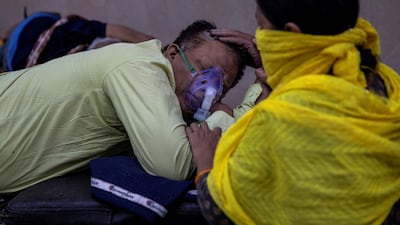
A woman takes care of her husband who has Covid-19 as they wait outside the casualty ward at Guru Teg Bahadur Hospital, in New Delhi, India. Reuters -

Family members mourn after a man is declared dead amid a surge in coronavirus cases in India. Reuters -
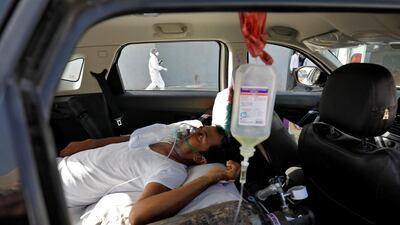
A patient with breathing problems is seen inside a car while waiting to enter a hospital for treatment, amid the spread of the coronavirus in Ahmedabad, India. Reuters -
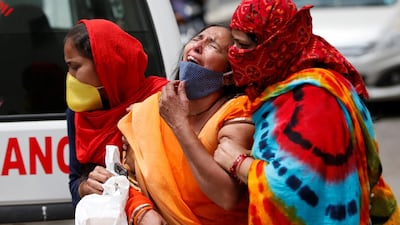
India’s second Covid-19 wave is devastating, with more than new 200,000 coronavirus cases recorded each day. Reuters -
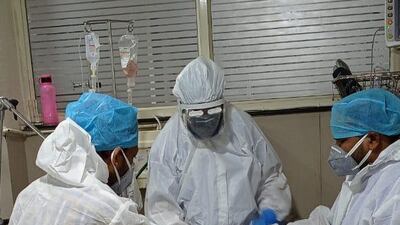
Dr Rajesh Bhagchandani, centre, a director at Apex hospital in Bhopal city, intubates a patient. He feels helpless that the hospital, which is now reserved for critically ill Covid-19 patients, cannot accommodate more people who require oxygen. Dr Rajesh Bhagchandani -
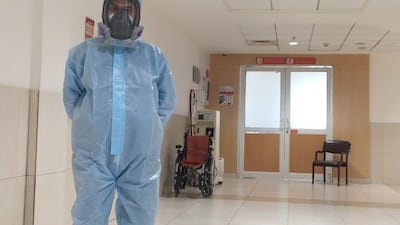
Dr Himanshu Dewan, director of critical care at QRG hospital in Faridabad, a town near India’s capital New Delhi, says the number of deaths will climb because patients do not have access to treatment. Dr Himanshu Dewan -
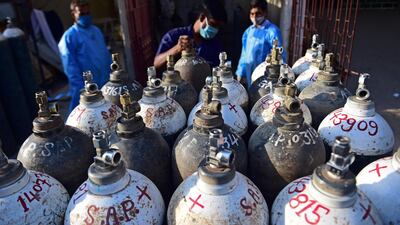
A health worker arranges oxygen cylinders that are being used for Covid-19 coronavirus patients at a private hospital in Allahabad. AFP -

Dr Himanshu Dewan, director of critical care at QRG hospital in Faridabad, a town near India’s capital New Delhi, is acutely aware a patient could die on the road if turned by hospitals that cannot admit more Covid-19 cases . Courtesy: Dr Himanshu Dewan -
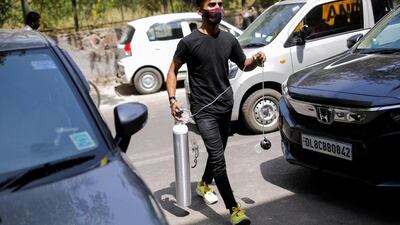
A man carries an empty oxygen cylinder to get it refilled at a private refilling station, for his relative who is suffering from the coronavirus disease, in New Delhi. Reuters -
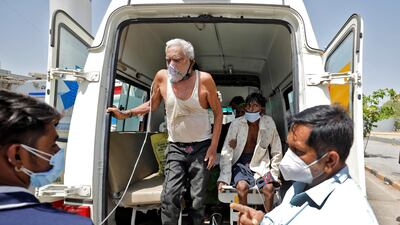
Patients with breathing problems are seen inside an ambulance waiting to enter a Covid-19 hospital for treatment in Ahmedabad. Reuters -

A health worker collects a nasal swab sample from a woman in Amritsar. AFP -
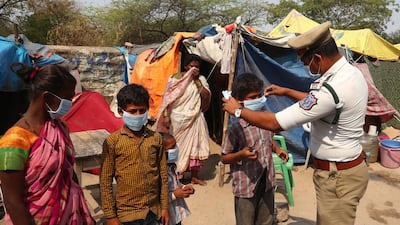
An Indian police officer distributes face masks in Hyderabad. AP Photo -
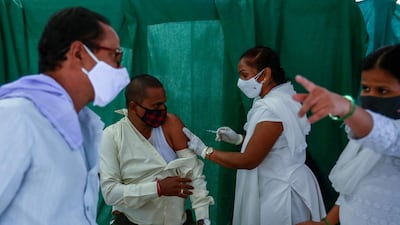
A health worker administers the Covidshield vaccine at a government hospital in Hyderabad. AP Photo -

People wearing masks wait to test for Covid-19 at a hospital in Hyderabad. AP Photo -

A health worker takes a mouth swab sample at a hospital in Hyderabad. AP Photo -
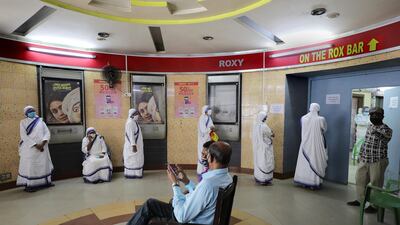
Nuns wait to take a test for Covid-19 at a test center in Kolkata, Eastern India. EPA


In Ghaziabad, a city in Uttar Pradesh, a Sikh temple opened to provide oxygen to Covid-19 patients whose saturation levels dropped significantly.
They are assured help until they can secure a hospital bed.
The Shri Guru Singh Sabha Gurudwara joined forces with a NGO, Khalsa Help International, and has helped to save 700 people so far. The temple offers testing facilities and provides medicine.
"We opened just three days ago but we are receiving anywhere between 250 to 300 patients a day, some come with oxygen saturation levels as low as 40," Inderjeet Singh, who is in charge of the temple, told The National.
“We had to start the service because the administration has been unable to do anything for the citizens and we had to do something."
Several non-profit organisations also offered oxygen to patients.
The Hemkunt Foundation, from Gurgaon, a city south-west of New Delhi, started an oxygen "drive through" at its office.
“We helped an old lady that even the hospital couldn’t help. She came in an ambulance and was given oxygen and taken care of,” the foundation tweeted.
Many people delivered food to Covid-19 patients and healthcare workers free of charge, with several Indian cities under lockdown.
In Ranchi, in eastern Jharkhand state, taxi driver Ravi Aggarwal was taking coronavirus patients to hospitals free of charge.
"I started on April 15 and I receive 50 calls every day, even from far-away places. But I managed to take five patients. So far I have given rides to 22 Covid-19 patients," Ravi Aggarwal, 21, told The National.
“I do not take any money; how can I ask them when they are in actual need?
"I am not afraid of catching the infection, but I take precautions so I don’t infect anyone in my family."

