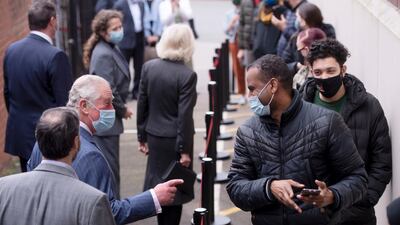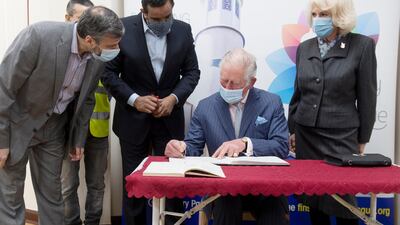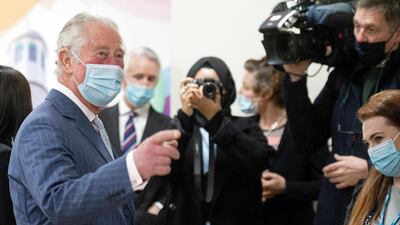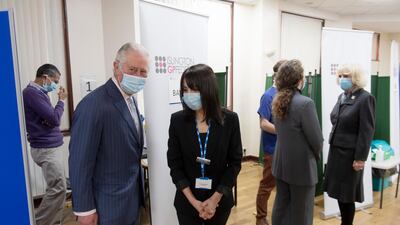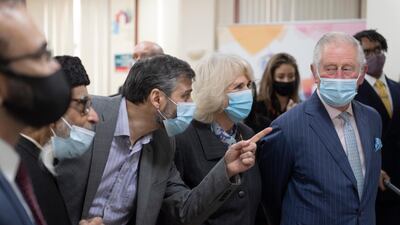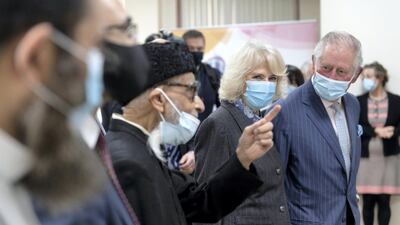
Prince Charles and Camilla visit a pop-up Covid-19 vaccination centre at Finsbury Park Mosque in London. Reuters

Prince Charles visits vaccine centre in London mosque as officials seek to boost uptake


Neil Murphy
  • English
  • Arabic

Prince Charles visited a mosque in London on Tuesday as authorities attempt to boost uptake of the Covid-19 shot among the UK's black and Asian communities.

The heir to the British throne was accompanied by his wife Camilla as they appeared at Finsbury Park Mosque in the north of the capital.

The royal said he was thrilled that his father Prince Philip was back at his Windsor Castle home after a month-long stay in hospital.

"Very good news, I'm thrilled about it. I've spoken to him – several times," he said.

  • Prince Charles speaks to a member of the public during a visit to a vaccination pop-up centre at Finsbury Park Mosque in north London. AP Photo
    Prince Charles speaks to a member of the public during a visit to a vaccination pop-up centre at Finsbury Park Mosque in north London. AP Photo
  • Prince Charles was accompanied by his wife Camilla as they appeared at Finsbury Park Mosque. Getty Images
    Prince Charles was accompanied by his wife Camilla as they appeared at Finsbury Park Mosque. Getty Images
  • Prince Charles tours the vaccination centre at Finsbury Park Mosque. AFP
    Prince Charles tours the vaccination centre at Finsbury Park Mosque. AFP
  • Camilla speaks to people as she is shown around the vaccination centre. AFP
    Camilla speaks to people as she is shown around the vaccination centre. AFP
  • Prince Charles said he was thrilled that his father Prince Philip was back at his Windsor Castle home after a month-long stay in hospital. Getty Images
    Prince Charles said he was thrilled that his father Prince Philip was back at his Windsor Castle home after a month-long stay in hospital. Getty Images
  • Prince Charles and Camilla during the visit. Getty Images
    Prince Charles and Camilla during the visit. Getty Images

During the visit, Camilla said she received the shot made by AstraZeneca when she had her first vaccine dose, and had not been concerned whether she received that or another shot made by Pfizer-BioNTech.

"I don't even ask because I hate injections so much that I shut my eyes ... so whatever comes out," said the duchess, who was vaccinated along with her 72-year-old husband last month.

Philip, 99, the husband of Queen Elizabeth II, left a London hospital on Tuesday after a four-week stay for treatment for an infection and to undergo heart surgery.

The Duke of Edinburgh was admitted to the private King Edward VII's Hospital on February 16 after he felt unwell and was given treatment for an unspecified illness.

Buckingham Palace issued a statement in which the duke thanked the medical staff and all those who had sent their good wishes. A royal source said he was in good spirits.

On Tuesday it was revealed that Prince Charles and Prince William spoke to Prince Harry for the first time since his bombshell TV interview earlier this month.

US breakfast show host Gayle King said she had called the Sussexes and was told Harry spoke to his father, the Prince of Wales, and brother the Duke of Cambridge – but no one has yet spoken to Meghan.

A friend of Meghan claimed initial talks were “not productive”.

King said on CBS This Morning: "I'm not trying to break news, but I did actually call them to see how they were feeling and it's true Harry has talked to his brother and he has talked to his father too.

“The word I was given was that those conversations were not productive, but they are glad that they have at least started a conversation.

“And I think what is still upsetting to them is that the palace keeps saying they want to work it out privately, but yet they believe these false stories are coming out that are very disparaging against Meghan still – no one in the royal family has talked to Meghan yet…”


In%20the%20Land%20of%20Saints%20and%20Sinners
%3Cp%3E%3Cstrong%3EDirector%3A%20%3C%2Fstrong%3ERobert%20Lorenz%3C%2Fp%3E%0A%3Cp%3E%3Cstrong%3EStarring%3A%3C%2Fstrong%3E%20Liam%20Neeson%2C%20Kerry%20Condon%2C%20Jack%20Gleeson%2C%20Ciaran%20Hinds%3C%2Fp%3E%0A%3Cp%3E%3Cstrong%3ERating%3A%20%3C%2Fstrong%3E2%2F5%3C%2Fp%3E%0A
'Ghostbusters: From Beyond'

Director: Jason Reitman

Starring: Paul Rudd, Carrie Coon, Finn Wolfhard, Mckenna Grace

Rating: 2/5

Queen

Nicki Minaj

(Young Money/Cash Money)

Ten tax points to be aware of in 2026

1. Domestic VAT refund amendments: request your refund within five years

If a business does not apply for the refund on time, they lose their credit.

2. E-invoicing in the UAE

Businesses should continue preparing for the implementation of e-invoicing in the UAE, with 2026 a preparation and transition period ahead of phased mandatory adoption. 

3. More tax audits

Tax authorities are increasingly using data already available across multiple filings to identify audit risks. 

4. More beneficial VAT and excise tax penalty regime

Tax disputes are expected to become more frequent and more structured, with clearer administrative objection and appeal processes. The UAE has adopted a new penalty regime for VAT and excise disputes, which now mirrors the penalty regime for corporate tax.

5. Greater emphasis on statutory audit

There is a greater need for the accuracy of financial statements. The International Financial Reporting Standards standards need to be strictly adhered to and, as a result, the quality of the audits will need to increase.

6. Further transfer pricing enforcement

Transfer pricing enforcement, which refers to the practice of establishing prices for internal transactions between related entities, is expected to broaden in scope. The UAE will shortly open the possibility to negotiate advance pricing agreements, or essentially rulings for transfer pricing purposes. 

7. Limited time periods for audits

Recent amendments also introduce a default five-year limitation period for tax audits and assessments, subject to specific statutory exceptions. While the standard audit and assessment period is five years, this may be extended to up to 15 years in cases involving fraud or tax evasion. 

8. Pillar 2 implementation 

Many multinational groups will begin to feel the practical effect of the Domestic Minimum Top-Up Tax (DMTT), the UAE's implementation of the OECD’s global minimum tax under Pillar 2. While the rules apply for financial years starting on or after January 1, 2025, it is 2026 that marks the transition to an operational phase.

9. Reduced compliance obligations for imported goods and services

Businesses that apply the reverse-charge mechanism for VAT purposes in the UAE may benefit from reduced compliance obligations. 

10. Substance and CbC reporting focus

Tax authorities are expected to continue strengthening the enforcement of economic substance and Country-by-Country (CbC) reporting frameworks. In the UAE, these regimes are increasingly being used as risk-assessment tools, providing tax authorities with a comprehensive view of multinational groups’ global footprints and enabling them to assess whether profits are aligned with real economic activity. 

Contributed by Thomas Vanhee and Hend Rashwan, Aurifer

World Cricket League Division 2

In Windhoek, Namibia - Top two teams qualify for the World Cup Qualifier in Zimbabwe, which starts on March 4.

UAE fixtures

Thursday February 8, v Kenya; Friday February 9, v Canada; Sunday February 11, v Nepal; Monday February 12, v Oman; Wednesday February 14, v Namibia; Thursday February 15, final

What is the FNC?

The Federal National Council is one of five federal authorities established by the UAE constitution. It held its first session on December 2, 1972, a year to the day after Federation.
It has 40 members, eight of whom are women. The members represent the UAE population through each of the emirates. Abu Dhabi and Dubai have eight members each, Sharjah and Ras al Khaimah six, and Ajman, Fujairah and Umm Al Quwain have four.
They bring Emirati issues to the council for debate and put those concerns to ministers summoned for questioning. 
The FNC’s main functions include passing, amending or rejecting federal draft laws, discussing international treaties and agreements, and offering recommendations on general subjects raised during sessions.
Federal draft laws must first pass through the FNC for recommendations when members can amend the laws to suit the needs of citizens. The draft laws are then forwarded to the Cabinet for consideration and approval. 
Since 2006, half of the members have been elected by UAE citizens to serve four-year terms and the other half are appointed by the Ruler’s Courts of the seven emirates.
In the 2015 elections, 78 of the 252 candidates were women. Women also represented 48 per cent of all voters and 67 per cent of the voters were under the age of 40.
 

ORDER OF PLAY ON SHOW COURTS

Centre Court - 4pm (UAE)
Gael Monfils (15) v Kyle Edmund
Karolina Pliskova (3) v Magdalena Rybarikova
Dusan Lajovic v Roger Federer (3)

Court 1 - 4pm
Adam Pavlasek v Novak Djokovic (2)
Dominic Thiem (8) v Gilles Simon
Angelique Kerber (1) v Kirsten Flipkens

Court 2 - 2.30pm
Grigor Dimitrov (13) v Marcos Baghdatis
Agnieszka Radwanska (9) v Christina McHale
Milos Raonic (6) v Mikhail Youzhny
Tsvetana Pironkova v Caroline Wozniacki (5)

Mercer, the investment consulting arm of US services company Marsh & McLennan, expects its wealth division to at least double its assets under management (AUM) in the Middle East as wealth in the region continues to grow despite economic headwinds, a company official said.

Mercer Wealth, which globally has $160 billion in AUM, plans to boost its AUM in the region to $2-$3bn in the next 2-3 years from the present $1bn, said Yasir AbuShaban, a Dubai-based principal with Mercer Wealth.

Within the next two to three years, we are looking at reaching $2 to $3 billion as a conservative estimate and we do see an opportunity to do so,” said Mr AbuShaban.

Mercer does not directly make investments, but allocates clients’ money they have discretion to, to professional asset managers. They also provide advice to clients.

“We have buying power. We can negotiate on their (client’s) behalf with asset managers to provide them lower fees than they otherwise would have to get on their own,” he added.

Mercer Wealth’s clients include sovereign wealth funds, family offices, and insurance companies among others.

From its office in Dubai, Mercer also looks after Africa, India and Turkey, where they also see opportunity for growth.

Wealth creation in Middle East and Africa (MEA) grew 8.5 per cent to $8.1 trillion last year from $7.5tn in 2015, higher than last year’s global average of 6 per cent and the second-highest growth in a region after Asia-Pacific which grew 9.9 per cent, according to consultancy Boston Consulting Group (BCG). In the region, where wealth grew just 1.9 per cent in 2015 compared with 2014, a pickup in oil prices has helped in wealth generation.

BCG is forecasting MEA wealth will rise to $12tn by 2021, growing at an annual average of 8 per cent.

Drivers of wealth generation in the region will be split evenly between new wealth creation and growth of performance of existing assets, according to BCG.

Another general trend in the region is clients’ looking for a comprehensive approach to investing, according to Mr AbuShaban.

“Institutional investors or some of the families are seeing a slowdown in the available capital they have to invest and in that sense they are looking at optimizing the way they manage their portfolios and making sure they are not investing haphazardly and different parts of their investment are working together,” said Mr AbuShaban.

Some clients also have a higher appetite for risk, given the low interest-rate environment that does not provide enough yield for some institutional investors. These clients are keen to invest in illiquid assets, such as private equity and infrastructure.

“What we have seen is a desire for higher returns in what has been a low-return environment specifically in various fixed income or bonds,” he said.

“In this environment, we have seen a de facto increase in the risk that clients are taking in things like illiquid investments, private equity investments, infrastructure and private debt, those kind of investments were higher illiquidity results in incrementally higher returns.”

The Abu Dhabi Investment Authority, one of the largest sovereign wealth funds, said in its 2016 report that has gradually increased its exposure in direct private equity and private credit transactions, mainly in Asian markets and especially in China and India. The authority’s private equity department focused on structured equities owing to “their defensive characteristics.”