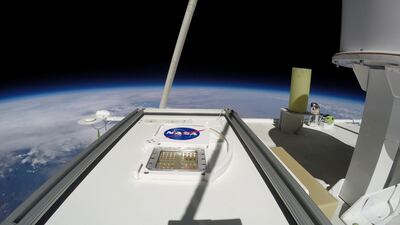
The microbes were sent into the Earth’s stratosphere, where they were exposed to high doses of UV radiation. Nasa

Life from Earth could survive on surface of Mars


Neil Murphy
  • English
  • Arabic

Life from Earth could live on Mars, according to scientific findings that could have a major effect on future space missions.

Microbes, such as fungi and bacteria, can survive in conditions similar to those found on the Martian surface, said Nasa and German Aerospace Centre researchers.

They sent micro-organisms by balloon into the Earth’s stratosphere, which comes close to replicating conditions on the Red Planet. When the balloon returned, the scientists discovered that some of the microbes had survived the trip.

The findings, published in Frontiers in Microbiology, mean scientists now better understand the threat of microbes to future space missions.

Quartz disc with dried Aspergillus niger spore samples. The fungi survived a trip to Earth's stratosphere.

“We successfully tested a new way of exposing bacteria and fungi to Mars-like conditions by using a scientific balloon to fly our experimental equipment up to Earth’s stratosphere,” said Marta Filipa Cortesao, an author of the study based at the German Aerospace Centre in Cologne.

“Some microbes, in particular spores from the black mould fungus, were able to survive the trip, even when exposed to very high UV radiation.”

Nasa's Perseverance space probe landed on Mars on Friday in a quest to determine whether life existed on the planet billions of years ago.

Over several years, Perseverance will attempt to collect 30 rock and soil samples in sealed tubes to send back to Earth for analysis in the 2030s.

Scientists searching for extraterrestrial life must ensure that anything discovered has not merely travelled there from Earth.

Aspergillus niger spores were found to have survived conditions that replicate those of the Martian surface.

“With crewed long-term missions to Mars, we need to know how human-associated micro-organisms would survive on the Red Planet, as some may pose a health risk to astronauts,” said joint author Katharina Siems, who is also based at the German Aerospace Centre.

Martian conditions are not easily replicated on the surface of our planet, but the area above the ozone layer in Earth’s middle stratosphere is remarkably similar.

“We launched the microbes into the stratosphere inside the Marsbox payload, which was kept at Martian pressure and filled with artificial Martian atmosphere throughout the mission,” Ms Cortesao said, referring to the Microbes in Atmosphere for Radiation, Survival and Biological Outcomes experiment.

“The top-layer samples were exposed to more than 1,000 times more UV radiation than levels that can cause sunburn on our skin.”

"While not all the microbes survived the trip, one previously detected on the International Space Station, the black mould Aspergillus niger could be revived after it returned home," Ms Siems said.

This month, the UAE released a close-up image of Mars captured by the Hope probe as it aims to uncover more secrets about the Red Planet.

The picture was posted on Twitter by Sheikh Mohammed bin Rashid, Vice President and Ruler of Dubai.

Mercer, the investment consulting arm of US services company Marsh & McLennan, expects its wealth division to at least double its assets under management (AUM) in the Middle East as wealth in the region continues to grow despite economic headwinds, a company official said.

Mercer Wealth, which globally has $160 billion in AUM, plans to boost its AUM in the region to $2-$3bn in the next 2-3 years from the present $1bn, said Yasir AbuShaban, a Dubai-based principal with Mercer Wealth.

Within the next two to three years, we are looking at reaching $2 to $3 billion as a conservative estimate and we do see an opportunity to do so,” said Mr AbuShaban.

Mercer does not directly make investments, but allocates clients’ money they have discretion to, to professional asset managers. They also provide advice to clients.

“We have buying power. We can negotiate on their (client’s) behalf with asset managers to provide them lower fees than they otherwise would have to get on their own,” he added.

Mercer Wealth’s clients include sovereign wealth funds, family offices, and insurance companies among others.

From its office in Dubai, Mercer also looks after Africa, India and Turkey, where they also see opportunity for growth.

Wealth creation in Middle East and Africa (MEA) grew 8.5 per cent to $8.1 trillion last year from $7.5tn in 2015, higher than last year’s global average of 6 per cent and the second-highest growth in a region after Asia-Pacific which grew 9.9 per cent, according to consultancy Boston Consulting Group (BCG). In the region, where wealth grew just 1.9 per cent in 2015 compared with 2014, a pickup in oil prices has helped in wealth generation.

BCG is forecasting MEA wealth will rise to $12tn by 2021, growing at an annual average of 8 per cent.

Drivers of wealth generation in the region will be split evenly between new wealth creation and growth of performance of existing assets, according to BCG.

Another general trend in the region is clients’ looking for a comprehensive approach to investing, according to Mr AbuShaban.

“Institutional investors or some of the families are seeing a slowdown in the available capital they have to invest and in that sense they are looking at optimizing the way they manage their portfolios and making sure they are not investing haphazardly and different parts of their investment are working together,” said Mr AbuShaban.

Some clients also have a higher appetite for risk, given the low interest-rate environment that does not provide enough yield for some institutional investors. These clients are keen to invest in illiquid assets, such as private equity and infrastructure.

“What we have seen is a desire for higher returns in what has been a low-return environment specifically in various fixed income or bonds,” he said.

“In this environment, we have seen a de facto increase in the risk that clients are taking in things like illiquid investments, private equity investments, infrastructure and private debt, those kind of investments were higher illiquidity results in incrementally higher returns.”

The Abu Dhabi Investment Authority, one of the largest sovereign wealth funds, said in its 2016 report that has gradually increased its exposure in direct private equity and private credit transactions, mainly in Asian markets and especially in China and India. The authority’s private equity department focused on structured equities owing to “their defensive characteristics.”

THE BIO

Born: Mukalla, Yemen, 1979

Education: UAE University, Al Ain

Family: Married with two daughters: Asayel, 7, and Sara, 6

Favourite piece of music: Horse Dance by Naseer Shamma

Favourite book: Science and geology

Favourite place to travel to: Washington DC

Best advice you’ve ever been given: If you have a dream, you have to believe it, then you will see it.

Sarfira

Director: Sudha Kongara Prasad

Starring: Akshay Kumar, Radhika Madan, Paresh Rawal 

Rating: 2/5

500 People from Gaza enter France

115 Special programme for artists

25   Evacuation of injured and sick
