


A new study indicates that conditions on Mars nearly four billion years ago made life on the Red Planet more likely than previously thought.
The paper, published in Nature Geoscience on Monday, dispels the commonly held view that Mars was warm and wet, and once featured rivers, rainfall and oceans. It shows that a large number of the valley networks on the planet's surface were carved by water melting beneath glacial ice, not by free-flowing rivers as has previously been believed.
Researchers developed and used new techniques to examine more than 10,000 Martian valleys, using an algorithm to infer their underlying erosion processes.
The paper’s lead author, Dr Anna Grau Galofre, former PhD student in the department of earth, ocean and atmospheric sciences at the University of British Columbia, said the findings of the study helped explain how the valleys would have formed 3.8 billion years ago on a planet that is farther from the sun than Earth, at a time when the sun’s heat was less intense.
"Climate modelling predicts that Mars' ancient climate was much cooler during the time of valley network formation," said Dr Grau Galofre.
The authors say that these environments would also have supported better survival conditions for possible ancient life on Mars. A sheet of ice would lend more protection and stability for underlying water, as well as providing shelter from solar radiation in the absence of a magnetic field - something that Mars once did have but which disappeared billions of years ago.
"For the last 40 years, since Mars's valleys were first discovered, the assumption was that rivers once flowed on Mars, eroding and originating all of these valleys," Dr Grau Galofre said.
-
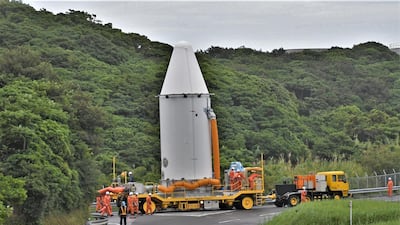
The Hope probe was placed inside this payload fairing last week and was transferred to building where the rocket is kept. Courtesy: Shoma Watanbe -
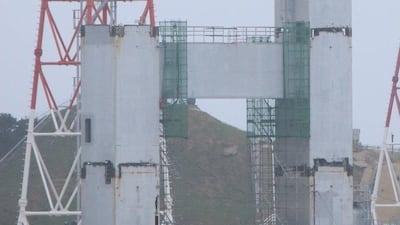
The launch pad is ready to receive the H-IIA rocket, which will deliver the Hope probe to space. It will take 30 to 40-minutes for the rocket to be transported to the launch pad. Courtesy: Yoshiaki Sakita -
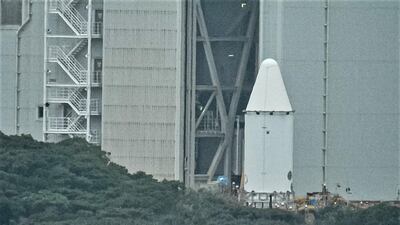
The payload fairing, which is holding the spacecraft, has been mounted on top of the rocket. The structure is meant to protect the probe from dynamic pressure and aerodynamic heating it experiences during its launch into an atmosphere. Courtesy: Shoma Watanbe -
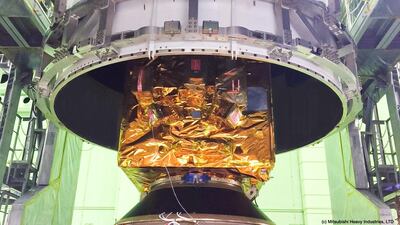
The probe was already fuelled with 800kgs of hydrogen for its seven-month-long journey to Mars. Courtesy: Emirates Mars Mission -
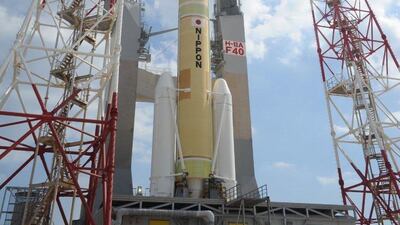
The H-IIA rocket that will carry the Hope probe into space. Dubai Twitter account -
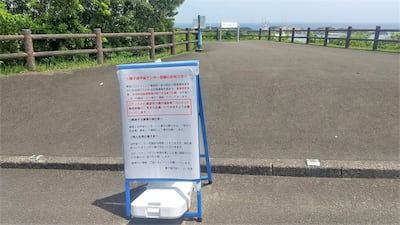
All launch viewing events in Tanegashima have been suspended as part of the Covid-19 safety measures. Signs have been up in all of popular spots, asking the public to keep a 3km distance from the Tanegashima Space Centre on launch day. Courtesy: Yoshiaki Sakita -
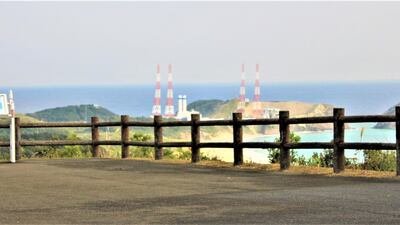
The most popular launch viewing site is the Rocket Hill. It is a five-minute drive from the main building of the Tangashima Space Centre and offers a clear view of the launch. It remains closed to the public. The National -

The free bus tour and exhibition at the Tanegashima Space Centre has also been suspended in efforts to contain the Covid-19 spread. Signs were placed outside of the centre, alerting the public. Courtesy: Yoshiaki Sakita -
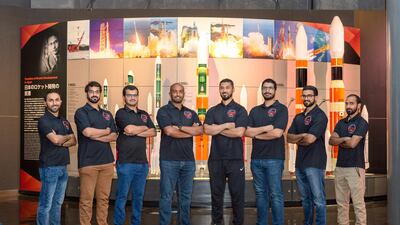
Engineers at the launch site in Tanegashima island, Japan. Courtesy: Emirates Mars Mission -

The completed Hope spacecraft. It will study the lower and upper atmosphere of Mars. Courtesy: Emirates Mars Mission


"But there are hundreds of valleys on Mars, and they look very different from each other. If you look at Earth from a satellite, you see a lot of valleys: some of them made by rivers, some made by glaciers, some made by other processes, and each type has a distinctive shape. Mars is similar, in that valleys look very different from each other, suggesting that many processes were at play to carve them."
Co-author Mark Jellinek, professor in the University of British Columbia’s department of earth, ocean and atmospheric sciences, said the results provided the first evidence of extensive subglacial erosion driven by channelised meltwater drainage beneath an ancient ice sheet on Mars.
"The findings demonstrate that only a fraction of valley networks match patterns typical of surface water erosion, which is in marked contrast to the conventional view,” he said.
The scientists found “striking similarities” between many Martian valleys and those in the Canadian Arctic Archipelago after comparing their subglacial channels.
"Devon Island [in Canada] is one of the best analogues we have for Mars here on Earth - it is a cold, dry, polar desert, and the glaciation is largely cold-based," another co-author, Gordon Osinski, professor in Western University's department of earth sciences and Institute for Earth and Space Exploration, said.
Although the research is focused on Mars, scientists believe that the same techniques can be applied to uncover more about the early history of our own planet.
"Currently, we can reconstruct rigorously the history of global glaciation on Earth going back about a million to five million years," says Prof Jellinek. "Anna's work will enable us to explore the advance and retreat of ice sheets back to at least 35 million years ago - to the beginnings of Antarctica, or earlier - back in time well before the age of our oldest ice cores.”
The UAE made history on July 20, after it launched its first mission to Mars in efforts to study the dynamic weather conditions of the planet.
The team behind the project was invited to the palace and were honoured by Sheikh Mohamed and Sheikh Mohammed bin Rashid, Vice President and Ruler of Dubai.

