


The mystery deaths of thousands of fish in the River Oder that separates Germany from Poland has led to allegations of “fake news” flying across the border as authorities in both countries search for answers.
Polish Environment Minister Anna Moskwa hit back at suggestions from Germany that a high level of pesticides in the water might be to blame for poisoning the 866-kilometre river.
Her counterparts in Germany said it was up to Poland, where most of the upstream river lies, to explain how at least 136 tonnes of fish found themselves in unsafe waters.
Some activities such as bathing and fishing have been banned on the river while authorities investigate whether there is any danger to humans.
The wider ecosystem in the Oder, including mussels, molluscs, algae and bacteria, is thought to be threatened by whatever has been killing the fish.
Ms Moskwa said Poland was not responsible for any poisoning or release of dangerous chemicals. “More fake news being circulated in Germany … in Poland, the substances were tested and found to be below the detection limit, so with no effects on fish or other animals,” she said.
A panel of experts from both countries was expected to meet on Monday after scientific studies into the fish deaths.
An institute in Berlin reported that toxins released by certain kinds of algae had been detected in the river, suggesting the cause was man-made because those species would not normally be found in the Oder.
“To occur in large numbers in this area, the species is dependent on salinity levels that can only be produced by industrial discharges,” said researchers at the Leibniz Institute of Freshwater Ecology and Inland Fisheries.
The environment ministry in Brandenburg said it might well be able to establish how the fish died, but that how and why the river was polluted “can only be cleared up by the Polish side”.

One laboratory in Brandenburg found high levels of pesticide between August 7 and 9, around the time the fish deaths were first noticed, leading to Ms Moskwa's rebuttal.
Germany said its own early warning system was in working order but that it had not received an alert from the Polish authorities until August 11, which did not include information about the possible cause of the deaths.
Some activities such as bathing and fishing have been banned on the river while authorities investigate whether there is any danger to humans.
The wider ecosystem in the Oder, including mussels, molluscs, algae and bacteria, is thought to be threatened by whatever has been killing the fish.
Things are little better in western Germany, where the country's longest river, the Rhine, has fallen to critically low water levels because of Europe's summer heatwave and drought.
Freight traffic has been affected along the vital inland shipping lane, deepening Germany's economic woes as energy providers struggle to get coal to power stations.
Europe's waterways hit by heatwave and drought - in pictures
-
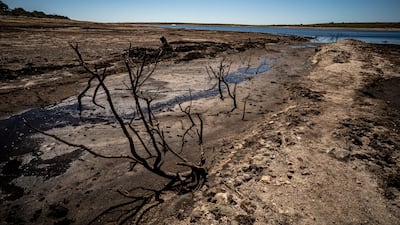
Dried mud and old trees at Colliford Lake in Cornwall, England, where water levels have severely dropped exposing the unseen trees and rocks in Cornwall's largest lake and reservoir. PA -
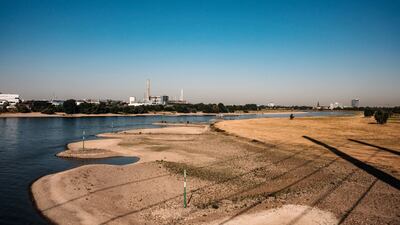
A large section of exposed River Rhine riverbed, due to low water levels caused by drought, in Duesseldorf, Germany. Bloomberg -
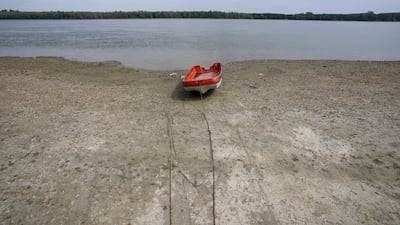
A boat on a bank of the receding Danube river, after a lengthy drought near the village of Cortanovci, Serbia. AP -
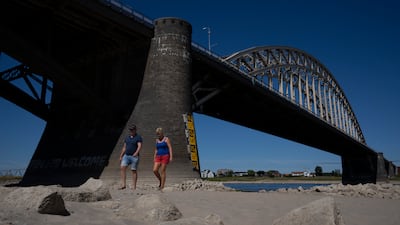
People take a stroll on the river bed of the Waal as water levels dropped because of drought in Nijmegen, Netherlands. AP -
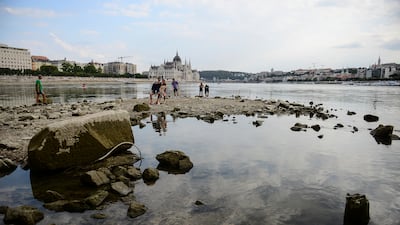
People take photos on the southern tip of Margaret Island, which can be seen due to low water level of the River Danube, in Budapest, Hungary. AP -
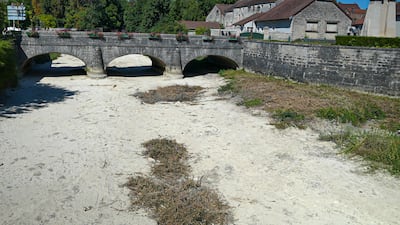
The dried-up river Tille in Lux, France. AP -

A bridge, which is usually submerged, over the dried bed of Llwyn-on Reservoir, during a heatwave in Wales. Reuters -
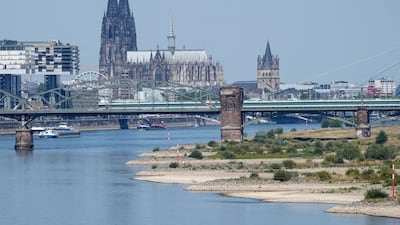
The Rhine river with low water levels in Cologne, Germany. AP -
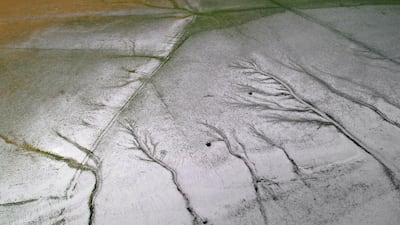
The Yesa reservoir and the Aragon River are practically without water in Yesa, Navarra, Spain. EPA -
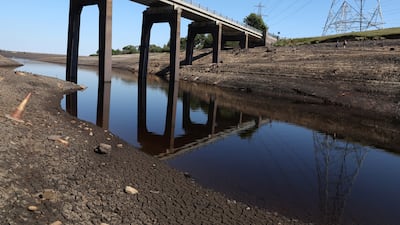
Low water levels at Baitings Reservoir in Ripponden, West Yorkshire, England. Reuters -
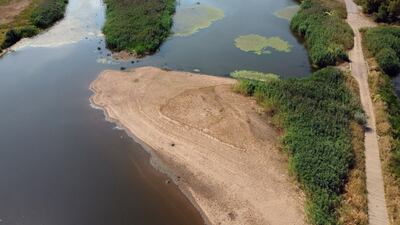
Low water levels at the Odra river near Czelin village, north-western Poland. EPA -
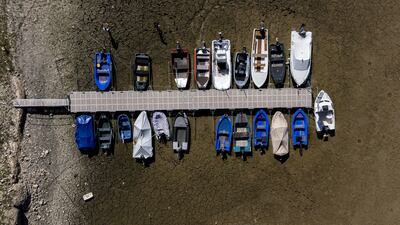
Boats on the dried bed of the drought-affected Doubs river on the border with France in Les Brenets, Switzerland. Reuters -
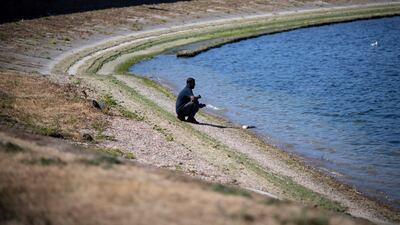
A person sits by a reservoir with low water levels and dried grass at Walthamstow Wetlands in London, England. EPA -
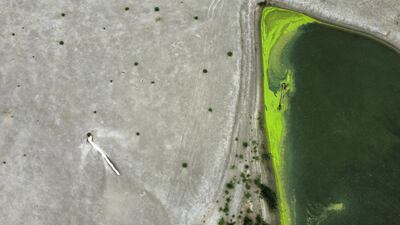
The dried-up River Po that has been affected by the worst drought in 70 years, near Borgo Virgilio, Italy. Reuters



