


Ukrainian President Volodymyr Zelenskyy on Thursday called for nations to impose “more courageous sanctions” against Russia to try to end the war.
In his evening address, Mr Zelenskyy said the current sanctions were “not yet the ones needed to stop Russia and stop the war”.
“If sanctions had really worked at 100 per cent, then it wouldn’t have been necessary to explain their importance in such a detailed and meticulous way," he said.
"That’s why I underline once again that we need more sanctions, more courageous sanctions. Courage and utility must be the criteria to assess the decisions.“
He also called for countries to supply more weapons to Ukraine.
“Ukraine needs weapons that will allow us to win on the battlefield,” he said. “It will be the strongest sanction against Russia of all possible ones.”
Western allies have increased financial penalties aimed at Moscow.
The US Congress voted on Thursday to suspend normal trade relations with Russia and ban the import of its oil, while the EU approved new sanctions, including a ban on Russian coal.
Mr Zelenskyy welcomed the General Assembly’s move.
He said Russia was “collecting bodies” of people killed in Mariupol, which he said then could be used to accuse Ukrainian troops of killing their own people.
“Russia has long had nothing to do with the concept of human rights," Mr Zelenskyy said. "It might change one day.
"But for now Russia and its military are the main threat on the planet for freedom, people’s safety and for the concept of human rights."
He said there would be a retaliatory response to Ukraine releasing images of killings in Bucha.
“We are receiving more and more information that Russian propaganda is preparing so-called ‘tit-for-tat’ response to the shock all normal people had from what they saw in Bucha," Mr Zelenskyy said.
"They are trying to show victims in Mariupol as if they were killed not by Russian forces, but by Ukrainian defenders of the city.
"For this purpose, occupiers are collecting bodies on the streets and taking them away. They might use it somewhere else in accordance to developed propaganda scenarios.”
-
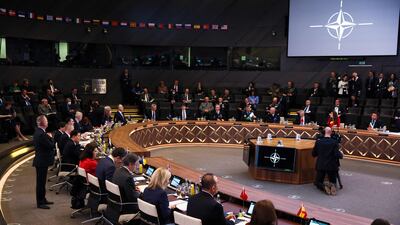
Nato foreign ministers meet in Brussels to discuss the latest in the continuing Russia-Ukraine war. AFP -
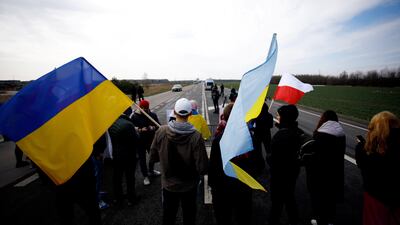
People take part in a protest against the transport of cargo to Russia and Belarus near the Polish-Belarusian border crossing in Koroszczyn, eastern Poland. EPA -
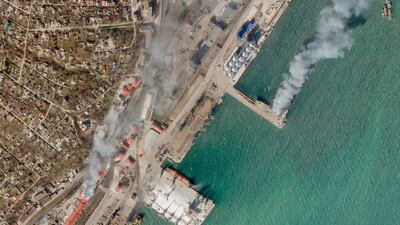
A Ukrainian naval vessel, thought to be the ‘Donbas’ and a nearby building burn in the besieged city of Mariupol. AP -
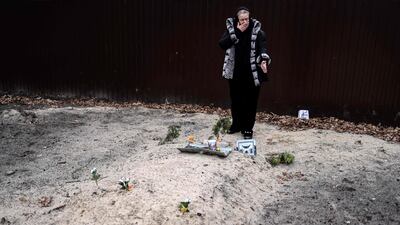
Bucha resident Tetiana Ustymenko weeps over the grave of her son, buried in the garden of her house, in Bucha, north-west of Kyiv. AFP -
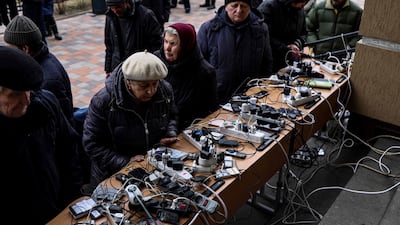
People charge their mobile phones in a public building in Bucha. AFP -
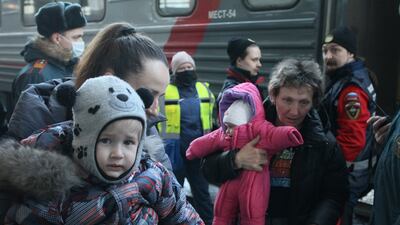
People from Mariupol leave a train to be taken to temporary residences in Nizhny Novgorod, Russia. AP -
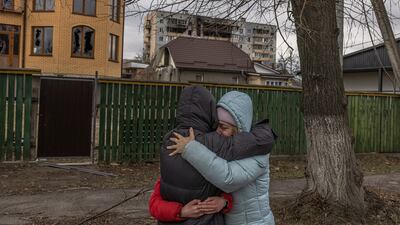
Vladyslava Liubarets, a Bucha resident, cries as she hugs her sister whom she had not seen since the beginning of the Russian invasion, in Bucha, the town which was retaken by the Ukrainian army. EPA -
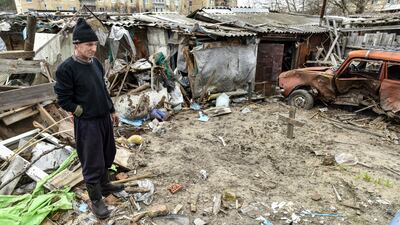
Local citizen Oleksandr, 55, looks at the grave of his neighbour in the backyard of his private house in Hostomel in Kyiv. EPA -

Debris of a rocket missile on the field near Kyiv. EPA -
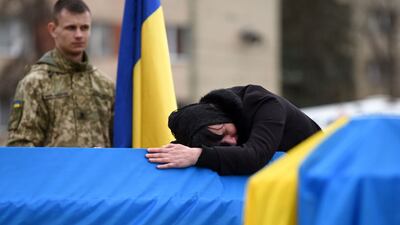
The mother of Ukrainian soldier Lubomyr Hudzeliak, who was killed during Russia's invasion of Ukraine, mourns during his funeral in the western Ukrainian city of Lviv. AFP -
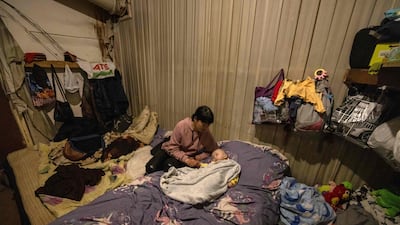
A woman takes care of a baby at a shelter in the Ukrainian city of Severodonetsk in Donbas region. AFP -
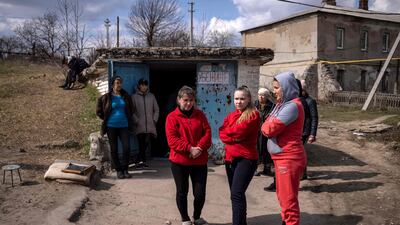
Residents gather outside a shelter in the city of Severodonetsk. AFP -
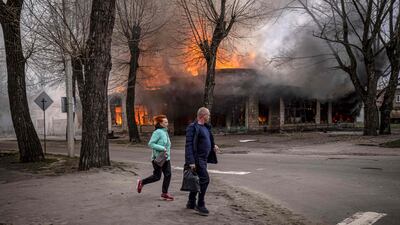
Residents in eastern Ukraine, including the city of Severodonetsk in Donbas region, have been asked by their government to leave 'now' or 'risk death'. AFP -
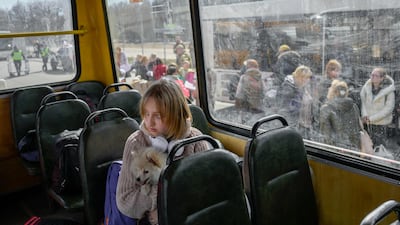
A young girl with her dog arrives at a centre for the displaced in Zaporizhzhia, north-west of Mariupol. AFP -
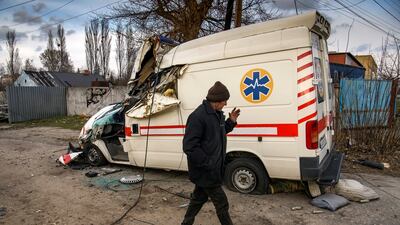
A damaged ambulance in Hostomel, on the outskirts of Kyiv. Reuters -
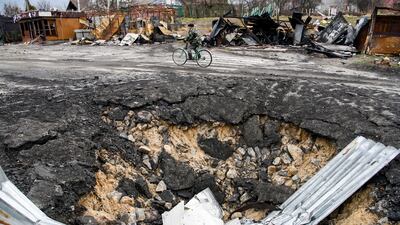
A bomb crater left behind by Russia's attack on the Ukrainian village of Demydiv, on the outskirts of Kyiv. Reuters -
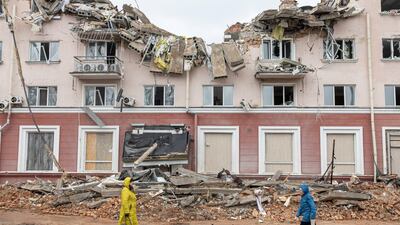
Russian attacks have reduced Hotel Ukraine in Chernihiv to debris. Reuters -
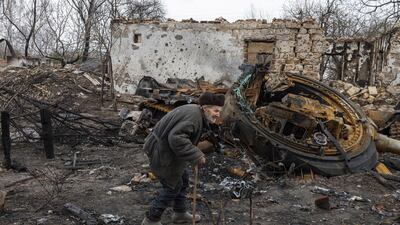
Oleksii Shcherbo, 98, near his burnt house in the village of Sloboda, on the outskirts of Chernihiv. Reuters -

Residents walk past destroyed Russian military machinery on the street, in Bucha, the town which was retaken by the Ukrainian army, north-west of Kyiv. EPA -
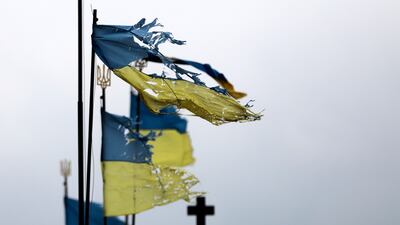
Damaged National flags flutter in the wind on a cemetry of Chernihiv city which was blocked by Russian troops for a long time. EPA -

Demonstrators lie down on the ground in tribute to the people killed in Russia's war against Ukraine, in Berlin, Germany. AP -

A Ukrainian firefighter works at the site of a burning fuel storage facility ignited by an air strike, in Dnipropetrovsk. Reuters -

A woman before and after she was removed by rescuers from debris after a military strike on the town of Rubizhne, Luhansk. Reuters -

People wait for help to evacuate Derhachi. Reuters -
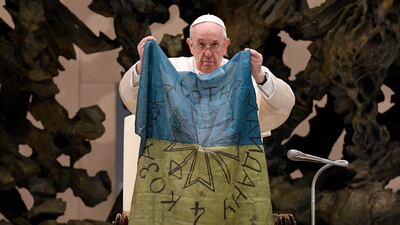
Pope Francis, in Vatican, holds a Ukrainian flag given to him by a delegation from the town of Bucha, where dozens of bodies had been found. EPA -
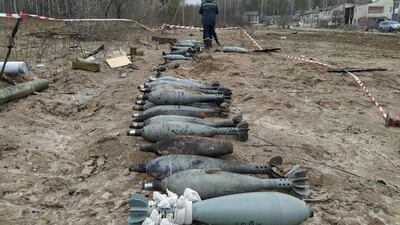
State emergency servicemen clear shells near Chernigiv, northern Ukraine. AFP -
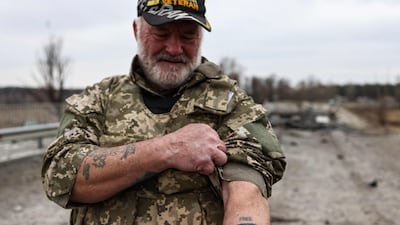
US war veteran Steven Straub shows his tattoo of the Ukrainian flag while on patrol near Buda-Babynetska, north of Kyiv, days after Russian forces retreated from the area. AFP -
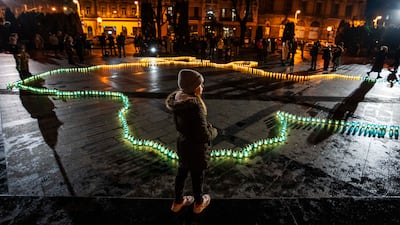
Candles are arranged in the shape of Ukraine by the monument to the poet Taras Shevchenko in the western city Lviv. AFP -
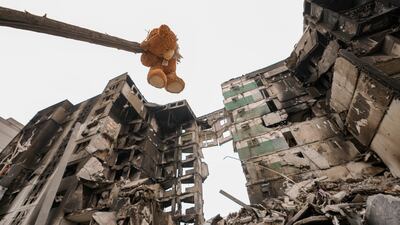
A teddy bear hangs from a tree branch outside an apartment building in Borodyanka, Kyiv oblast. AP -
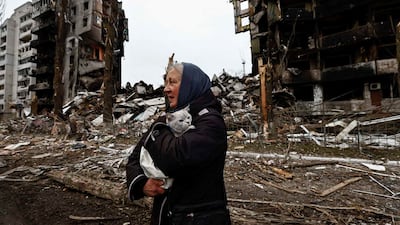
A woman carries her cat as she walks past buildings that were destroyed by Russian shelling, in Borodyanka. Reuters -
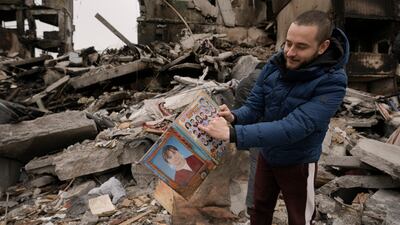
Dmitriy Evtushkov, 25, points to his picture in a primary school album retrieved from the rubble of a block of flats. AP -
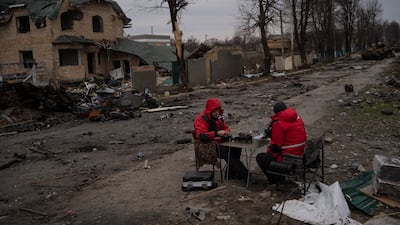
Technicians try to fix the internet in Bucha. AP -

A smashed mobile phone lies next to a Russian army ration book in Bucha. AP -
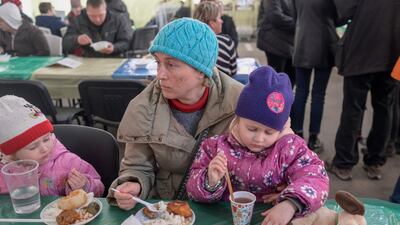
A woman and children after their arrival at a centre for displaced persons in Zaporizhzhia, about 200 kilometres north-west of Mariupol. AFP -
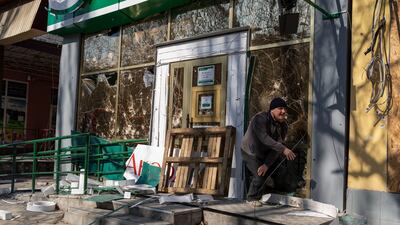
A man leaves a damaged pharmacy after a bombing that killed several civilians, in Mykolaiv. AP -
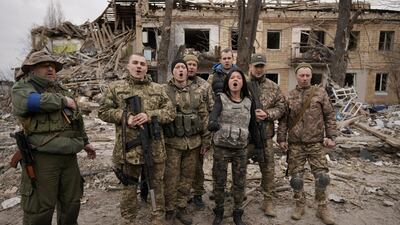
Ukrainian soldiers sing a patriotic song with buildings in the background that were destroyed during fighting in Borodyanka. AP -
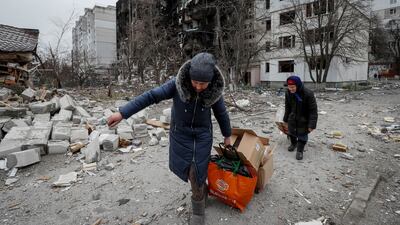
Borodyanka residents carry humanitarian aid packages. Reuters -

Elderly Ukrainians shelter in a basement in Kharkiv, in eastern Ukraine. EPA -
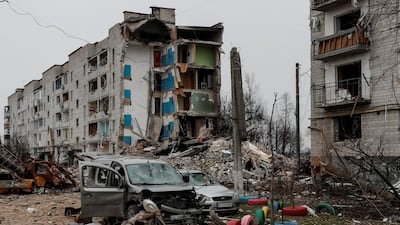
Destroyed apartment buildings in Borodyanka. Reuters -
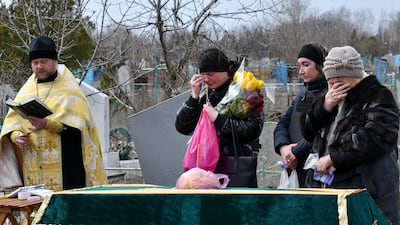
Relatives and friends are overwhelmed with emotions as they stand next to the coffin of Anatoly German during his funeral. AP


The Ukrainian leader also welcomed the return of Turkish, Slovenian and Lithuanian diplomats to Kyiv, calling for other countries to reopen their embassies in the capital.
“I’m looking forward to the opportunity to meet everyone who is with us, everyone who is brave,” Mr Zelenskyy said.
"Come back with every diplomat who has returned to our capital and continues working.
"The presence of foreign diplomatic missions in Kyiv, normal work of embassies, is a clear signal to the aggressor that Kyiv is our capital.
"It’s not a regional city in Russia, it’s the Ukrainian capital.”

