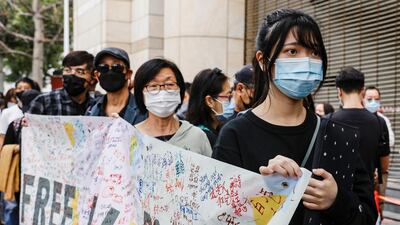
Supporters hold a banner to support pro-democracy activists as they queue up for a court hearing over the national security law outside West Kowloon Magistrates' Courts, in Hong Kong. Reuters

Protests reignite after popular Hong Kong dissidents charged with 'subversion'


  • English
  • Arabic

Hundreds of democracy supporters gathered outside a Hong Kong courthouse on Monday chanting slogans and flashing protest symbols as many of the city's best-known dissidents were charged with subversion.

The alleged offence of those arrested for subversion was to organise an unofficial primary last summer to choose candidates for the city's partially elected legislature, in the hope that the pro-democracy bloc might take a majority for the first time and block government legislation.

HONG KONG, HONG KONG - MARCH 1: Pro-democracy supporters line up outside the West Kowloon court as police officers patrol on March 1, 2021 in Hong Kong. The protest took place during the court appearances by dozens of dissidents charged with subversion in the largest use of Beijing's sweeping new the national security law to date. (Photo by Anthony Kwan/Getty Images)

Chinese and Hong Kong officials viewed the primary as an attempt to "overthrow" the city's government and therefore a threat to national security.

Beijing is battling to stamp out dissent in semi-autonomous Hong Kong after swathes of the population hit the streets in 2019 in huge and sometimes violent democracy demonstrations.

It has blanketed the once free-wheeling finance hub in a sweeping national security law, while anti-coronavirus measures ban public gatherings of more than four people.

Police on Sunday charged 47 leading dissidents with conspiracy to commit subversion in the largest use yet of the security legislation.

Monday's hearing sparked a resurgence of defiance from members of the public in a city where protest has been all but outlawed.

Hundreds queued up outside the law courts in one of the biggest gatherings in months as a heavy police presence looked on.

Some chanted slogans including "Release all political prisoners" and "Liberate Hong Kong, revolution of our times" – the latter a slogan authorities say is now illegal under the security law.

Others flashed the three-finger "Hunger Games" salute that has been embraced by fellow democracy campaigners in Thailand and Myanmar, who have grouped their movements under one umbrella called "the milk tea alliance."

Tensions rose and fell throughout the afternoon as police raised banners warning that an illegal gathering was taking place and that protesters were breaking the national security law with their chanting. Crowds did not disperse.

People gather outside the West Kowloon Magistrates’ Courts during a hearing for 47 opposition activists charged with violating the city’s national security law in Hong Kong, China, on Monday, March 1, 2021. Defiant Hong Kong protesters risked arrest outside a local court in the biggest demonstration in months, as dozens of the city’s most prominent pro-democracy activists were jailed on subversion charges and authorities in Beijing moved to limit the opposition’s role in future elections. Photographer: Paul Yeung/Bloomberg

Local district councilor Kwan Chun-sang was one of dozens who camped overnight to bag a spot at the front of the queue for the court's public gallery.

"Soon after the charges were laid yesterday I decided to come and spend the night here," Kwan told AFP. "I would like to show my support for the pro-democracy activists."

A small group of nationalist protesters held banners welcoming the subversion charges.

"Punish the traitors severely, enact the national security law and throw them all behind bars," one sign read.

The defendants represent a broad cross-section of Hong Kong's opposition, from veteran former pro-democracy lawmakers to academics, lawyers, social workers and a host of youth activists.

So many have been charged that officials had to open up three other courtrooms to accommodate the overspill.

After a brief appearance by the charged, proceedings were adjourned to later in the afternoon.

The dissidents were arrested in a series of dawn raids in January and charged on Sunday with "conspiracy to commit subversion" – one of the new broadly defined national security crimes. They face up to life in prison if convicted.

US Secretary of State Anthony Blinken led international criticism of the latest charges, calling for the group's immediate release, as western powers accused Beijing of shredding the freedoms and autonomy it promised Hong Kong could maintain before the territory's handover from the British.

Britain and the European Union said the charges showed the law was being used to target political dissent rather than actual threats to national security.

China's foreign ministry on Monday dismissed the US criticism and said Beijing "resolutely supports Hong Kong police … in upholding national security as well as Hong Kong's security and stability".

The security law was imposed on the city last year and criminalises any act deemed to be subversion, secession, terrorism or collusion with foreign forces.

The wording and subsequent application of the legislation has successfully curbed dissent, outlawed a host of political views and radically transformed semi-autonomous Hong Kong's relationship with the authoritarian mainland.

Those charged can usually expect to be remanded into custody for months until their trial as the law removes the territory's tradition of granting bail for non-violent crimes.


Diriyah%20project%20at%20a%20glance
%3Cp%3E-%20Diriyah%E2%80%99s%201.9km%20King%20Salman%20Boulevard%2C%20a%20Parisian%20Champs-Elysees-inspired%20avenue%2C%20is%20scheduled%20for%20completion%20in%202028%0D%3Cbr%3E-%20The%20Royal%20Diriyah%20Opera%20House%20is%20expected%20to%20be%20completed%20in%20four%20years%0D%3Cbr%3E-%20Diriyah%E2%80%99s%20first%20of%2042%20hotels%2C%20the%20Bab%20Samhan%20hotel%2C%20will%20open%20in%20the%20first%20quarter%20of%202024%0D%3Cbr%3E-%20On%20completion%20in%202030%2C%20the%20Diriyah%20project%20is%20forecast%20to%20accommodate%20more%20than%20100%2C000%20people%0D%3Cbr%3E-%20The%20%2463.2%20billion%20Diriyah%20project%20will%20contribute%20%247.2%20billion%20to%20the%20kingdom%E2%80%99s%20GDP%0D%3Cbr%3E-%20It%20will%20create%20more%20than%20178%2C000%20jobs%20and%20aims%20to%20attract%20more%20than%2050%20million%20visits%20a%20year%0D%3Cbr%3E-%20About%202%2C000%20people%20work%20for%20the%20Diriyah%20Company%2C%20with%20more%20than%2086%20per%20cent%20being%20Saudi%20citizens%0D%3C%2Fp%3E%0A
Key facilities
  • Olympic-size swimming pool with a split bulkhead for multi-use configurations, including water polo and 50m/25m training lanes
  • Premier League-standard football pitch
  • 400m Olympic running track
  • NBA-spec basketball court with auditorium
  • 600-seat auditorium
  • Spaces for historical and cultural exploration
  • An elevated football field that doubles as a helipad
  • Specialist robotics and science laboratories
  • AR and VR-enabled learning centres
  • Disruption Lab and Research Centre for developing entrepreneurial skills
Test

Director: S Sashikanth

Cast: Nayanthara, Siddharth, Meera Jasmine, R Madhavan

Star rating: 2/5

THREE
%3Cp%3EDirector%3A%20Nayla%20Al%20Khaja%3C%2Fp%3E%0A%3Cp%3EStarring%3A%20Jefferson%20Hall%2C%20Faten%20Ahmed%2C%20Noura%20Alabed%2C%20Saud%20Alzarooni%3C%2Fp%3E%0A%3Cp%3ERating%3A%203.5%2F5%3C%2Fp%3E%0A

Mercer, the investment consulting arm of US services company Marsh & McLennan, expects its wealth division to at least double its assets under management (AUM) in the Middle East as wealth in the region continues to grow despite economic headwinds, a company official said.

Mercer Wealth, which globally has $160 billion in AUM, plans to boost its AUM in the region to $2-$3bn in the next 2-3 years from the present $1bn, said Yasir AbuShaban, a Dubai-based principal with Mercer Wealth.

Within the next two to three years, we are looking at reaching $2 to $3 billion as a conservative estimate and we do see an opportunity to do so,” said Mr AbuShaban.

Mercer does not directly make investments, but allocates clients’ money they have discretion to, to professional asset managers. They also provide advice to clients.

“We have buying power. We can negotiate on their (client’s) behalf with asset managers to provide them lower fees than they otherwise would have to get on their own,” he added.

Mercer Wealth’s clients include sovereign wealth funds, family offices, and insurance companies among others.

From its office in Dubai, Mercer also looks after Africa, India and Turkey, where they also see opportunity for growth.

Wealth creation in Middle East and Africa (MEA) grew 8.5 per cent to $8.1 trillion last year from $7.5tn in 2015, higher than last year’s global average of 6 per cent and the second-highest growth in a region after Asia-Pacific which grew 9.9 per cent, according to consultancy Boston Consulting Group (BCG). In the region, where wealth grew just 1.9 per cent in 2015 compared with 2014, a pickup in oil prices has helped in wealth generation.

BCG is forecasting MEA wealth will rise to $12tn by 2021, growing at an annual average of 8 per cent.

Drivers of wealth generation in the region will be split evenly between new wealth creation and growth of performance of existing assets, according to BCG.

Another general trend in the region is clients’ looking for a comprehensive approach to investing, according to Mr AbuShaban.

“Institutional investors or some of the families are seeing a slowdown in the available capital they have to invest and in that sense they are looking at optimizing the way they manage their portfolios and making sure they are not investing haphazardly and different parts of their investment are working together,” said Mr AbuShaban.

Some clients also have a higher appetite for risk, given the low interest-rate environment that does not provide enough yield for some institutional investors. These clients are keen to invest in illiquid assets, such as private equity and infrastructure.

“What we have seen is a desire for higher returns in what has been a low-return environment specifically in various fixed income or bonds,” he said.

“In this environment, we have seen a de facto increase in the risk that clients are taking in things like illiquid investments, private equity investments, infrastructure and private debt, those kind of investments were higher illiquidity results in incrementally higher returns.”

The Abu Dhabi Investment Authority, one of the largest sovereign wealth funds, said in its 2016 report that has gradually increased its exposure in direct private equity and private credit transactions, mainly in Asian markets and especially in China and India. The authority’s private equity department focused on structured equities owing to “their defensive characteristics.”