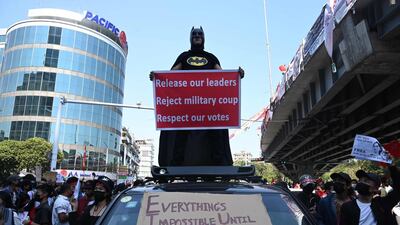
The Myanmar coup caught many by surprise, as events of international significance seem to do on a regular basis. We are bad at predicting outcomes generally, despite expending so much effort and resources on analysis that tries to make forecasts, even when we know certain developments are inevitable. Governments cut funding for their pandemic response in the years leading up to the current pandemic. Few intelligence agencies predicted the Arab uprisings in 2011 despite the ongoing ferment of dissatisfaction with many of the region's rulers, and even the political minds behind Brexit and the rise of Donald Trump thought both were long shots.
Post-facto analyses, though, tend to discern the warning signs and patterns with the benefit of hindsight. In the conventional wisdom, the events in question become inevitabilities rather than things that could have been predicted. The election of Mr Trump was a reaction to economic inequalities, the sweep of anti-immigration sentiment and repressed white nationalism, and most media simply failed to foresee it either because it did not take the threat seriously or because its practitioners were too disconnected from the story, for example.
It was the same with Myanmar. The tidy narrative of a military handing over power to civilians on the road to democratic reform was the story many around the world were told, until it wasn't. The post-facto analysis revealed that the military, contrary to popular belief, had not really given up its power and remained largely running things behind the scenes, and took back all the reins when the charade became untenable, all while the world was not paying attention.
The world was largely surprised by the rise of former US president Donald Trump and Brexit, which UK politician Nigel Farage campagned for. Reuters
I have been thinking about this idea of the narratives we tell ourselves, especially as it relates to Myanmar, because of a powerful strain of reaction on Arab social media when the news emerged. Many online users expressed pleasure at the development because they saw Aung San Suu Kyi, the deposed state counsellor, democracy activist and Nobel Peace Prize laureate, as having abetted the genocide and forced displacement of the Rohingya, despite the fact that the military that ousted her were the ones that carried out the actual atrocities.
As a journalist, I have come to appreciate the power of narratives and the stories we tell ourselves to rationalise or understand faraway events that we don’t intuitively grasp or have direct experience of. The world is a big place with profound suffering in many of its corners. And while most of us have empathy, we lack the capacity to identify with every tragedy that we read about. Premade narratives help solve this problem by providing us with a template that allows us to understand complex, scary events around the world.
This is something we deal with in the Middle East on a regular basis. It is easier to ascribe the violence that grips places such as Syria and Iraq to ancient hatreds and centuries-old religious and sectarian schisms that make conflict inevitable and the arduous work of peacebuilding and reconciliation subsequently pointless and not worth the effort. It is easier to blame forces outside of our control rather than look at the power imbalances, the corruption, the lack of electricity, the failing education and public health systems, and the environmental degradation brought about by climate change and years of war because those problems are harder to solve.
An Iraqi demonstrator jumps over a burning tyre during anti-government protests in Basra, Iraq in December. Reuters
Local journalists often know what the real story is
However, these narratives are also a consequence of how the media covers these issues and conflicts. Limited by the decline in funding and resources that have seen many newsrooms shutter their foreign bureaus and dismantle their foreign desks, international journalists are stretched thin. Without the capacity to spend more time in and with the communities they cover, without the space and time to develop expertise and knowledge, we will be doomed to a glib and shallow understanding the world, rooted in stereotypes and cliches.
How do we resolve this? Newsrooms should empower local journalists and freelancers operating around the world who have cultural and social connections to the communities they cover, and who have developed the expertise necessary to report truthfully, accurately and with subtlety about those communities, and pay them a fair wage for the effort. Local journalists are more able to track local developments, identify important sources, and draw on cultural knowledge to accurately report stories. And they often know what the real story is.
International journalists are essential to journalism, often because they are able to report on particularly sensitive stories without repercussions as dire as they may be for local journalists, who sometimes have to pay dearly for their work. But encouraging greater collaboration with local journalists whose ears are glued to the ground will pay dividends, not just by creating more diversity in newsrooms and having a broader array of original international coverage, but also by creating more complex, subtle, and truer narratives of the world. Rather than shy away from complexity with ever dwindling word counts from faraway places, we can embrace it.
Kareem Shaheen is a veteran Middle East correspondent in Canada and a columnist for The National

Key products and UAE prices
iPhone XS
With a 5.8-inch screen, it will be an advance version of the iPhone X. It will be dual sim and comes with better battery life, a faster processor and better camera. A new gold colour will be available. Price: Dh4,229
iPhone XS Max
It is expected to be a grander version of the iPhone X with a 6.5-inch screen; an inch bigger than the screen of the iPhone 8 Plus. Price: Dh4,649
iPhone XR
A low-cost version of the iPhone X with a 6.1-inch screen, it is expected to attract mass attention. According to industry experts, it is likely to have aluminium edges instead of stainless steel. Price: Dh3,179
Apple Watch Series 4
More comprehensive health device with edge-to-edge displays that are more than 30 per cent bigger than displays on current models.
Online: The match will be broadcast live on Dubai Exiles’ Facebook page
UAE squad: Lucas Waddington (Dubai Exiles), Gio Fourie (Exiles), Craig Nutt (Abu Dhabi Harlequins), Phil Brady (Harlequins), Daniel Perry (Dubai Hurricanes), EsekaiaDranibota (Harlequins), Matt Mills (Exiles), JaenBotes (Exiles), KristianStinson (Exiles), Murray Reason (Abu Dhabi Saracens), Dave Knight (Hurricanes), Ross Samson (Jebel Ali Dragons), DuRandt Gerber (Exiles), Saki Naisau (Dragons), Andrew Powell (Hurricanes), EmosiVacanau (Harlequins), NikoVolavola (Dragons), Matt Richards (Dragons), Luke Stevenson (Harlequins), Josh Ives (Dubai Sports City Eagles), Sean Stevens (Saracens), ThinusSteyn (Exiles)
They involve criminals conning mobile phone operators into issuing them with replacement Sim cards by claiming to be the victim, often pretending their phone has been lost or stolen in order to secure a new Sim.
They use the victim's personal details - obtained through criminal methods - to convince such companies of their identity.
The criminal can then access any online service that requires security codes to be sent to a user's mobile phone, such as banking services.
Pakistan 418-5 (declared)
New Zealand 90 and 131-2 (follow on)
Day 3: New Zealand trail by 197 runs with 8 wickets remaining
The candidates
Dr Ayham Ammora, scientist and business executive
Ali Azeem, business leader
Tony Booth, professor of education
Lord Browne, former BP chief executive
Dr Mohamed El-Erian, economist
Professor Wyn Evans, astrophysicist
Dr Mark Mann, scientist
Gina MIller, anti-Brexit campaigner
Lord Smith, former Cabinet minister
Sandi Toksvig, broadcaster
Mercer, the investment consulting arm of US services company Marsh & McLennan, expects its wealth division to at least double its assets under management (AUM) in the Middle East as wealth in the region continues to grow despite economic headwinds, a company official said.
Mercer Wealth, which globally has $160 billion in AUM, plans to boost its AUM in the region to $2-$3bn in the next 2-3 years from the present $1bn, said Yasir AbuShaban, a Dubai-based principal with Mercer Wealth.
“Within the next two to three years, we are looking at reaching $2 to $3 billion as a conservative estimate and we do see an opportunity to do so,” said Mr AbuShaban.
Mercer does not directly make investments, but allocates clients’ money they have discretion to, to professional asset managers. They also provide advice to clients.
“We have buying power. We can negotiate on their (client’s) behalf with asset managers to provide them lower fees than they otherwise would have to get on their own,” he added.
Mercer Wealth’s clients include sovereign wealth funds, family offices, and insurance companies among others.
From its office in Dubai, Mercer also looks after Africa, India and Turkey, where they also see opportunity for growth.
Wealth creation in Middle East and Africa (MEA) grew 8.5 per cent to $8.1 trillion last year from $7.5tn in 2015, higher than last year’s global average of 6 per cent and the second-highest growth in a region after Asia-Pacific which grew 9.9 per cent, according to consultancy Boston Consulting Group (BCG). In the region, where wealth grew just 1.9 per cent in 2015 compared with 2014, a pickup in oil prices has helped in wealth generation.
BCG is forecasting MEA wealth will rise to $12tn by 2021, growing at an annual average of 8 per cent.
Drivers of wealth generation in the region will be split evenly between new wealth creation and growth of performance of existing assets, according to BCG.
Another general trend in the region is clients’ looking for a comprehensive approach to investing, according to Mr AbuShaban.
“Institutional investors or some of the families are seeing a slowdown in the available capital they have to invest and in that sense they are looking at optimizing the way they manage their portfolios and making sure they are not investing haphazardly and different parts of their investment are working together,” said Mr AbuShaban.
Some clients also have a higher appetite for risk, given the low interest-rate environment that does not provide enough yield for some institutional investors. These clients are keen to invest in illiquid assets, such as private equity and infrastructure.
“What we have seen is a desire for higher returns in what has been a low-return environment specifically in various fixed income or bonds,” he said.
“In this environment, we have seen a de facto increase in the risk that clients are taking in things like illiquid investments, private equity investments, infrastructure and private debt, those kind of investments were higher illiquidity results in incrementally higher returns.”
The Abu Dhabi Investment Authority, one of the largest sovereign wealth funds, said in its 2016 report that has gradually increased its exposure in direct private equity and private credit transactions, mainly in Asian markets and especially in China and India. The authority’s private equity department focused on structured equities owing to “their defensive characteristics.”
Cryptocurrency Investing for Dummies – by Kiana Danial
There are several primers for investing in cryptocurrencies available online, including e-books written by people whose credentials fall apart on the second page of your preferred search engine.
Ms Danial is a finance coach and former currency analyst who writes for Nasdaq. Her broad-strokes primer (2019) breaks down investing in cryptocurrency into baby steps, while explaining the terms and technologies involved.
Although cryptocurrencies are a fast evolving world, this book offers a good insight into the game as well as providing some basic tips, strategies and warning signs.
South Africa
Faf du Plessis (captain), Dean Elgar, Aiden Markram, Hashim Amla, AB de Villiers, Quinton de Kock (wkt), Vernon Philander, Keshav Maharaj, Kagiso Rabada, Morne Morkel, Lungi Ngidi.
The flights Etihad and Emirates fly direct from the UAE to Delhi from about Dh950 return including taxes. The hotels
Double rooms at Tijara Fort-Palace cost from 6,670 rupees (Dh377), including breakfast.
Doubles at Fort Bishangarh cost from 29,030 rupees (Dh1,641), including breakfast. Doubles at Narendra Bhawan cost from 15,360 rupees (Dh869). Doubles at Chanoud Garh cost from 19,840 rupees (Dh1,122), full board. Doubles at Fort Begu cost from 10,000 rupees (Dh565), including breakfast. The tours
Amar Grover travelled with Wild Frontiers. A tailor-made, nine-day itinerary via New Delhi, with one night in Tijara and two nights in each of the remaining properties, including car/driver, costs from £1,445 (Dh6,968) per person.
What is graphene?
Graphene is extracted from graphite and is made up of pure carbon.
It is 200 times more resistant than steel and five times lighter than aluminum.
It conducts electricity better than any other material at room temperature.
It is thought that graphene could boost the useful life of batteries by 10 per cent.
Graphene can also detect cancer cells in the early stages of the disease.
The material was first discovered when Andre Geim and Konstantin Novoselov were 'playing' with graphite at the University of Manchester in 2004.
MATCH INFO
Europa League semi-final, second leg
Atletico Madrid (1) v Arsenal (1) Where: Wanda Metropolitano When: Thursday, May 3 Live: On BeIN Sports HD
Know your camel milk: Flavour: Similar to goat’s milk, although less pungent. Vaguely sweet with a subtle, salty aftertaste. Texture: Smooth and creamy, with a slightly thinner consistency than cow’s milk. Use it: In your morning coffee, to add flavour to homemade ice cream and milk-heavy desserts, smoothies, spiced camel-milk hot chocolate. Goes well with: chocolate and caramel, saffron, cardamom and cloves. Also works well with honey and dates.
