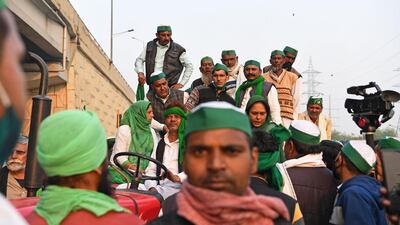
Farmers gather near a police road block at the Delhi-Uttar Pradesh state border after they were prevented them from travelling to New Delhi to protest against agricultural reforms. AFP

Canada's Trudeau backs farmer protest in India


  • English
  • Arabic

Canadian Prime Minister Justin Trudeau on Tuesday created a diplomatic row with India after lending support to tens of thousands of farmers protesting against new legislation that liberalises the farm sector, attracting a sharp rebuke from New Delhi.

Mr Trudeau expressed concern over how the Indian government was handling the crisis.

Farmers, mainly from the Sikh-majority region of Punjab, clashed with police and occupied main roads leading to the capital, blocking access to the city.

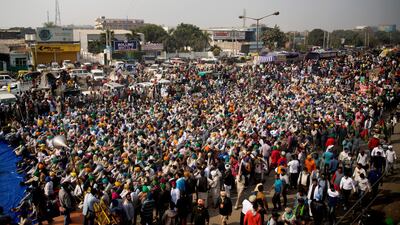
Tens of thousands of farmers from the northern Punjab and Haryana states occupied roads at the border with Delhi for a fifth day after they were prevented from proceeding to a protest.

The laws allow farmers to sell their harvests to private companies.

Farmers' unions demanded the legislation is repealed over claims it benefits businesses and ends a decades-old policy of the government deciding the minimum prices for produce.

The legislation was passed by the government in September and farmers marched to Delhi to protest against the laws last week.

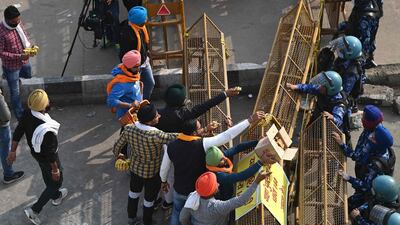
Police used tear gas, water cannons and steel barricades to thwart the marchers, leading to sporadic clashes. Protesters have been camping out near the capital since the weekend.

  • An elderly farmers shouts slogans as others listen to a speaker as they block a major highway during a protest at the Delhi-Haryana state border, India. Talks between protesting farmers and the Indian government failed. AP
    An elderly farmers shouts slogans as others listen to a speaker as they block a major highway during a protest at the Delhi-Haryana state border, India. Talks between protesting farmers and the Indian government failed. AP
  • Farmers shout slogans near a police road block stopping them from marching to New Delhi to protest against the central government's recent agricultural reforms. AFP
    Farmers shout slogans near a police road block stopping them from marching to New Delhi to protest against the central government's recent agricultural reforms. AFP
  • Farmers are seen in a tractor trolley near a police road block stopping them from marching to New Delhi to protest against the central government's recent agricultural reforms AFP
    Farmers are seen in a tractor trolley near a police road block stopping them from marching to New Delhi to protest against the central government's recent agricultural reforms AFP
  • Farmers cover their faces, amid smoke during fumigation by the muncipal corporation, near a road block stopping farmers from marching to New Delhi to protest against the central government's agricultural reforms. AFP
    Farmers cover their faces, amid smoke during fumigation by the muncipal corporation, near a road block stopping farmers from marching to New Delhi to protest against the central government's agricultural reforms. AFP
  • Farmers offer bananas and jaggery to the Indian security personnel at a road block stopping farmers from marching to New Delhi to protest against the central government's recent agricultural reforms. AFP
    Farmers offer bananas and jaggery to the Indian security personnel at a road block stopping farmers from marching to New Delhi to protest against the central government's recent agricultural reforms. AFP
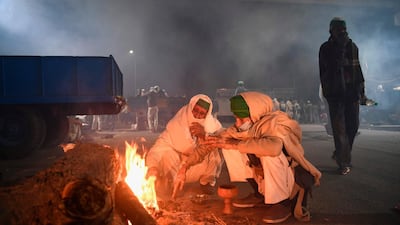
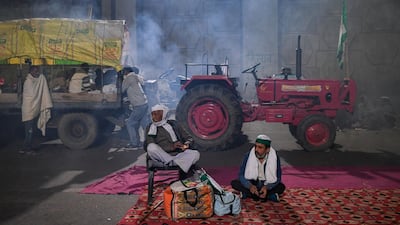
  • Farmers warm up around a bonfire under a bridge near a police road block stopping them from marching to New Delhi to protest against the central government's recent agricultural reforms. AFP
    Farmers warm up around a bonfire under a bridge near a police road block stopping them from marching to New Delhi to protest against the central government's recent agricultural reforms. AFP
  • Farmers rest on a tractor trailer near a police road block stopping them from marching to New Delhi to protest against the central government's recent agricultural reforms. AFP
    Farmers rest on a tractor trailer near a police road block stopping them from marching to New Delhi to protest against the central government's recent agricultural reforms. AFP
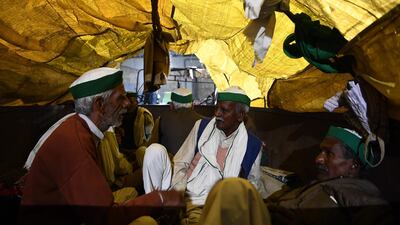
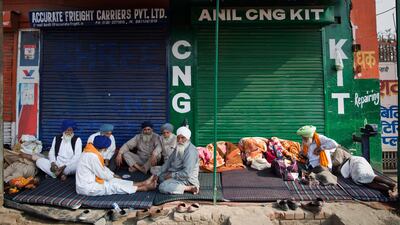
  • Farmers rest under a bridge near a police road block stopping them from marching to New Delhi to protest against the central government's recent agricultural reforms. AFP
    Farmers rest under a bridge near a police road block stopping them from marching to New Delhi to protest against the central government's recent agricultural reforms. AFP
  • Farmers smoke a water pipe while resting under a bridge near a police road block stopping them from marching to New Delhi to protest against the central government's recent agricultural reforms. AFP
    Farmers smoke a water pipe while resting under a bridge near a police road block stopping them from marching to New Delhi to protest against the central government's recent agricultural reforms. AFP
  • Protesting farmers eat a meal at the border between Delhi and Haryana state. Talks between protesting farmers and the Indian government failed Tuesday after both the parties could not reach a common ground. AP
    Protesting farmers eat a meal at the border between Delhi and Haryana state. Talks between protesting farmers and the Indian government failed Tuesday after both the parties could not reach a common ground. AP
  • Farmers listen to a speaker as they block a major highway during a protest at the Delhi-Haryana state border, India. Talks between protesting farmers and the Indian government failed. AP
    Farmers listen to a speaker as they block a major highway during a protest at the Delhi-Haryana state border, India. Talks between protesting farmers and the Indian government failed. AP
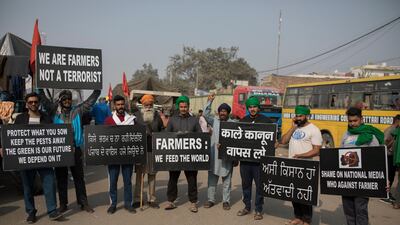
  • Protesting farmers hold placards at the border between Delhi and Haryana state. Talks between protesting farmers and the Indian government failed. AP
    Protesting farmers hold placards at the border between Delhi and Haryana state. Talks between protesting farmers and the Indian government failed. AP
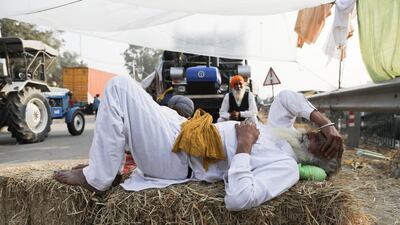
  • A farmer rests on a stack of hay at a site of a protest against the newly passed farm bills at Singhu border near Delhi, India. Reuters
    A farmer rests on a stack of hay at a site of a protest against the newly passed farm bills at Singhu border near Delhi, India. Reuters

“The situation is concerning and we’re all very worried about family and friends,” Mr Trudeau said during a Facebook interaction to mark the birth anniversary of Guru Nanak, founder of the Sikhism.

“Let me remind you, Canada will always be there to defend the right of peaceful protest."

New Delhi issued a sharp rebuke of Mr Trudeau's comments, which it said were "ill-informed and unwarranted and internal to a democratic country".

"It is also best that diplomatic conversations are not misrepresented for political purposes," India's foreign ministry spokesman Anurag Srivastava said.

There are more than 500,000 Sikhs in Canada, the second largest Sikh community outside India, which makes them an influential immigrant group.

Three members of Mr Trudeau’s Cabinet are Sikhs, including defence minister Harjit Sajjan.

Canadian Prime Minister Justin Trudeau faces criticism from the Indian government after backing the demonstrations. AP

Relations between New Delhi and Ottawa have been icy since Mr Trudeau visited India in 2018. New Delhi accused Canada of pandering to groups that want to create a sovereign Sikh state in the Punjab.

The Punjab produces about 12 per cent of India's cereals and is a key contributor to the country's gross domestic product, of which 17 per cent comes for agriculture.

About 70 per cent of India's population of 1.3 billion depend on agriculture.

But farmers across India, particularly the Punjab, face difficulties because of an increase in production costs and shrinking income. They also face water crises, erratic weather patterns and debt.

More than 3,300 farmers have died by suicide in the Punjab in the past decade. Nationally more than 10,300 farmers died by suicide in 2019, according to government figures.

Farmers say the legislation will put them at a disadvantage compared with large companies.

But the government defended the laws and Prime Minister Narendra Modi said they were a "watershed moment" in the history of the farm sector.

On Tuesday, three ministers held talks with farmer leaders to try to assuage their fears. Agriculture Minister Narendra Singh Tomar said the talks would continue on Thursday.


Match info:

Portugal 1
Ronaldo (4')

Morocco 0

Chatham House Rule

A mark of Chatham House’s influence 100 years on since its founding,  was Moscow’s formal declaration last month that it was an “undesirable
organisation”. 


The depth of knowledge and academics that it drew on
following the Ukraine invasion had broadcast Mr Putin’s chicanery.  


The institute is more used to accommodating world leaders,
with Nelson Mandela, Margaret Thatcher among those helping it provide
authoritative commentary on world events. 


Chatham House was formally founded as the Royal Institute of
International Affairs following the peace conferences of World War One. Its
founder, Lionel Curtis, wanted a more scientific examination of international affairs
with a transparent exchange of information and ideas.  


That arena of debate and analysis was enhanced by the “Chatham
House Rule” states that the contents of any meeting can be discussed outside Chatham
House but no mention can be made identifying individuals who commented.  


This has enabled some candid exchanges on difficult subjects
allowing a greater degree of free speech from high-ranking figures.  


These meetings are highly valued, so much so that
ambassadors reported them in secret diplomatic cables that – when they were
revealed in the Wikileaks reporting – were thus found to have broken the rule. However,
most speeches are held on the record.  


Its research and debate has offered fresh ideas to
policymakers enabling them to more coherently address troubling issues from climate
change to health and food security.   

 
TOP%2010%20MOST%20POLLUTED%20CITIES
%3Cp%3E1.%20Bhiwadi%2C%20India%0D%3Cbr%3E2.%20Ghaziabad%2C%20India%0D%3Cbr%3E3.%20Hotan%2C%20China%0D%3Cbr%3E4.%20Delhi%2C%20India%0D%3Cbr%3E5.%20Jaunpur%2C%20India%0D%3Cbr%3E6.%20Faisalabad%2C%20Pakistan%0D%3Cbr%3E7.%20Noida%2C%20India%0D%3Cbr%3E8.%20Bahawalpur%2C%20Pakistan%0D%3Cbr%3E9.%20Peshawar%2C%20Pakistan%0D%3Cbr%3E10.%20Bagpat%2C%20India%3C%2Fp%3E%0A%3Cp%3E%3Cem%3ESource%3A%20IQAir%3C%2Fem%3E%3C%2Fp%3E%0A
How much do leading UAE’s UK curriculum schools charge for Year 6?
  1. Nord Anglia International School (Dubai) – Dh85,032
  2. Kings School Al Barsha (Dubai) – Dh71,905
  3. Brighton College Abu Dhabi - Dh68,560
  4. Jumeirah English Speaking School (Dubai) – Dh59,728
  5. Gems Wellington International School – Dubai Branch – Dh58,488
  6. The British School Al Khubairat (Abu Dhabi) - Dh54,170
  7. Dubai English Speaking School – Dh51,269

*Annual tuition fees covering the 2024/2025 academic year

Formula%204%20Italian%20Championship%202023%20calendar
%3Cp%3EApril%2021-23%3A%20Imola%3Cbr%3EMay%205-7%3A%20Misano%3Cbr%3EMay%2026-28%3A%20SPA-Francorchamps%3Cbr%3EJune%2023-25%3A%20Monza%3Cbr%3EJuly%2021-23%3A%20Paul%20Ricard%3Cbr%3ESept%2029-Oct%201%3A%20Mugello%3Cbr%3EOct%2013-15%3A%20Vallelunga%3C%2Fp%3E%0A
Ten tax points to be aware of in 2026

1. Domestic VAT refund amendments: request your refund within five years

If a business does not apply for the refund on time, they lose their credit.

2. E-invoicing in the UAE

Businesses should continue preparing for the implementation of e-invoicing in the UAE, with 2026 a preparation and transition period ahead of phased mandatory adoption. 

3. More tax audits

Tax authorities are increasingly using data already available across multiple filings to identify audit risks. 

4. More beneficial VAT and excise tax penalty regime

Tax disputes are expected to become more frequent and more structured, with clearer administrative objection and appeal processes. The UAE has adopted a new penalty regime for VAT and excise disputes, which now mirrors the penalty regime for corporate tax.

5. Greater emphasis on statutory audit

There is a greater need for the accuracy of financial statements. The International Financial Reporting Standards standards need to be strictly adhered to and, as a result, the quality of the audits will need to increase.

6. Further transfer pricing enforcement

Transfer pricing enforcement, which refers to the practice of establishing prices for internal transactions between related entities, is expected to broaden in scope. The UAE will shortly open the possibility to negotiate advance pricing agreements, or essentially rulings for transfer pricing purposes. 

7. Limited time periods for audits

Recent amendments also introduce a default five-year limitation period for tax audits and assessments, subject to specific statutory exceptions. While the standard audit and assessment period is five years, this may be extended to up to 15 years in cases involving fraud or tax evasion. 

8. Pillar 2 implementation 

Many multinational groups will begin to feel the practical effect of the Domestic Minimum Top-Up Tax (DMTT), the UAE's implementation of the OECD’s global minimum tax under Pillar 2. While the rules apply for financial years starting on or after January 1, 2025, it is 2026 that marks the transition to an operational phase.

9. Reduced compliance obligations for imported goods and services

Businesses that apply the reverse-charge mechanism for VAT purposes in the UAE may benefit from reduced compliance obligations. 

10. Substance and CbC reporting focus

Tax authorities are expected to continue strengthening the enforcement of economic substance and Country-by-Country (CbC) reporting frameworks. In the UAE, these regimes are increasingly being used as risk-assessment tools, providing tax authorities with a comprehensive view of multinational groups’ global footprints and enabling them to assess whether profits are aligned with real economic activity. 

Contributed by Thomas Vanhee and Hend Rashwan, Aurifer

Living in...

This article is part of a guide on where to live in the UAE. Our reporters will profile some of the country’s most desirable districts, provide an estimate of rental prices and introduce you to some of the residents who call each area home.