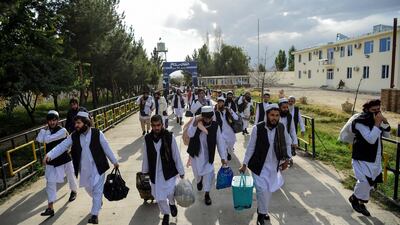
Despite the Taliban’s announcement of a three-day ceasefire beginning on Friday, Eid Al Adha celebrations across Afghanistan remain sombre and muted. The increasing violence, failing peace efforts and swiftly spreading pandemic weigh on people’s minds in the capital Kabul and across the country.
On July 28, the Taliban announced a temporary truce for Eid Al Adha, instructing all fighters to refrain from attacking enemies unless provoked.
"All Mujahideen are instructed to halt offensive operations against enemy forces during the three days and nights of Eid Al Adha," Zabihullah Mujahid, the Taliban spokesperson, said in a statement on Tuesday. "However, if the opposition carries out an attack, they must be met with a strong response," he added.
This is the second ceasefire between the insurgent group and the Afghan government this year, and only the third pause in fighting over two decades of war in Afghanistan.
But with insurgent attacks continuing to cause high civilian casualties, Afghans are sceptical of the Taliban’s commitment to peace.
A car bomb detonated on Thursday, just hours ahead of the start of the ceasefire, left 18 killed and over 40 civilians injured in Logar, a province close to the Afghan capital. The Taliban has denied involvement in the attack but Afghan security officials claim to have evidence that a local Taliban leader was involved in the massacre.

This year has seen a rise in violence in Afghanistan, with the United Nations Assistance Mission in Afghanistan (UNAMA) reporting a 33 percent increase in civilian casualites from Taliban related-attacks in the first half of 2020 compared to 2019.
As a result, many Afghans remain deeply cautious, even as they welcome the temporary truce.
“I was so happy when I heard about the ceasefire. it seemed like it could help pave the way for a permanent end of fighting,” Shkula Zadran, a 25-year-old women’s rights activist from Kabul said.
Memories of the Eid Al Adha ceasefire in 2018 has rekindled hopes for brotherhood and bonhomie. During that truce, the Taliban fighters entered into government-controlled cities and interacted with the locals they usually target, joining in with celebrations and taking selfies.
“That ceasefire was quite unusual and surprising. The Taliban were walking around the city, enjoying ice cream and food with locals. Some were even interviewed by female journalists. It was like a dream,” she recalled.
-
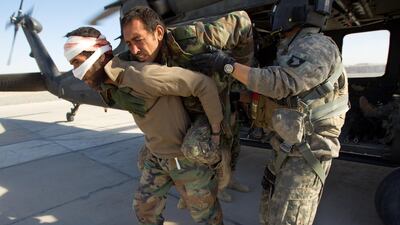
Sergeant Jay Kenney, 26, with the 101st Airborne Division, Task Force Destiny, assists wounded Afghan National Army (ANA) soldiers off the Blackhawk UH-60A helicopter after they were rescued in an air mission in Kandahar on December 12, 2010 in Kandahar province, Afghanistan. Getty Images -
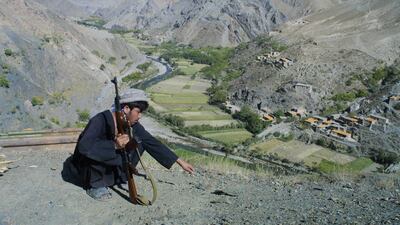
An Afghan Northern Alliance fighter mans the front line against the Taliban on October 2, 2001 near Jabul os Sarache, 30 miles north of Kabul. Getty Images -
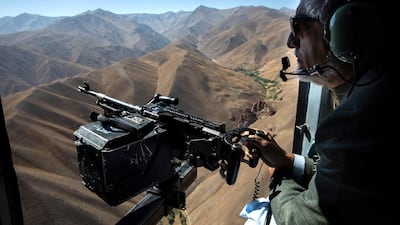
Abdullah Abdullah, chief executive of Afghanistan travelling via helicopter for the final campaign rally in Bamiyan, Afghanistan on September 25, 2019. Afghans will head to the polls on Saturday, September 28th. Getty Images -
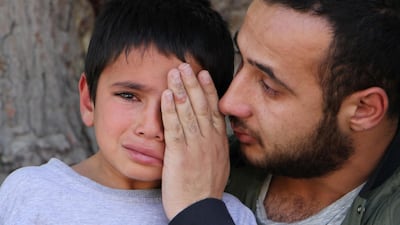
Mustafa Tamanna, 10, son of Afghan reporter Zabihullah Tamanna, weeps during the funeral ceremony in Kabul, Afghanistan on June 7, 2016. Tamanna was killed by a rocket-propelled grenade fired by the Taliban. Getty Images -
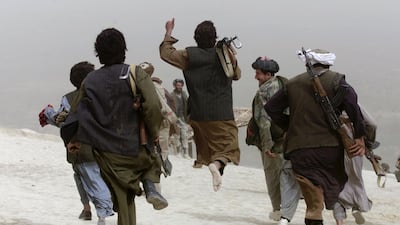
Northern Alliance soldiers come back from the front line after a battle near Charatoy town in the north of Afghanistan on October 10, 2001. REUTERS -
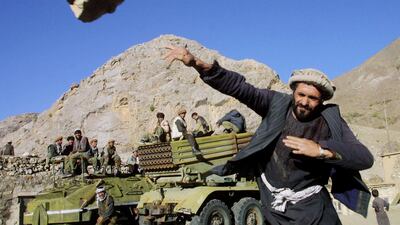
A Northern Alliance fighter throwing rocks as part of a popular national game yards away from a multiple Grad missile launcher in October 12, 2001 in the Salang Gorge in Northern Afghanistan. Getty Images -
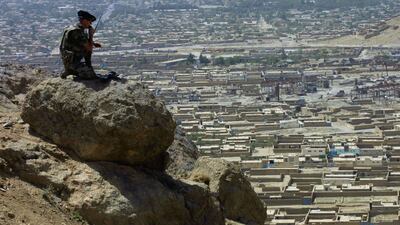
A French soldier from the 7th Mountain Regiment, part of the International Security and Assistance Force (ISAF) stands on a boulder overlooking Kabul during a patrol August 3, 2002 in Afghanistan. The ISAF has been patrolling Kabul since January 2002, working with the government and a new police force to prevent the violence and lawlessness that threatened to engulf the city after a U.S.-led coalition forced the Taliban from power. Getty Images -
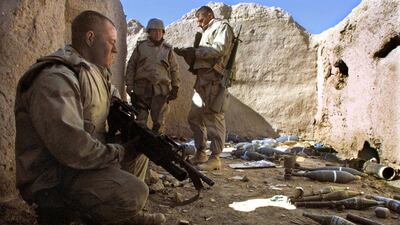
US Marine Sgt. Jerry Brown (L) of Jacksonville, North Carolina watches over a weapons cache found during a patrol near the American military compound at Kandahar Airport in January 16, 2002 in Kandahar, Afghanistan. The Marines recovered mortars, rockets, rocket-propelled grenades and artillery rounds discovered in various caches near the base while on the patrol. Getty Images) -
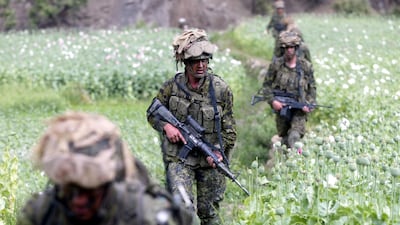
Members of the Princess Patricia's Canadian Light Infantry patrol through poppy fields in the village of Markhanai in May 6, 2002 in the Tora Bora valley region of Afghanistan. Getty Images -
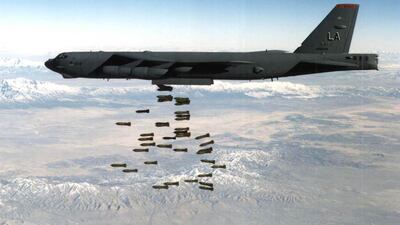
The United States and Britain on October 7, 2001 launched a first wave of air strikes against Afghanistan. President George W. Bush said the action heralded a "sustained, comprehensive and relentless" campaign against terrorism. REUTERS -
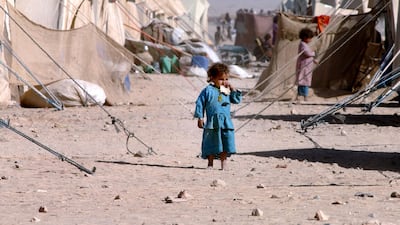
A young Afghan girl eats a piece of bread at the Chaman refugee camp on November 8, 2001 on the Pakistan border with Afghanistan. The UNHCR has estimated that since September 11, 2001 over 135,000 Afghans have crossed the border into Pakistan, adding to the already millions of refugees living in the country. Getty Images -
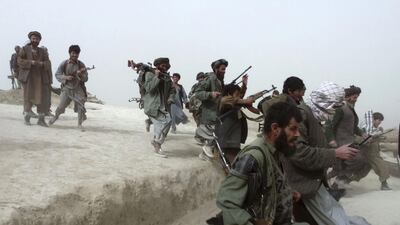
Afghan opposition Northern Alliance soldiers leap over a trench as they return from front line positions after battle near the town of Charatoy in the north of Afghanistan October 10, 2001. REUTERS -
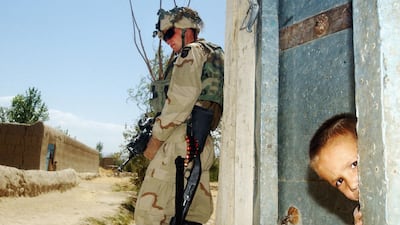
An Afghan child peeks out from the doorway of his family's home as a US Army soldier from the 101st Airborne stands guard in the eastern Afghan village of Hesarak on July 16, 2002 during what the Army refers to as a 'sensitive site exploitation' mission or 'SSE'. Getty Images -
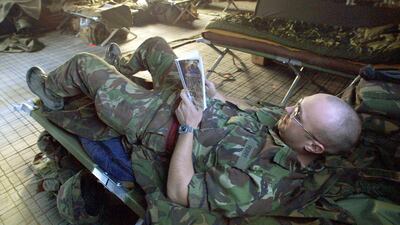
Fred Perry, a British Royal Engineer soldier, reads the book "Black Hawk Down" inside his tent after a day of work on January 29, 2002 at the International Security Assistance Force (ISAF) barracks at the Kabul airport in Kabul, Afghanistan. Getty Images -
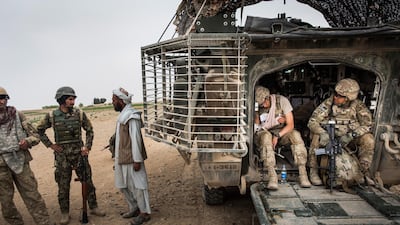
Afghan soldiers (L) speak to a local Afghan, while a medic in the U.S. Army's 1st Battalion, 36th Infantry Regiment, Charlie Company (R) monitors a soldier who has just survived a blast from an improvised explosive device (IED) while driving a vehicle during a mission near Command Outpost Pa'in Kalay, on March 19, 2013 in Kandahar Province, Maiwand District, Afghanistan. Getty Images -

Marines on a light armored vehicle prepare for patrol as an AH1W "Super Cobra" helicopter flies by on December 28, 2001 at the U.S. Marine Corps Base in Kandahar, Afghanistan. Getty Images -
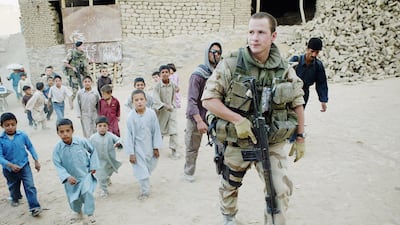
A Norwegian ISAF (International Security Assistance Force)soldier from Recce Squadron 3 patrols on October 4, 2004 in Kabul, Afghanistan as election officials get ready for the Presidential elections. Getty Images -
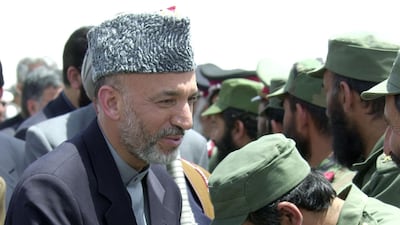
Interim Afghan leader Hamid Karzai (L) is greeted by a group of Afghan military officers on his arrival to Kandahar airbase on May 04, 2002 in Southern Afghanistan. Getty Images -
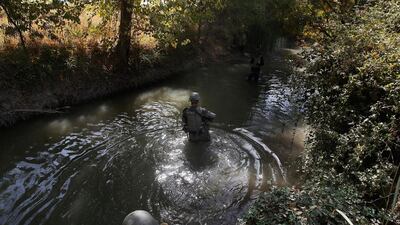
Soldiers in the U.S. Army's 101st Airborne Division wade though a creek to avoid buried insurgent bombs while on patrol October 16, 2010 in Zhari district west of Kandahar, Afghanistan. Getty Images -

British commandos descend from a mountain observation post overlooking the beginning of the Helmand River at the Kajaki hydroelectric dam on March 13, 2007 in Afghanistan's southern Helmand province. Getty Images -
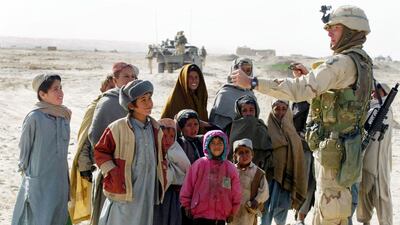
101st Airbornes 1st Sgt. Kerry Black from Westmoreland, Tennessee uses an Afghan child's sling shot on February 6, 2002 as children crowd around him while he patrols on the outskirts of Kandahar, Afghanistan. Getty Images -

Marine Cpl. Jonathan Eckert of Oak Lawn, IL attached to India Battery, 3rd Battalion, 12th Marine Regiment works his improvised explosive device (IED) sniffing dog Bee as they secure a compound during a patrol near Forward Operating Base (FOB) Zeebrugge on October 11, 2010 in Kajaki, Afghanistan. Getty Images -
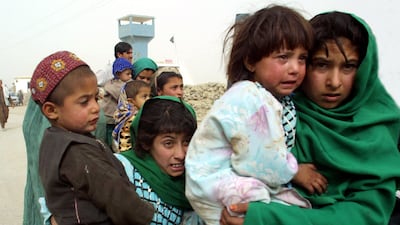
Afghan refugees walk across the border into Pakistan on October 11, 2001 as they leave Afghanistan at the Chaman crossing point on the 4th day of U.S.-led air strikes against the ruling Taliban and terrorist networks in the country. Getty Images -

Anti-Taliban Afghan fighters watch several explosions from U.S. bombings in the Tora Bora mountains in Afghanistan on December 16, 2001. -
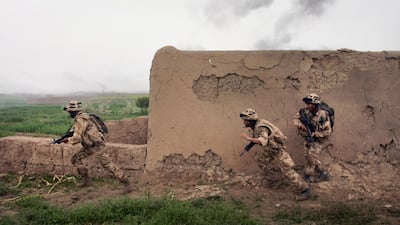
British Marines run under fire from the Taliban during a morning operation on March 18, 2007 near Kajaki in the Afghan province of Helmand. Getty Images -

Afghan Army troops prepare to board a British chinook helicopter from their base at Shorabak on March 12, 2007 in Southern Helmand province, Afghanistan. Getty Images -
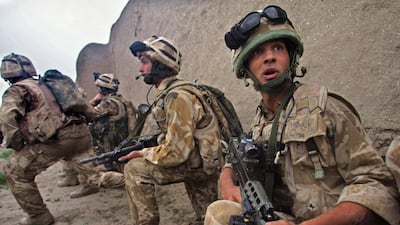
British Marine Joe Harvey from Stafford, England (R), watches as British forces come under fire by Taliban insurgents on March 18, 2007 near Kajaki in the Afghan province of Helmand. Getty Images -

U.S. Army 101st Airborne 3-187 "Bravo" company soliders pass through a corn field while conducting a sensitive site exploitation (SSE) mission July 23, 2002 near the town of Narizah in Southeastern Afghanistan. Getty Images -
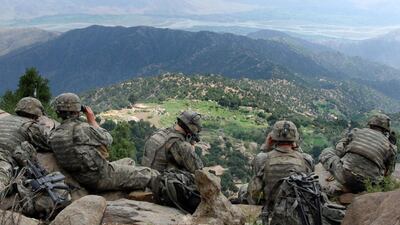
Scouts from 2nd Battalion, 503rd Infantry Regiment (Airborne), pull overwatch during Operation Destined Strike while 2nd Platoon, Able Company searches a village below the Chowkay Valley in Kunar Province, Afghanistan on August 22, 2006. US Army


But less than 24 hours after the latest ceasefire announcement, Ms Zadran regretted raising her hopes. “I watched the aftermath of the explosion in Logar that killed so many innocent people. Now I feel this announcement of ceasefire is meaningless. The Taliban hasn’t shown real commitment and willingness for their actions,” she said.
Similar sentiments were shared across the country as Afghans mourned the loss of human life in yet another attack on civilians. “We can’t trust them. They might deny it, but it is so clear to us that Taliban killed my friends,” said Haroon, a civil society activist from Logar who lost five loved ones in Thursday’s attack—four of whom were from one family.
Haroon, who did not wish to share his real name for fear of reprisal, claimed the number of casualties was much higher than the government had declared. “What peace and what ceasefire are you talking about? I have a list of 143 people who were injured. Can you imagine the grief of a father who lost four sons in this attack?” he said, speaking between tears.
“The Taliban offer peace to Americans, but for Afghans, they call us kafir (disbeliever) and give [us] violence,” he said.

The Taliban has ramped up attacks on Afghans and government forces this year, despite promising to reduce violence in a deal signed with the US on February 29.
A quarterly report released on Friday by the US government’s oversight authority on reconstruction in Afghanistan expressed concern over mounting casualties.
According to the Special Inspector General for Afghanistan Reconstruction (SIGAR) report, the months of April to June showed a 59-percent increase in civilian casualties in Afghanistan on the previous quarter, and an 18-per cent increase compared to the same period last year.
Amid this rising civilian death toll, many Afghans have simply lost hope. "Peace in this country is close to impossible," Ahmad Ali, a 21-year-old shopkeeper from West Kabul told The National.
“The last time they implemented such a ceasefire [in 2018], three days later they killed dozens of Hazara men in my village in Maidan Wardak. How is that peace?”
The Taliban has been known to persecute members of the Hazara community, a Shia minority group in Afghanistan.
Ali, who has only ever known war in his lifetime, has been an eyewitness to the growing insecurity in the country.
“I am only 21 but I can tell you tonnes of stories of explosions, roadside bombs and complex attacks that I have seen with my own eyes,” he said.
Ms Zadran, the women’s rights activist, says negotiation seems futile. “The Taliban are playing games with our lives… They want the Afghan government to release their prisoners but in return they are killing our people. For any negotiation there needs to be trust, but how can we trust them if they are not honest in their words.”

