• In this screen image captured at Beijing Aerospace Control Center released by Xinhua News Agency, Chinese astronauts from left, Liu Yang, Chen Dong and Cai Xuzhe salute after entering the space station core module Tianhe on Sunday, June 5, 2022. Photo: Li Xin / Xinhua via AP
    In this screen image captured at Beijing Aerospace Control Center released by Xinhua News Agency, Chinese astronauts from left, Liu Yang, Chen Dong and Cai Xuzhe salute after entering the space station core module Tianhe on Sunday, June 5, 2022. Photo: Li Xin / Xinhua via AP
  • The rocket carrying the Shenzhou-14 mission with three Chinese astronauts lifts off at the Jiuquan Satellite Launch Center in Northwest China’s Gansu Province on June 5, 2022. Photo: AFP / China OUT
    The rocket carrying the Shenzhou-14 mission with three Chinese astronauts lifts off at the Jiuquan Satellite Launch Center in Northwest China’s Gansu Province on June 5, 2022. Photo: AFP / China OUT
  • Chinese astronauts Cai Xuzhe (L), Chen Dong (C) and Liu Yang pose during a ceremony prior to the launch at the Shenzhou-14 mission at the Jiuquan Satellite Launch Center in Northwest China’s Gansu Province on June 5, 2022. China launched a rocket carrying three astronauts on a mission to complete construction on its new space station, the latest milestone in Beijing's drive to become a major space power. Photo by AFP / China OUT
    Chinese astronauts Cai Xuzhe (L), Chen Dong (C) and Liu Yang pose during a ceremony prior to the launch at the Shenzhou-14 mission at the Jiuquan Satellite Launch Center in Northwest China’s Gansu Province on June 5, 2022. China launched a rocket carrying three astronauts on a mission to complete construction on its new space station, the latest milestone in Beijing's drive to become a major space power. Photo by AFP / China OUT
  • The astronauts will complete the space station's construction and carry out 24 science experiments during their six-month stay on the Tiangong station. Photo: Li Gang / Xinhua via AP
    The astronauts will complete the space station's construction and carry out 24 science experiments during their six-month stay on the Tiangong station. Photo: Li Gang / Xinhua via AP
  • The latest crew will complete the assembly and construction of Tiangong, expanding it from a single-module structure to a three-module national space laboratory. This will comprise of the Tianhe core module and two laboratory modules, Wentian and Mengtian. Photo: Li Gang / Xinhua via AP
    The latest crew will complete the assembly and construction of Tiangong, expanding it from a single-module structure to a three-module national space laboratory. This will comprise of the Tianhe core module and two laboratory modules, Wentian and Mengtian. Photo: Li Gang / Xinhua via AP
  • During the crew’s first week on Tiangong, their job will be to enter the cargo spacecraft and transfer the supplies. Photo: CHINA OUT.
    During the crew’s first week on Tiangong, their job will be to enter the cargo spacecraft and transfer the supplies. Photo: CHINA OUT.
  • The crew will also be carrying out 24 science experiments during their stay on Tiangong, including ones that will study the impact of weightlessness on the human body. Photo: Cai Yang / Xinhua via AP
    The crew will also be carrying out 24 science experiments during their stay on Tiangong, including ones that will study the impact of weightlessness on the human body. Photo: Cai Yang / Xinhua via AP

China to recruit more astronauts as its space station nears completion


Sarwat Nasir
  • English
  • Arabic

China is recruiting more astronauts for its human space flight programme, as its space station nears completion.

The China Manned Space Agency announced last week that 12 to 14 reserve astronauts will be selected, including pilots, space flight engineers and payload experts.

The announcement comes as the construction of the Tiangong space station is nearing completion, with the third and final module expected to be launched in October.

“In order to meet the needs of the follow-up missions of the manned space project, the selection of the fourth batch of reserve astronauts in the country has been started recently,” the space agency said.

Astronauts Chen Dong, Liu Yang and Cai Xuhe are already on board the station.

They arrived there in June on a six-month mission to complete the lab’s construction.

The Tiangong station falls under China’s ambitions to become a leading space power, with a thriving sector that also includes planetary, lunar and deep-space exploration.

From 2016 to December 2021, the country completed 207 launch missions, including 183 by the Long March carrier rocket series.

China has already landed a spacecraft on the Moon and Mars.

It also has plans to build the International Lunar Research Station on the Moon's surface, with the help of international partners.

A launch pad for emerging nations

China has said that it is also open to hosting astronauts from other countries on its Tiangong space station.

Zhaoyu Pei, deputy director of lunar exploration and the space engineering centre at the China National Space Agency, said that emerging space nations were showing interest in sending their astronauts to Tiangong.

“Some developing countries are trying to look for opportunities to send their astronauts to the Chinese space station,” he said at the International Astronautical Congress in Paris last month.

The agency also spoke about how other countries could get involved in their lunar research station by sending their own payloads.

The lunar research station was first announced as a joint project with Russia’s space agency Roscosmos, but officials did not mention Russia’s participation during their presentation.

Roscosmos did not participate in the conference. Russian news agency Tass had reported that officials did not “receive invitations and visa assistance”.

China will help the UAE to launch its second Moon rover later this decade.

However, China’s relations with US space agency Nasa are still non-existent.

Nasa is not allowed to co-operate with China because of the Wolf Amendment — a law passed by the US Congress in 2011 that prevents the agency from working with China’s space agency and private companies.

Nasa administrator Bill Nelson had said that co-operation is “up to China” and that there “has to be an openness” from their side “that has not been forthcoming”.

“We have done deconfliction with regard to activities in and around Mars,” Mr Nelson said.

“But we see that there’s not a lot of transparency with regard to the Chinese space programme."

Memorable moments on the International Space Station — in pictures

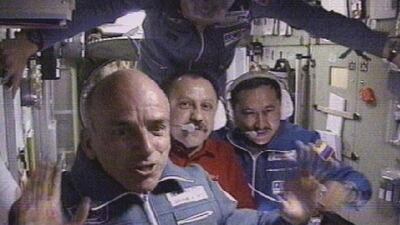
  • The world's first space tourist Dennis Tito waves in front of the International Space Station crew on April 30, 2001. Courtesy: RTV
    The world's first space tourist Dennis Tito waves in front of the International Space Station crew on April 30, 2001. Courtesy: RTV
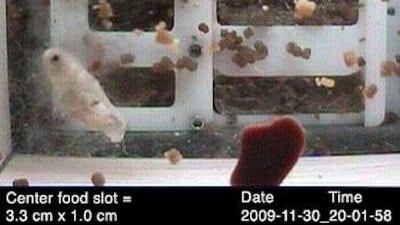
  • Painted Lady butterflies live in their habitat aboard the International Space Station. Courtesy: Nasa
    Painted Lady butterflies live in their habitat aboard the International Space Station. Courtesy: Nasa
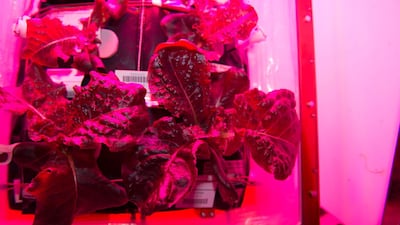
  • Red romaine lettuce was the first vegetable to grow in space in August 2015. Courtesy: Nasa
    Red romaine lettuce was the first vegetable to grow in space in August 2015. Courtesy: Nasa
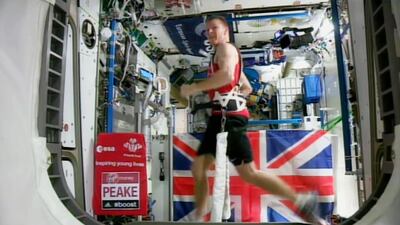
  • In 2016, British astronaut Tim Peake completed the fastest marathon in space. Courtesy: European Space Agency
    In 2016, British astronaut Tim Peake completed the fastest marathon in space. Courtesy: European Space Agency
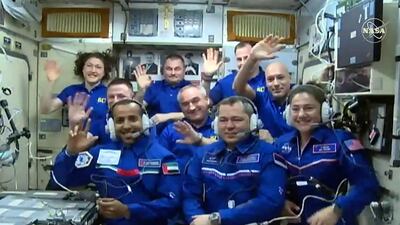
  • Maj Hazza Al Mansouri meets the rest of the team at the International Space Station shortly after docking. Courtesy: Nasa
    Maj Hazza Al Mansouri meets the rest of the team at the International Space Station shortly after docking. Courtesy: Nasa
Updated: October 08, 2022, 7:30 AM