



Dengue cases are soaring in Asia as countries continue to divert public health resources to fight the Covid-19 pandemic.
Doctors say efforts to eliminate mosquitoes and surveillance have taken a back seat as governments grapple with containing coronavirus cases and rolling out testing and vaccination campaigns.
Dr Lal Sadasivam, a public health expert and a consultant for the United Nations, told The National that after two years of fighting Covid-19, governments will have to refocus on dengue control measures.
a public health expert for United Nations
“A chunk of government and donor funding was focused on containing the global pandemic,” he said.
“Even awareness programmes relayed on television channels and radios only spoke about the need for wearing masks and washing hands. We did not hear much about mosquito control measures and the need to empty out stagnant water.
“It is time to take notice of the rising cases of dengue even though we are not yet Covid-free. We cannot afford another epidemic.”
Dr Deepak Saxena, professor of epidemiology at the Indian Institute of Public Health in the state of Gujarat, said the pandemic hurt the fight against other dangerous diseases, including dengue.
“With Covid-19, priorities changed. Focus shifted from not just dengue but other diseases like tuberculosis, malaria, and even cancer,” Dr Saxena told The National.
More people fell ill with dengue this summer as Asia recorded higher than average rainfall, putting severe pressure on the already strained health infrastructure of these countries.
What is dengue?
It is a viral infection transmitted to humans through Aedes aegypti mosquitoes, mainly found in tropical, subtropical and some temperate climates.
These mosquitoes can also spread chikungunya, Zika fever, Mayaro and yellow fever.

Dengue infections are caused by four closely related viruses named DEN-1, DEN-2, DEN-3, and DEN-4 and because of that, a person can get infected four times.
A patient can be asymptomatic or show severe flu-like symptoms. In extreme cases, it can lead to internal bleeding, organ impairment, plasma leakage and even death.
Pakistan's deadly floods exacerbated dengue crisis
Unprecedented floods in Pakistan that have killed nearly 1,500 people have also led to a steep rise in dengue cases across the country.
In the last week, the capital Islamabad and Rawalpindi reported more than 1,400 cases, double the number in the week before.
Hospitals in the region are reportedly reporting an average of 100 new infections a day, and three people died in Islamabad alone in the past week.
Dr Syed Faisal Mahmood, associate professor at the infectious diseases department at the Aga Khan University in Pakistan, told The National that the country was expecting a bad cycle this year.
“Dengue epidemics occur in a three- to five-year cycle. We had a bad one in 2019,” he said.
He said the floods have increased the risk of waterborne diseases, including cholera and dengue.
“Usually, dengue infections peak during the second half of September and October. But with monsoons and floods, we saw a high rate of infections starting in June and July”.
Floods in Pakistan — in pictures
-

Nearly a third of Pakistan is flooded — an area the size of the United Kingdom — following months of record monsoon rains, which have killed 1,300 people and wreaked havoc. AFP -
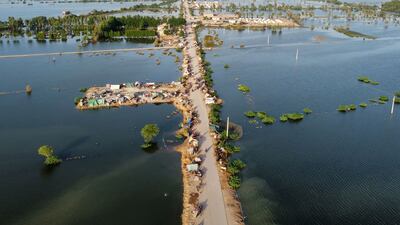
Makeshift tents for people displaced due to the floods, which were caused by heavy monsoon rains in Sohbatpur, Balochistan, Pakistan. AFP -
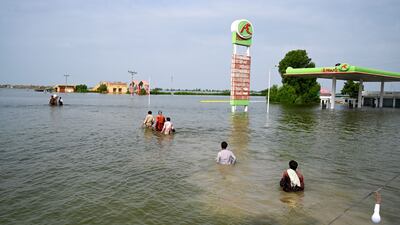
People have been left to wade through floodwaters in order to return home in Dadu District, Sindh Province. AFP -
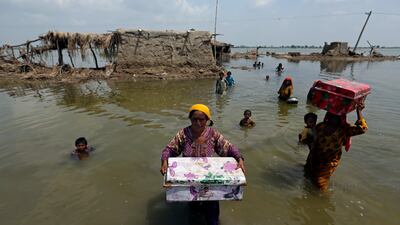
Women carry belongings salvaged from their flooded home in the Qambar Shahdadkot District of Sindh Province. AP -
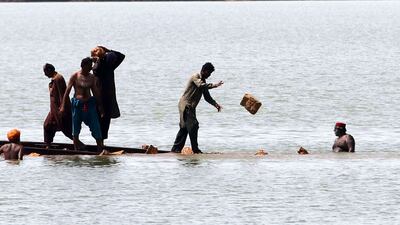
Pakistani railway workers repair the track in flooded areas in Sehwan, Sindh Province. EPA -
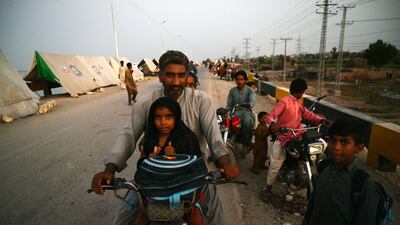
Families gather outside their tents at a makeshift camp in Sukkur, Sindh Province. AFP -

Men perform ablution with the flood water in Bajara village, at the banks of Manchar Lake, Sehwan. Reuters -

Nur Mohammad has taken refuge at a school after the rains in Jacobabad, Sindh Province. AFP -
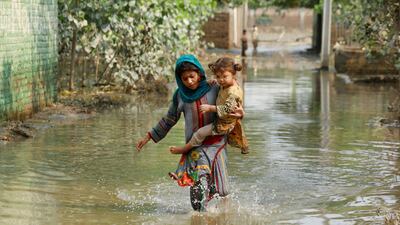
A girl carries her sibling as she walks through floodwaters in Nowshera, Khyber Pakhtunkhwa. Reuters -
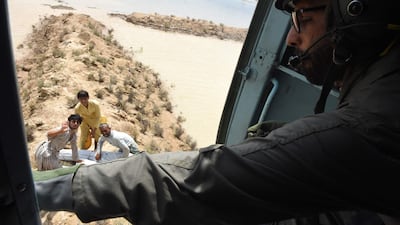
A Pakistan soldier drops tents and food aid from a helicopter in Jaffarabad District, Balochistan Province. AFP -

People wait for relief supplies being dropped by Pakistan army helicopters. AFP -

Roads across the country have been damaged by floodwaters, including a vital route in Kalam Valley, Khyber Pakhtunkhwa. AP -
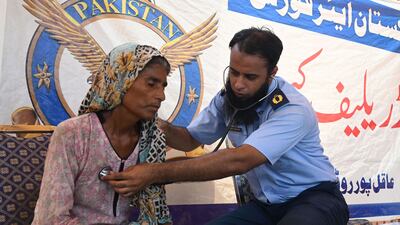
A Pakistan Air Force doctor examines a patient displaced by the floods at a makeshift medical camp in Rajanpur District, Punjab Province. AFP -
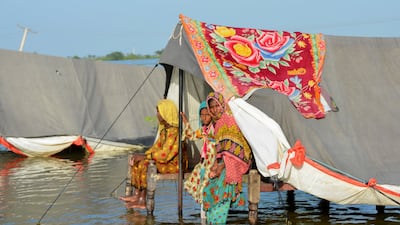
A family sit with their belongings as floodwaters rise in Sohbatpur, in Jaffarabad District. Reuters -
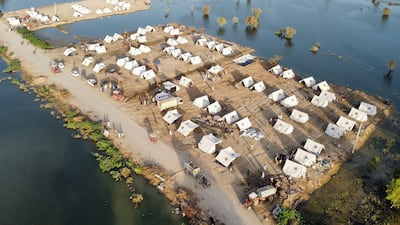
Makeshift tents in Sohbatpur. AFP -
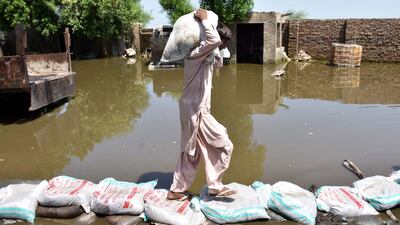
People affected by floods move to higher ground on the outskirts of Quetta, Balochistan Province. EPA -
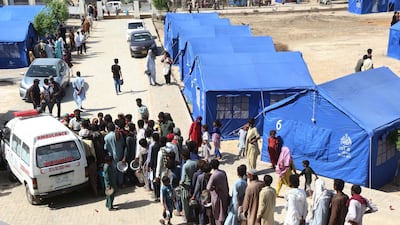
Displaced people join a food queue at a tent city set up by the Government of Sindh, Hyderabad. EPA -
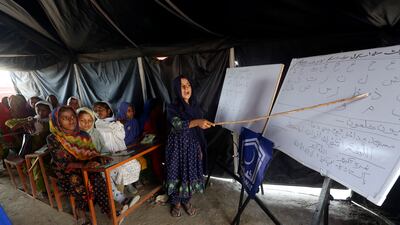
Children attend classes in Sukkur. AP


Officials say it may take three to six months for the water to recede.
Dr Mahmood said the limited resources to educate the public and to run prevention campaigns because of the pandemic were partly to blame for the increase in dengue infections.
“We had two major Covid surges this year due to the Omicron variant. But cases are dipping now and hospitals are not under pressure, which means we have enough resources to treat dengue patients,” he said.
Dr Mahmood said health authorities are now focusing on vector control measures, which is the detection and elimination of mosquito breeding sources.
Dengue cases hit Vietnam and Singapore after pandemic lull
Thang Nguyen Tien, a public health researcher at the Consortium of Agricultural Research Centres, told the British Medical Journal that dengue is on the rise because of the failure of mosquito control programmes, bad preventive practices, and stagnant water, particularly in densely populated cities.
As of the first week of August 2022, Vietnam had recorded 145,536 cases and 53 deaths.
In June, Singapore declared that is was fighting a dengue 'emergency' with cases rising to more than 11,000.
The National Environment Agency is conducting intensified vector control operations at various dengue cluster areas and daily cases had dropped below 300 by the middle of September.
Residents are urged to carry out protective actions, including spraying insecticide in dark corners around the house, applying insect repellent regularly and wearing long-sleeved tops and long trousers.
Source eradication of mosquito breeding habitats and spraying of insecticide to control the adult mosquito population remain key to dengue prevention.
In the Philippines, official data shows 319 people had died of dengue up to August this year and cases continue to rise.
As of July 16, 82,597 cases had been recorded, up 106 per cent from last year.
A similar trend has been reported in Malaysia, the Philippines and Indonesia.
India braces for a sharp rise in cases
Data from European Centre for Disease Prevention and Control shows that as of May 31, 10,172 cases and three deaths have been reported in India, but the numbers are largely underreported.
In Delhi, 61 cases have been reported in 2022 so far, the highest since 2017. Dr Saxena of the Indian Institute of Public Health, said cases would go up by the end of September when monsoon rains intensify.

“Unfortunately, there is no treatment for dengue. So, what we need is surveillance and community participation. The good news is after two years, our system is again ready to fight dengue,” he said.
More wet days mean more cases
With the monsoon season expected to last until the end of September, experts are worried about dengue infections surging in the coming weeks.
Experts say changes in weather increase the risk of waterborne diseases such as dengue.
“Climate change will make dengue fever more of a threat globally as largely populated areas that were previously unexposed to the disease will be at much higher risk,” Youssef Idaghdour, assistant professor of biology at the New York University Abu Dhabi told The National.
“There should be routine entomological [study of insects] surveillance to identify potential mosquito breeding sites and deploy aggressive vector control measures.”
Mr Idaghdour said these measures have been affected by diverting public health resources to contain Covid-19 during lockdowns.
“If control measures are taken immediately after the first cases are detected, the disease might not have spread all over parts of Asia as is currently happening”.
Fight against neglected tropical diseases — in pictures
-
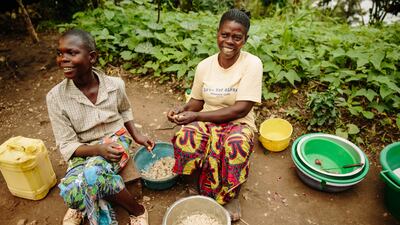
Toyota Mksiyura, right, from the Democratic Republic of Congo, who suffers from severe swelling in her feet caused by lymphatic filariasis. The UAE's Reach Campaign is aimed at tackling neglected tropical diseases. Photo: End Fund -
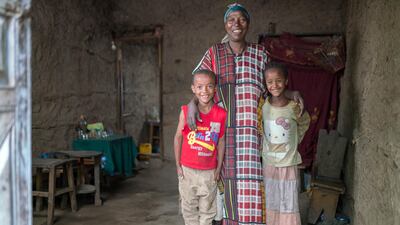
Ethiopian Kasech Fantu, who suffers from elephantiasis, with her children. Neglected tropical diseases are little known in the wider world but devastating for sufferers. Photo: The Carter Centre -

Daniel Boakye, a researcher working with The End Fund, is one of the world's foremost experts on black flies. The UAE began its Reach initiative mainly to help eliminate river blindness and lymphatic filariasis, which are caused by parasitic worms carried by flying insects. Photo: End Fund -
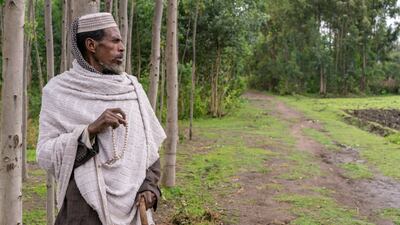
Farmer Lelamo Mukhtar had to sell his land and could not work anymore after he became ill with lymphatic filariasis. Photo: End Fund -
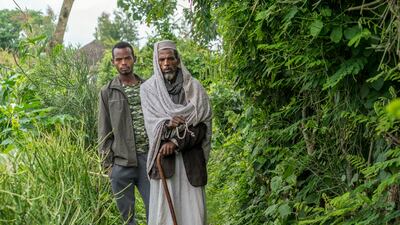
Mr Mukhtar with his son Fouwad, who has taken over farming and supporting the family after his father became ill. Photo: End Fund -
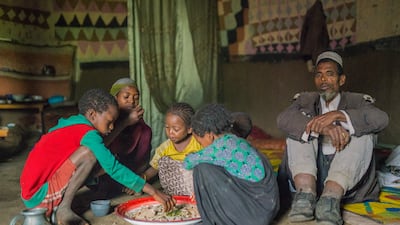
Mr Mukhtar with some of his 10 children. Photo: End Fund -
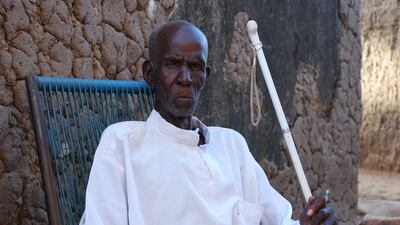
Malian Moce lost his eyesight over thirty years ago to river blindness. More than 200 million people globally require treatment for the disease, one of the leading causes of preventable blindness. Photo: End Fund -
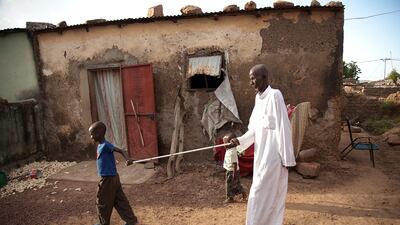
Moce is now receiving treatment. Photo: End Fund



