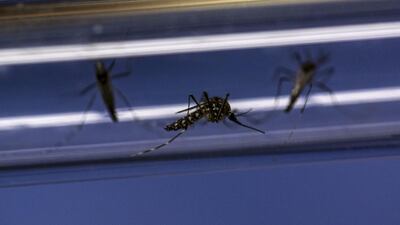

Dengue fever rates plummeted in a trial where an army of mosquitoes was infected with a virus inhibiting bacteria.
The study, which resulted in a 77 per cent cut in infections and an 86 per cent fall in hospital cases, took place in Yogyakarta city, Indonesia.
The World Mosquito Programme said the results could help eradicate the dengue fever virus, which causes about 400 million infections every year.
Dengue can result in outbreaks that overwhelm hospitals. Its symptoms include a high fever, headache, vomiting, muscle and joint pains, and a skin rash.
The study was inspired by the idea that mosquitoes infected with the bacteria Wolbachia do not transmit viruses to people as easily, which reduces the incidence of those viruses.
The bacteria is found in 60 per cent of insect species, and resides in the same areas of the mosquito body as viruses like dengue, where it competes for space.
This makes it harder for dengue to reproduce, meaning mosquitoes are much less likely to spread viruses.
Researchers divided the Indonesian city into 24 clusters and released mosquitoes infected with Wolbachia into half of them.
Impressed by the success of the study, the scientists released the Wolbachia-infected mosquitoes across the entire city.
"It's very exciting, it's better than we could have hoped for to be honest," researcher Dr Katie Anders told BBC News.
"We think it can have an even greater impact when it is deployed at scale in large cities around the world, where dengue is a huge public health problem," said Dr Anders, who is also the director of impact assessment at the World Mosquito Programme.
The possibility of eliminating dengue
Models which predicted Wolbachia would cut transmission of dengue by 66 per cent to 75 per cent suggested the bacteria would eventually eradicate the virus in some areas.
"Our results suggest that establishment of [Wolbachia-infected mosquitoes] at a high frequency in a dengue-endemic setting would result in the complete abatement of transmission," said a study led by the Imperial College London epidemiologist Professor Neil Ferguson from 2015.
"Establishment of [Wolbachia-infected mosquitoes] is also predicted to have a substantial effect on transmission that would be sufficient to eliminate dengue in low or moderate transmission settings, but may be insufficient to achieve complete control in settings where R0 is high."
Singapore also released Wolbachia-infected mosquitoes in 2016, during the height of the Zika outbreak, as part of a six-month field study to reduce the number of the insects in the city state.
Research showed that when male mosquitoes carrying Wolbachia mate with female mosquitoes that do not have the bacteria, their eggs do not hatch.
The study continues, but has so far shown a 90 per cent decrease in the number of mosquitoes in the release sites.
In pictures: dengue fever outbreak in the Philippines
-

Dengue patients at the San Lazaro government hospital in Manila on August 7. All photos: AP -
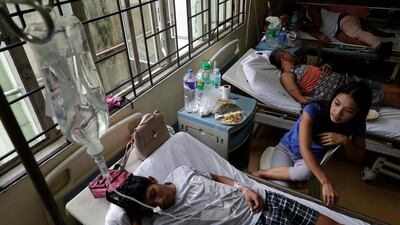
The Philippines' Department of Health says the country's outbreak of dengue is a national epidemic. -

A young dengue patient walks inside the San Lazaro government hospital in Manila. -

A young dengue patient plays on a smartphone at the San Lazaro government hospital in Manila. -
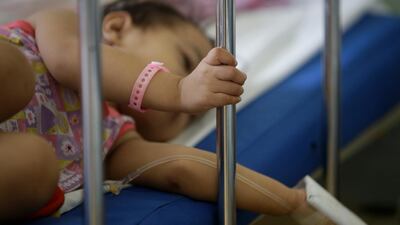
The Philippines has recorded 146,062 cases of dengue from January through July 20 this year. -

Dengue patients at the San Lazaro government hospital in Manila. -

Dengue infections are caused by four closely related viruses named DEN-1, DEN-2, DEN-3, and DEN-4 and because of that, a person can get infected four times.



