



It was 1.30am on Wednesday when Mohammad Noor was woken by the earth shaking around him, possessions smashing to the floor.
A 6.1-magnitude earthquake that would kill more than 1,000 people in the eastern Afghan provinces of Khost and Paktika had struck.
“I grabbed my two children and screamed at my wife to run. Luckily, we were able to leave the house before it partially collapsed,” he said.
Other members of his family were not so lucky; an uncle and three cousins died when the roof of their house collapsed as they slept, and two cousins remain missing.
“I hope they are alive somewhere,” Mr Noor told The National.
But as the hours pass, the hope of finding them alive seems to be ebbing away.
Clinging to hope, Mr Noor and other Afghans continue to clear the rubble and search for survivors. Aid from the Taliban who took over the country in August last year, or the international community is slow to arrive.
The remoteness of the provinces, lack of infrastructure and difficult weather aren’t helping matters.
“Since yesterday, we have rescued three families, including children and women. We have also found at least 15 bodies so far,” Mr Noor said.
“It is chaotic and there isn’t enough help or support,”
Most of the homes that collapsed, Mr Noor said, were made of mud and other lower-quality materials, meaning that they were more easily damage and that casualties were higher.
“We are poor people and a lot of us can’t afford to build homes from solid bricks — a lot of these houses were made of poor-quality materials,” he explained.
It means for some, they have lost their entire families and the roof over their heads. Mr Noor said one child who he pulled out from under the rubble was the only survivor from a family of eight.
“He is 4 years old and he has lost seven members of his family, including his parents and siblings. He is in shock and doesn’t know anything. A village elder has taken him to his house for now,” he said.
Volunteer rescuers are working to the limits of endurance. Dr Hasan Rahman, 29, said he had barely slept or eaten in the 48 hours since the earthquake, which was followed by a powerful aftershock on Friday.
“Everywhere I dig, I find a body. I lost count; children, men, women, young and old,” he said.
“This morning we pulled a pregnant woman from the debris. She must’ve been seven or eight months pregnant. She died but I don’t know if her baby survived. We rushed her to the clinic and I haven’t heard back yet,” he said.
Co-ordinating rescues in such remote areas is difficult, Dr Rahman said.
“We are helping in a very remote area and there is hardly any mobile signal here. Most of the time we are coordinating using the Taliban’s walkie-talkie.”
As the second day after the quake drew to a close, some medical assistance had begun to trickle in, but it is nowhere near enough for the estimated 1,000 injured.
-
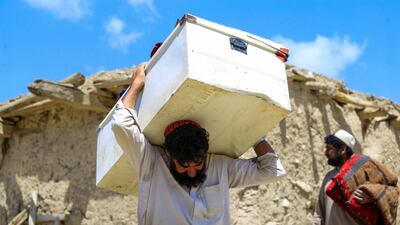
People salvage their belongings from a damaged house in the earthquake-affected Gayan village in the Paktika province, Afghanistan. EPA -

The 5. 9-magnitude quake struck hardest in the rugged east along the border with Pakistan, killing more than 1,000 and leaving thousands homeless. AFP -

An Afghan man stands besides the ruins of a house damaged after an earthquake in Gayan. AFP -

Afghan men talk among themselves as they look for their belongings amid the ruins of damaged houses. AFP -
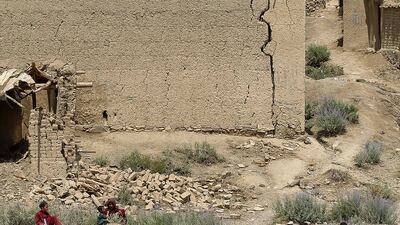
Afghan children play in the backdrop of houses damaged after the earthquake. AFP -

World Food Programme trucks with aid material head out towards affected villages. AFP -
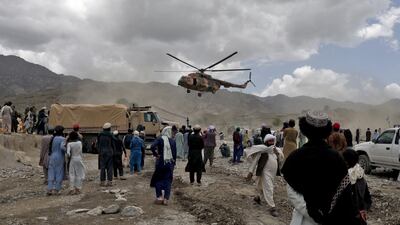
A Taliban helicopter carrying aid lands in Gayan. Reuters -

An Afghan family carry their belongings following the earthquake. Reuters -
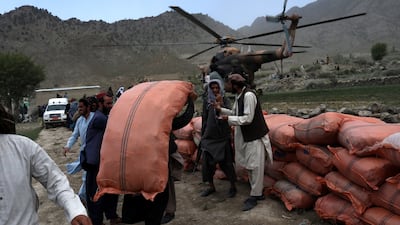
A man carries a sack in Gayan. Reuters -
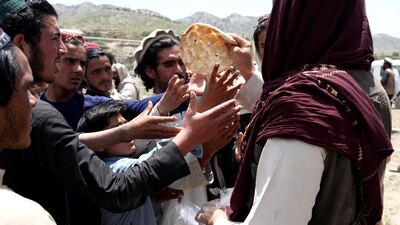
Afghan men receive bread. Reuters -

Afghan men stand on the debris of a house that was destroyed by an earthquake in Gayan. Reuters -
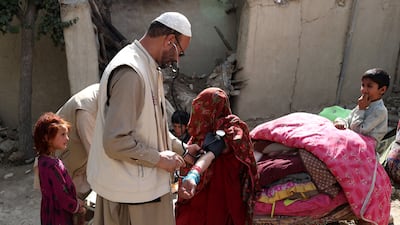
An Afghan woman is treated by a doctor. Reuters -
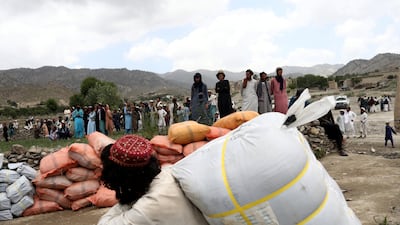
Afghan people wait to receive aid in Gayan. Reuters -
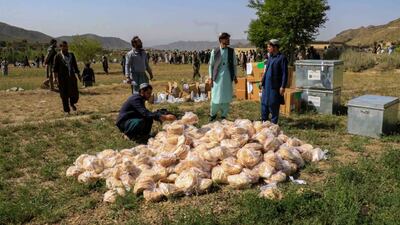
Volunteers gather medicine and other items brought by Afghan Minister of Refugees Khalil Ahmad Haqqani (not pictured) during his visit to Gayan. EPA -
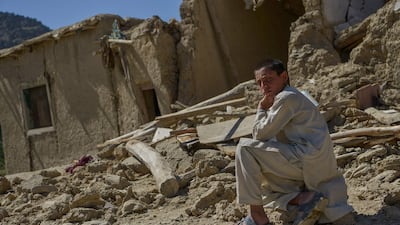
An Afghan youth sits besides the ruins of damaged houses. AFP


“We are facing shortage of staff, medicines and basic first aid such as bandage, gauze, cotton and serums,” Dr Rahman said, appealing to the international community to send supplies to Afghanistan.
The UAE has sent a medical team and field hospital, plus food, medical supplies and other aid, after President Sheikh Mohamed ordered that an air bridge be established.
While many international agencies and countries, including the US, have offered support to victims of the earthquake, the flow of aid to Afghanistan has slowed since last summer, making it harder to respond to emergencies.
International sanctions following the collapse of the Afghan government and Taliban takeover last August has economically weaken the aid-dependent country and triggered a humanitarian crisis.
Mr Noor said that while he had heard of international aid arriving in Afghanistan, little had yet reached his village in Gayan district.
“So far, I have only seen the Red Crescent teams in Gayan who are helping rescue people along with a very small number of Taliban forces,” he shared.
“There are villages in more remote areas that the rescue teams haven’t even been able to go to,” he said, adding that people from those parts were appealing for help from them.
“But our resources are very limited, and there isn’t enough manpower.
“Today some help and resources have arrived from Kabul and other provinces.
“But we need a lot more helping hands. We need doctors, medical supplies, food, water and some machinery so we can dig the ground and find other bodies, and perhaps even survivors,” Mr Noor said.

