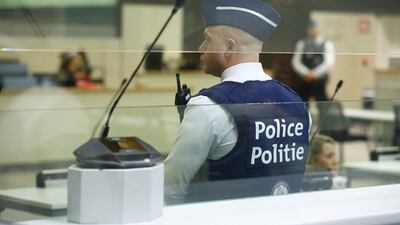

Belgian police this week arrested seven alleged ISIS supporters — almost all Chechens — who were accused of attempting to plan a terrorist attack within the country.
The men were believed to have been searching for weapons.
The arrests brought renewed attention to the Chechen community in Belgium and its ties to extremist groups.
The Chechens are regularly portrayed in a negative light in the Belgian press because of alleged links to gang violence.
Yet there has so far been no ISIS-claimed attack organised by Chechens in Belgium. None of the perpetrators of the biggest ISIS attack on Belgian soil, which killed 32 people in 2016, had Chechen links.
The most attention-grabbing ISIS-claimed attack involving a Chechen refugee in Europe was the 2020 decapitation of French secondary schoolteacher Samuel Paty by 18-year-old Abdoullakh Anzorov.
What is the significance of these arrests?
Between 10,000 and 17,000 Chechens live in Belgium, a country of about 12 million people. The community is known for not mixing easily with others.
“The vast majority of community is Muslim. Within that population, you have some individuals that have grown very radical,” said Thomas Renard, director of the International Centre for Counter-Terrorism in The Hague.
The most high-profile recent arrest of a Chechen-Belgian terrorist was Lors Doukaev, who was sentenced to 12 years in prison in 2011 in Denmark for a failed attack against a newspaper.
Denmark transferred him to Belgium in 2013 for the rest of his prison sentence.
Belgium tried to strip him of his citizenship but failed after it appeared that he would become stateless.
Moscow refused to grant him Russian citizenship, according to Belgian daily Le Soir.
Doukaev’s case shows that the presence of Islamist extremist Chechens in Belgium predates the creation of ISIS in Syria and Iraq in 2014, said Mr Renard.
Yet Chechens represent a relatively small proportion of terrorism convictions between 1990 and 2019.
Mr Renard’s figures show that about 25 Chechens were sentenced by Belgian courts for terrorism during that time frame out of 557 convictions in total.
“It’s smaller than people from North Africa or Europe,” he said.
Most of those arrests happened after 2014 and involved Chechens with links to ISIS.
Authorities have found Chechen communities in Belgium hard to infiltrate, Mr Renard said.
“Even when they travelled to Syria and Iraq, Chechens joined all-Chechen battalions,” said Mr Renard.
He contrasted this choice with other groups that formed along linguistic lines, such as French speakers from France and Belgium.
“They could have coalesced with other Russian-speaking foreign fighters but it seems they didn't,” said Mr Renard.
What are the links between Chechens and ISIS?
Russian passport holders, mostly from Chechnya, were the second-biggest ethnic group to leave or attempt to leave Belgium to join ISIS in Syria and Iraq out of about 700 people, according to a 2018 study published by the ICCT.
The report’s authors counted dual citizens as Belgian. They represented 76.6 per cent of departures.
In Syria, some Chechen-led rebel battalions later splintered between ISIS and other extremist groups, said Thomas Pierret, senior researcher at the French National Centre for Scientific Research.
“Many military leaders were Chechens,” Mr Pierret told The National. Most of them came from the Caucasus, not Western Europe.
One of the most prominent figures in the group was Abu Omar Al Shishani, a fighter of Chechen origin born in Georgia who was distinguished by his long red beard.

Some Chechen groups still operate independently in the rebel-held region of Idlib in north-east Syria, according to Mr Pierret.
Others have gone on to fighting Russia in Ukraine, such as Abdul Hakim Al Shishani, who used to lead a rebel group in Syria.
Shishani means Chechen in Arabic.
Belgian authorities did not indicate whether the men arrested on Thursday had been to Syria, but radicalism also exists within the diaspora in Europe that never joined ISIS abroad.
Mr Paty’s killer had been in contact with Russian-speaking fighters in Syria before the murder but had not been there himself.
Why did Chechens play an important role within ISIS?
The fact that Chechens were the second-largest group in Belgium to join ISIS in Syria and Iraq is “surprising”, considering how small the community is, said the ICCT report.
The report suggested that there might be a link between the fact that Chechens had experienced violent conflict and the high level of militancy within the diaspora.
Mr Pierret said that there was a clear relation between Russian war crimes in Chechnya during the two Chechen wars in the 1990s and 2000s and the emergence of extremist networks within the community.
“Its population has been brutalised in a horrendous fashion by Russia,” he said.
The war started as a nationalist insurrection in the 1990s but became more radicalised with the death of moderate leaders and the arrival of fighters who had fought Russia in Afghanistan.
“The Chechen cause rallied many people because it was a black-and-white scenario: Christian Orthodox Russia oppresses Muslim community,” said Mr Pierret.

