

The words “I don’t need a ride, I need ammo” will echo in history as much as the opening salvos of Russia’s bungled invasion of Ukraine.
Joining President Volodymyr Zelenskyy’s words will be the 34-second video he shot in Maidan Square, the political heart of Kyiv, where 24 hours into the offensive, he stood shoulder to shoulder with key ministers proclaiming: “The President is here” — despite an offer from the US to fly him out.
It was a key moment in European history, in which a wartime leader stood defiantly, inspiring not only his people but the western world to back him.
With Russian tanks rumbling towards Kyiv and paratroopers seizing Hostomel international airport, Mr Zelenskyy’s personal survival was being measured in hours.
But rumours of Chechen assassination squads and Spetsnaz special forces “decapitating” the Ukraine government were instantly checked when he uploaded the video to Facebook.
Dressed in what would become his famous green fatigues, the President assured his people that “we are all here”, ending the clip with: “Glory to Ukraine. Glory to the heroes.”
It was a pivotal moment in the war, and the video was viewed three million times in the first hour after it was uploaded to social media.
History turns
“European history turned on that moment, it really did,” said leading military analyst Michael Clarke. “He went on to the streets and said, ‘I'm here and I’m not anywhere else’ and that he didn’t need a ride but ammo.
“I can't think of a wartime turning point that was quite so brief and dramatic as that.”
Western leaders — including US President Joe Biden — were among those who viewed the video, becoming convinced that their countries should robustly defend Ukraine against Russia.
The clip's imagery was “a reminder of the power of iconic leadership”, said Gen Sir Richard Barrons.

“Russia’s intent was to decapitate the regime, yet here was a figure who Ukraine in all its fractured glory could coalesce around,” said the former chief of Britain’s Joint Forces Command.
“But more than that, so many of the international community could identify with him. Foremost, Zelenskyy’s a naturally gifted communicator.”
His decision to stay in Kyiv, in addition to releasing the video, was a “masterstroke”, said Russian military expert Brig Ben Barry.
“Zelenskyy has been a very successful war leader in terms of messaging, not only the Ukrainian population but the global audience,” said the Land Warfare specialist at the IISS think tank.
Gen Barrons also contended that the words and video were “emblematic of the resistance” signalling “a spirit of fighting and defiance” in Ukraine.
“It was of course buttressed very early on by battlefield success, which meant he actually was never under any great pressure to run,” he added.
What if?
If Mr Zelenskyy had taken the US “ride” and decided to fight the war from Germany or Washington, then the consequences could have been very difficult.
Leaderless and without substantial western arms and financing, Ukraine’s army would likely have collapsed with significant geopolitical fallout, probably hastening America’s continued retreat from Nato, begun under President Donald Trump.
-
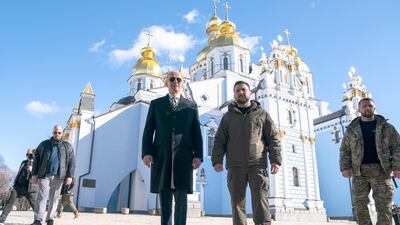
Volodymyr Zelenskyy with US President Joe Biden at St Michael's Golden-Domed Cathedral in Kyiv during Mr Biden's surprise visit, on February 20. AP -
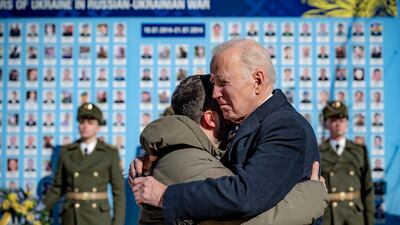
The two presidents embrace each other at a wreath-laying ceremony at the Wall of Remembrance of the Fallen for Ukraine, in Kyiv. EPA -

President of the European Council Charles Michel, European Commission President Ursula von der Leyen and Mr Zelenskyy at a EU summit in Brussels in February 2023. AFP -
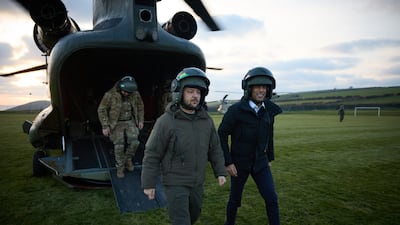
British Prime Minister Rishi Sunak and Mr Zelenskyy arriving to visit Ukrainian troops being trained in southern England in February 2023. PA -
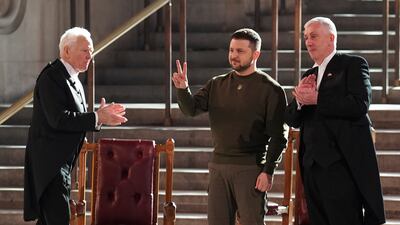
Mr Zelenskyy is applauded after his address to parliamentarians at Westminster Hall, London, in February 2023. AP -

Ukraine's President receives a warm welcome at No 10 Downing Street. Photo: Simon Walker / No 10 Downing Street -
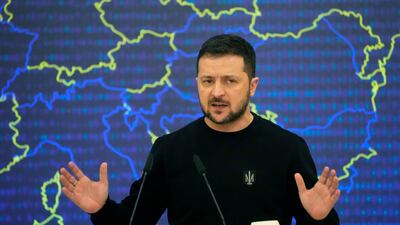
Mr Zelenskyy addresses a media conference after the EU-Ukraine summit in Kyiv in February 2023. AP -
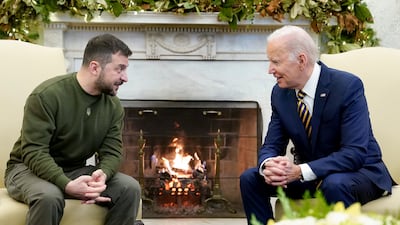
Joe Biden speaks to Mr Zelenskyy in the Oval Office of the White House, Washington DC, in December 2022. AP -

Rishi Sunak and Mr Zelenskyy meet in Kyiv in November 2022. Getty Images -
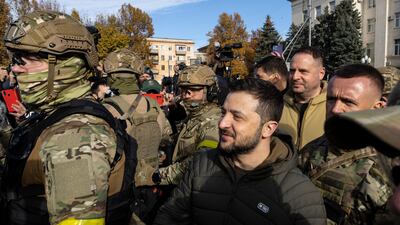
Mr Zelenskyy makes a surprise visit to Kherson, Ukraine, in November 2022. Getty Images -
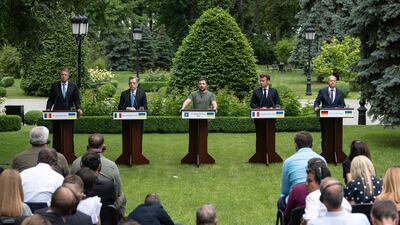
Romanian President Klaus Iohannis, Italian Prime Minister Mario Draghi, Mr Zelenskyy, France President Emmanuel Macron and German Chancellor Olaf Scholz hold a press conference in Kyiv in June 2022. Getty Images -
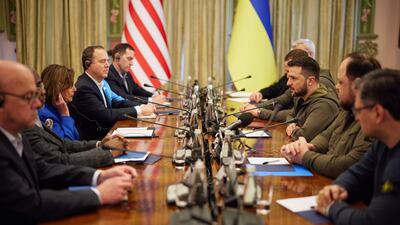
Mr Zelenskyy meets US Speaker Nancy Pelosi during a visit by a US congressional delegation in April 2022 in Kyiv. Getty Images -
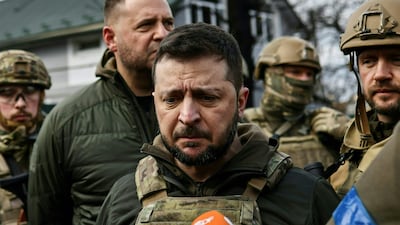
Mr Zelenskyy speaks to the press in the town of Bucha, north-west of Kyiv, in April 2022, where he said the Russian leadership was responsible for killing civilians. AFP -

Mr Zelenskyy receives a standing ovation before he addresses the German Bundestag, in Berlin, via live video link from Kyiv in March 2022. Getty Images -
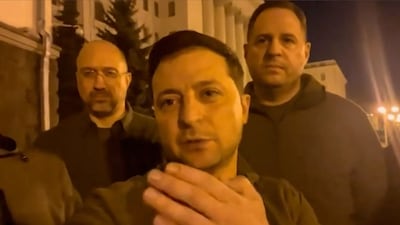
A still from a video posted on the Facebook account of Mr Zelenskyy in February 2022 shows him speaking to camera in Kyiv after Russia's invasion. He said 'we are all here'. AFP -
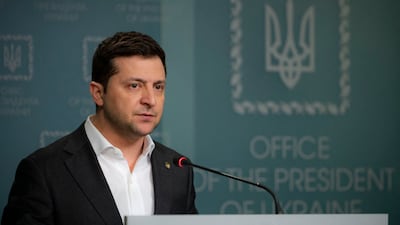
Mr Zelenskyy holds a briefing at the Office of the Head of State in Kyiv in February 2022, after Russian President Vladimir Putin launched a full-scale invasion of Ukraine. AFP -
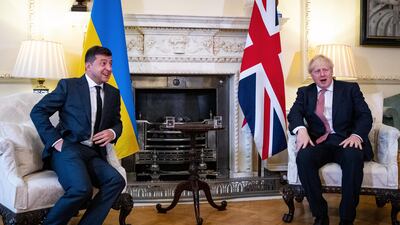
British prime minister at the time, Boris Johnson, meets Mr Zelenskyy in No 10 Downing Street, London, in October 2020. Getty Images -
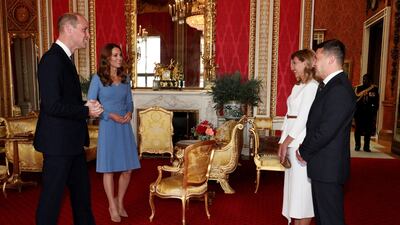
Prince William and his wife Catherine meet Mr Zelenskyy and his wife Olena at Buckingham Palace in October 2020. Getty Images -
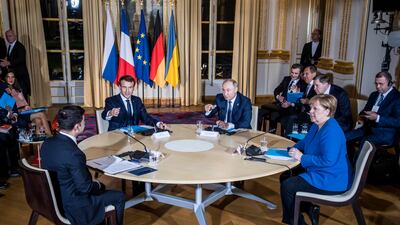
Mr Zelenskyy, Mr Macron, Mr Putin and then-German chancellor Angela Merkel attend a summit on Ukraine at Elysee Palace in Paris in December 2019. Getty Images -
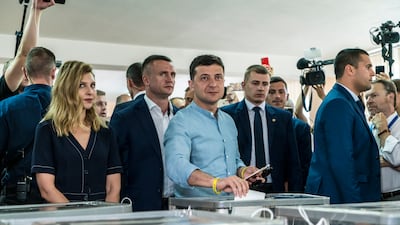
Mr Zelenskyy casts his ballot in parliamentary elections in July 2019 in Kyiv. Getty Images -

Mr Zelenskyy, as Ukrainian president-elect, walks into the parliament to be sworn in, in May 2019. Getty Images -
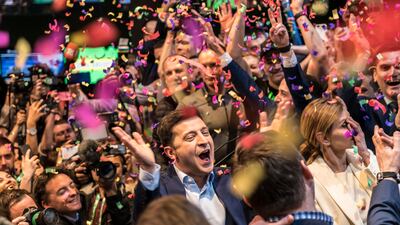
Mr Zelenskyy celebrates his victory in Ukraine's presidential election in April 2019 in Kyiv. Getty Images -
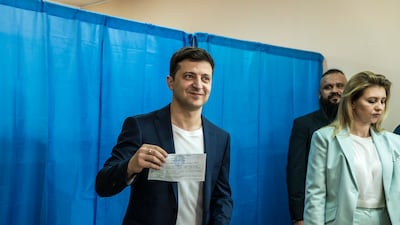
Mr Zelenskyy, as Ukrainian presidential candidate, and his wife Olena cast their ballots in April 2019 in Kyiv. Getty Images -
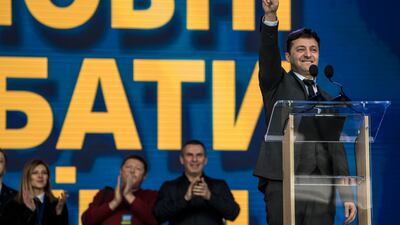
Mr Zelenskyy takes centre stage before a debate with then-president Petro Poroshenko at the Olympiskiy Stadium in April 2019 in Kyiv. Getty Images -
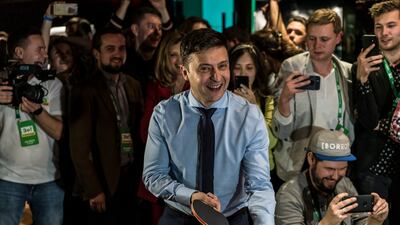
Playing table tennis with a journalist at his election night gathering in March 2019 in Kyiv. Getty Images -
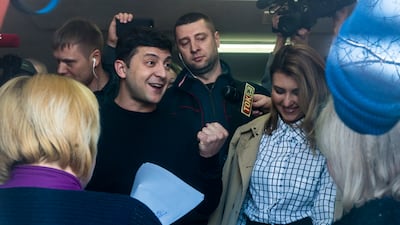
Mr Zelenskyy holds his ballot at a polling station before voting in Ukraine's presidential election in March 2019 in Kyiv. Getty Images -

Mr Zelenskyy backstage during the filming of his comedy show Liga Smeha (League of Laughter) in March 2019 in Kyiv. Getty Images


“If the United States was not fighting for Ukraine, then they certainly wouldn't be reinforcing Europe,” said Mr Clarke. “And instead of being a shot in the arm for Nato, a Russian takeover would have been a shot in the head to Nato,”
The alliance’s south-eastern European members would probably have struck deals with Russian President Vladimir Putin similar to what Hungary has done, knowing that they, too, were now vulnerable.
Ukraine would have been eviscerated as a state, denied any access to the Black Sea, “strangled as an independent country” and “turned into another Belarus client state”, said Mr Clarke.
Open intelligence
Aside from Mr Zelenskyy’s trailblazing war leader communication abilities, the part British and US intelligence played in the weeks and days leading to the war were highly significant.
Their security agencies openly predicted when the Russians would invade almost down the exact day and hour, and had warned of Mr Putin’s belligerent intent for months.
Until a few days before February 24, Kyiv had chosen to listen to French and other European intelligence, which proposed that the massed Russian armoured columns on the borders were no more than bluster.
Gen Barrons contended that Europe’s intelligence failure was “because they preferred not to think an invasion was going to happen”.

But the absolute clarity of US and UK intelligence finally persuaded Mr Zelenskyy of the peril ahead, allowing the military, the population and the wider world to prepare for the coming onslaught.
Mr Clarke described the intelligence move as “very usual but very successful” in that “took away the element of surprise” when Russia did attack.
“It also gave great credibility to everything that was then said after the invasion because what they said was going to happen actually happened,” said the former director of the Rusi think tank.
Brig Barry added: “Politically that was very important. It didn't change the Russian calculus but it did make it a lot easier as soon as the war started for America and Britain to tell Europe ‘well, we told you the Russians are serious, now let's work hard together to keep Ukraine in being’.”
But this could not hide “two great tragedies” of the war, said Gen Barrons: One was the West’s failure to adequately arm Ukraine after Mr Putin’s 2014 invasion and the other was that Europe’s denial of the intelligence “inhibited the sort of preparations that we are still trying to do now”.
“Since February, we're catching up with our failure to equip Ukraine and now we're doing it piecemeal,” he added.
Dumb Artillery
The intelligence warnings also galvanised the US and Britain to step up their arms supply from late 2021, with Ukraine receiving thousands of NLAWs — Next Generation Light Anti-Tank Weapon — alongside anti-tank Javelins and the man-portable Stinger air defence missiles.
Twitter and Telegram were filled with videos of these apparent wonder weapons shooting down helicopters or smashing into tank turrets.
Despite those images, Gen Barrons argued that it was “dumb artillery” rather than the NLAWs that broke the back of the Russian attack as well as the invaders’ “sheer incompetence”.

“They got a stuffing and there's a lot of talk about NLAWs but that’s massively overstated, “Gen Barrons said.
“By far the decisive weapon system that broke the Russian assault on Kyiv was dumb artillery because the Russians obliged by providing concentrations for which dumb artillery is the ideal weapon.
“So, for all the technology in this evolving orchestra of war, dumb artillery remains the decisive factor.”
Mr Clarke attached greater importance to the hurriedly shipped arms, suggesting that their portability and the previous training Ukraine had received from Nato countries meant they were able to operate in small units, picking off Russian armour and their vital fuel tankers.
“The Ukrainians used them very cannily, making those logistical problems worse for the Russians, which made them simply run out of steam and literally run out of food,” he said. “Without the NLAWs, the Russians would have encircled key cities.”
Brig Ben suggested that the imagery of NLAW attacks had a key impact, saying that “Ukrainians were fighting, but also making good use of the externally supplied equipment”.
That encouraged the West to provide even more advanced weaponry, culminating last month in heavy tanks, including German Leopards 2s.
Sluice gates
Perhaps it was his years as an actor and in particular in his role as Ukraine’s fictional president in the television series Servant of the People that allowed Mr Zelenskyy to craft an appealing and credible personality.
Clearly no acting was required with his country under attack, but his ability to say things in a powerful way has resonated with domestic opinion in the West to the point that he has persuaded Nato to send tanks against Russia.

“People want leaders who are decisive, bold and courageous because it helps them put up with very difficult circumstances,” said Gen Barrons.
And if he had taken that US “ride”, in a practical sense, it would have made it much harder to run the country, said Brig Barry, denying the necessary close co-ordination between government and military.
“With the government remaining in the capital, it could co-ordinate which bridges should be blown up or which sluice gates opened to allow water to be exploited as a defence and to help run the trains to get the refugees out,” Gen Barrons added.
“That would have been a lot more difficult if Zelenskyy had taken the ‘ride’.”
One year of the Russia-Ukraine war — in pictures
-
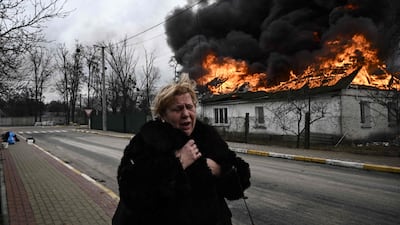
February 24 will be a year since Russia started the Ukraine war. The National picks out the most powerful images from the conflict. AFP -
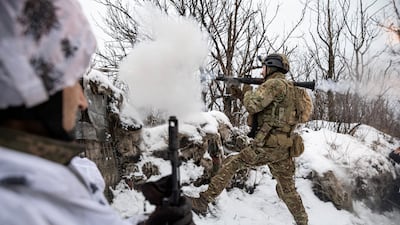
A member of Ukraine's 79th Air Assault Brigade fires a rocket-propelled grenade at Russian positions near Marinka in February. Reuters -
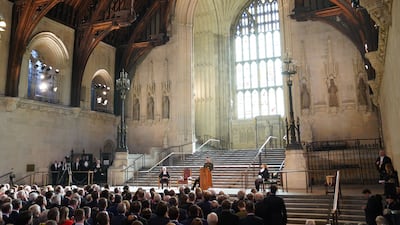
Ukrainian President Volodymyr Zelenskyy addresses MPs in Westminster Hall, London, in February 2023. Getty Images -

Destroyed buildings 32km west of the front lines in Donetsk in January. Getty Images -
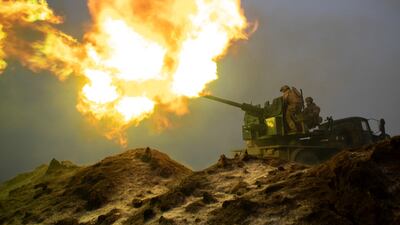
An anti-aircraft gun in January fires at Russian positions near Bakhmut, Donetsk. Reuters -
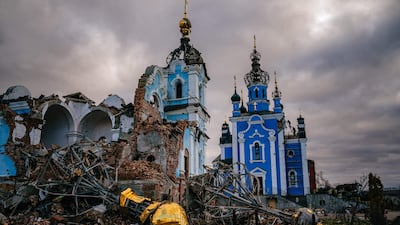
Destruction in the village of Bohorodychne, Donetsk. AFP -

A Ukrainian artilleryman discards an empty shell on the outskirts of Bakhmut, eastern Ukraine, in December 2022. AFP -
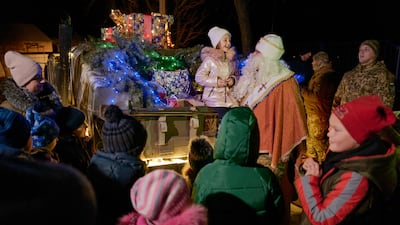
Children receive presents from a Ukrainian soldier dressed as Santa on Christmas Eve in Sloviansk. Getty Images -
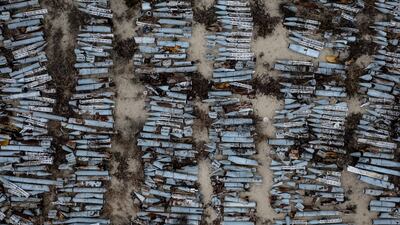
More than 1,000 missiles and rockets fired by Russian forces collected for cataloguing in Kharkiv in December 2022. Getty Images -
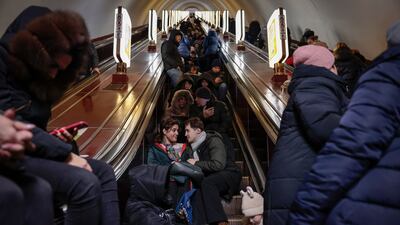
The Metro provides shelter as Russia launches another missile attack on Kyiv, Ukraine's capital, in December 2022. Getty Images -

Children at a PE class in Kyiv after Russia abandoned its attempt to seize the capital in November 2022. Getty Images -
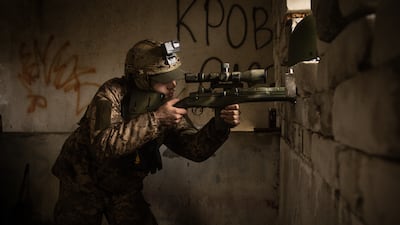
A sniper searches for Russian positions on the bank of the Dnipro river in Kherson in November 2022. Getty Images -
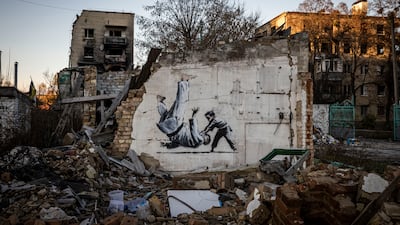
Graffiti by Banksy on a wall among the debris in Borodyanka in November 2022. Getty Images -
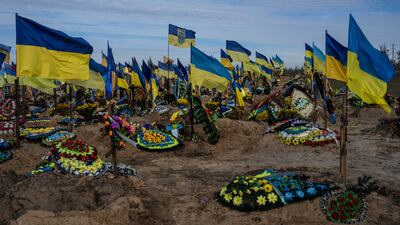
Ukrainian flags flutter around graves in a cemetery for soldiers killed in action in Kharkiv in October 2022. Getty Images -
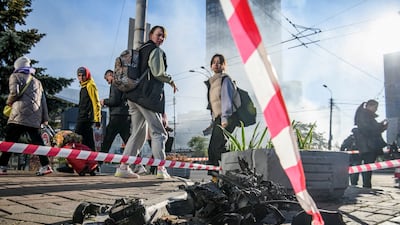
Parts of a drone, which Ukrainian authorities said was Iranian-made, after a Russian strike in Kyiv in October 2022. Reuters -
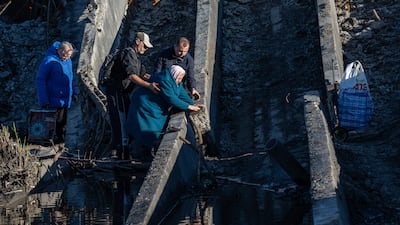
An elderly woman is helped across a damaged bridge in Bakhmut in October 2022. Getty Images -
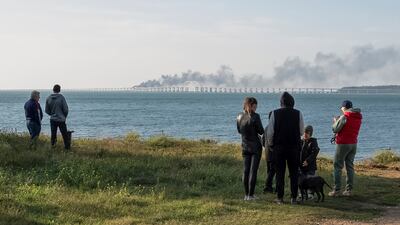
Fuel tanks ablaze on damaged sections of the Kerch bridge in Crimea, in October 2022. Reuters -

A destroyed bridge makes crossing the Donets river difficult, in Staryi Saltiv, east of Kharkiv, in September 2022. AFP -
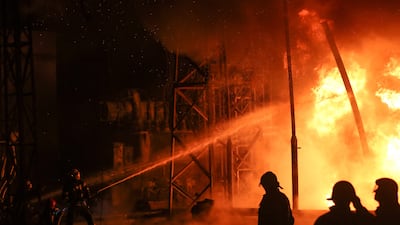
Firefighters at a thermal power plant in Kharkiv damaged by a Russian missile strike in September 2022. Reuters -
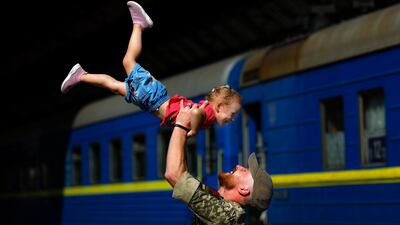
Ukrainian soldier Oleksandr with his daughter Nikole at Lviv railway station in August 2022. Getty Images -
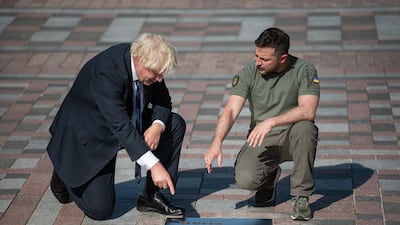
Ukrainian President Volodymyr Zelenskyy and then-British prime minister Boris Johnson read a plaque in Kyiv in August 2022 dedicated to the latter for his support. Getty Images -
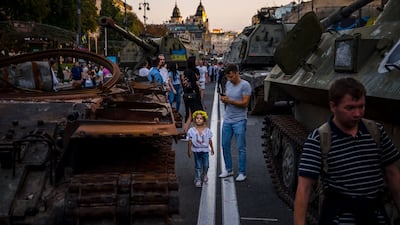
Destroyed Russian military equipment on Khreshchatyk street in Kyiv. The materiel was turned into an open-air military museum ahead of Ukraine's Independence Day on August 24. AFP -
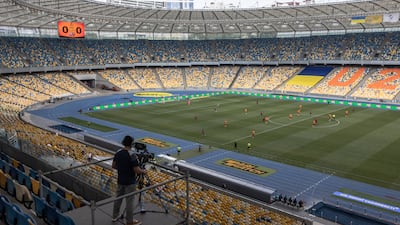
Shakhtar Donetsk v Metalist Kharkiv kicks off the Ukrainian Premier League season in August 2022 amid fears of bomb and missile alerts. EPA -
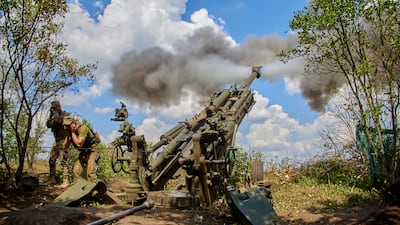
Ukrainian servicemen fire an American-made 155mm M777 howitzer in July 2022 in the Kharkiv area. EPA -
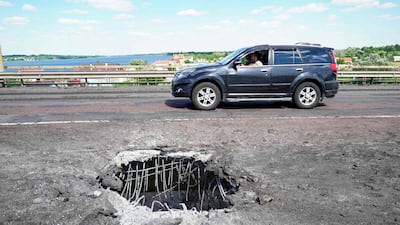
A bomb crater on the Antonovsky bridge across the Dnipro river in Kherson, July 2022. AFP -

Maksym and Andrii with plastic guns at a 'checkpoint' they set up while playing in Kharkiv, July 2022. AP -
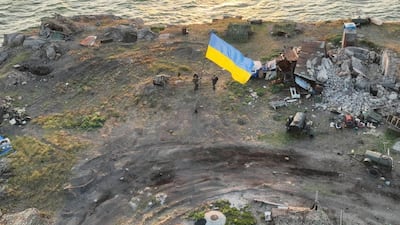
Ukrainian troops on Snake Island in June 2022. Reuters -
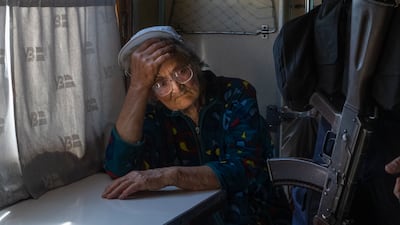
A woman evacuated from an area of conflict in June 2022 contemplates what the next move might be. AP -
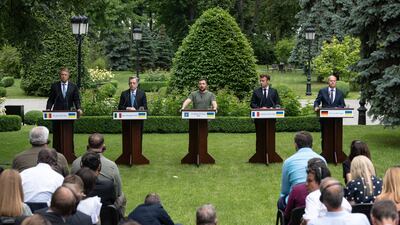
Romanian President Klaus Iohannis, Italian Prime Minister Mario Draghi, Ukrainian President Volodymyr Zelenskyy, French President Emmanuel Macron and German Chancellor Olaf Scholz in Kyiv in June 2022. Getty Images -
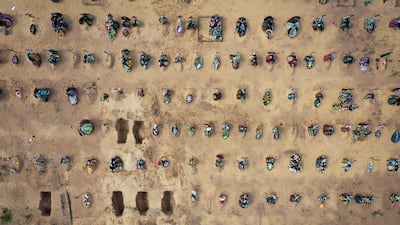
Graves in Irpin cemetery, May 2022. Getty Images -
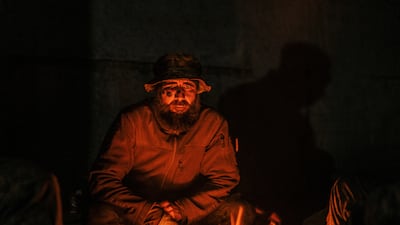
A Ukrainian soldier trapped within the besieged Azovstal Iron and Steel Works complex in Mariupol in May 2022. Reuters -
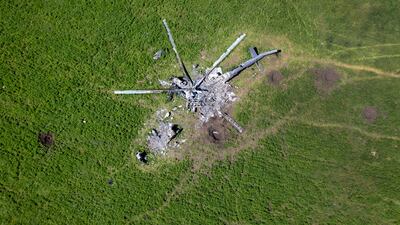
The wreckage of a Russian helicopter in a bomb-cratered field in Biskvitne, May 2022. Getty Images -
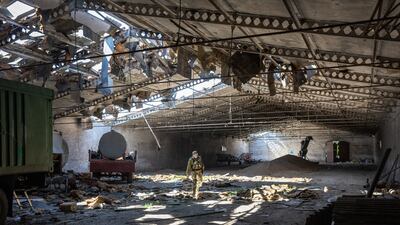
A Ukrainian army officer inspects a grain warehouse shelled by Russian forces in May 2022 near Novovorontsovka, Kherson. Getty Images -
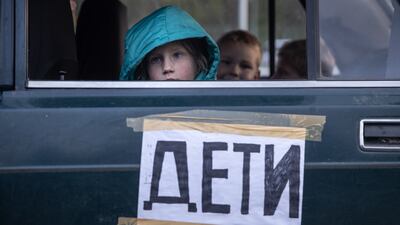
A boy from Mariupol arriving at an evacuation point in Zaporizhzhia in May 2022. Getty Images -
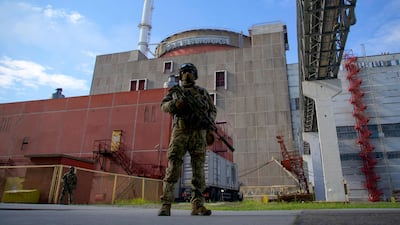
A Russian serviceman on guard outside Zaporizhzhia nuclear power station in May 2022. AFP -
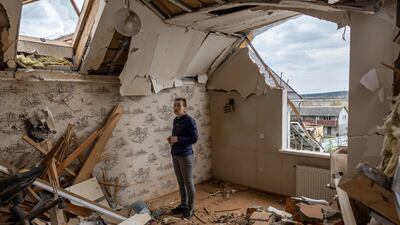
Oksana searches for salvageable items on the destroyed second floor of her home in Hostomel, April 2022. Getty Images -

A floral memorial wall in Lviv for Ukrainian civilians killed during the Russian invasion, April 2022. Getty Images -
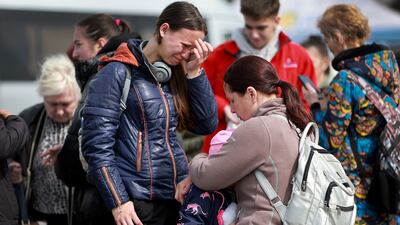
People fleeing Lviv, eastern Ukraine, in April 2022, wait for a bus that will take them to Poland. Getty Images -
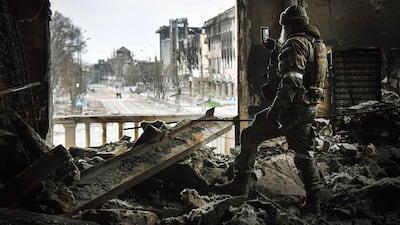
A Russian soldier patrols a bombed Mariupol theatre in April 2022, as Moscow intensified its campaign to take the strategic port city. AFP -
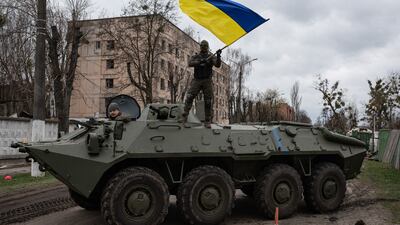
A Ukrainian celebrates success in Hostomel in April 2022. Getty Images -
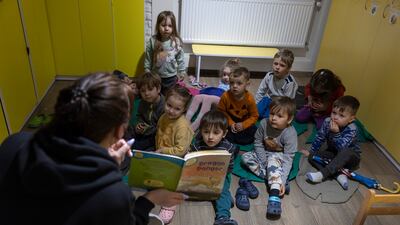
Julia Palovskaya reads to children during an air raid drill in the basement shelter at a preschool in Lviv, April 2022. Getty Images -
Volodymyr Zelenskyy in Bucha in April 2022, where hundreds of bodies were found in the street and it was claimed the Russian leadership was responsible for killing civilians. AFP -
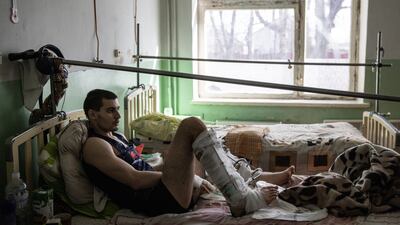
Oleh Smolin, 23, who suffered leg injuries from Russian shelling in April 2022, in hospital in Chuhuiv. Getty Images -
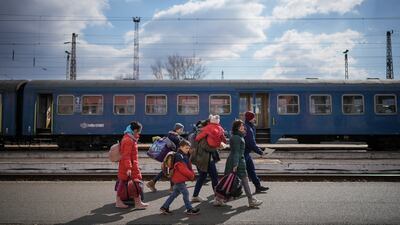
Fleeing refugees arrive at the border train station of Zahony, Hungary, in March 2022. Getty Images -
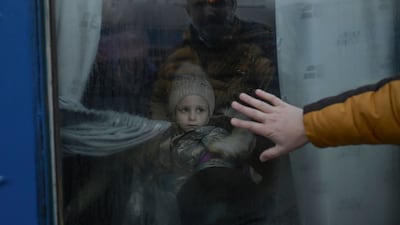
A father says goodbye to his daughter on an evacuation train about to leave Odesa in March 2022. AFP -
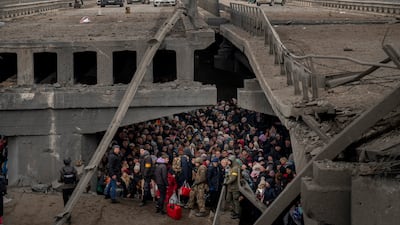
Ukrainians under a destroyed bridge as they try to cross the Irpin river on the outskirts of Kyiv in March 2022. AP -
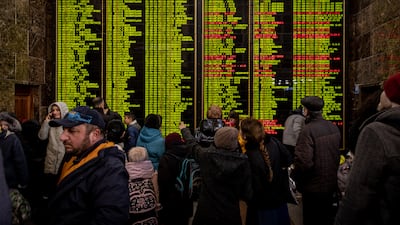
People cram into Kyiv station to catch trains to Poland or to western parts of Ukraine, shortly after the initial invasion in February 2022. Getty Images -
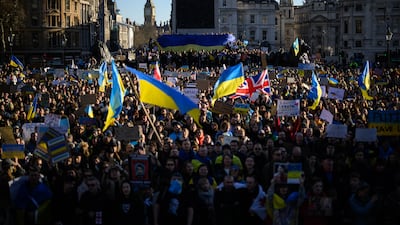
A demonstration in support of Ukraine in Trafalgar Square, London, February 2022 . Getty Images -
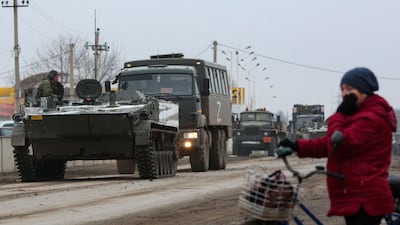
Russian army vehicles in Armyansk, Crimea, in February 2022. AFP -
Volodymyr Zelenskyy in Kyiv on February 25, 2022, in a video on Facebook. He said 'we are all here', shortly after the Russian invasion began. AFP -
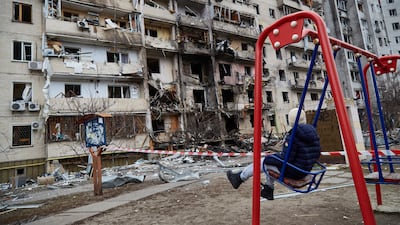
A residential building damaged by a missile strike in Kyiv in February 2022. Getty Images -

A metro station in Kyiv in February 2022, crowded with people trying to escape the invasion. AFP -
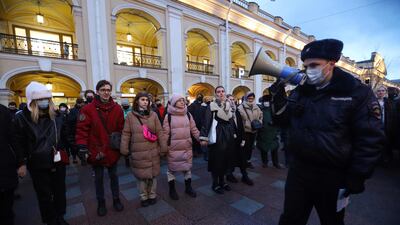
A police officer addresses people gathered to protest against the invasion of Ukraine, in central Saint Petersburg, Russia, February 2022. AFP -
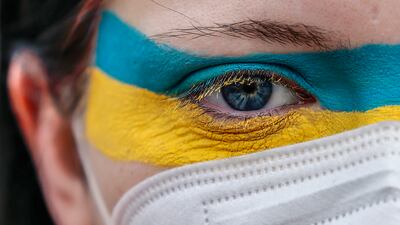
A protester in support of Ukraine, in Berlin, Germany, in February 2022. Getty Images -
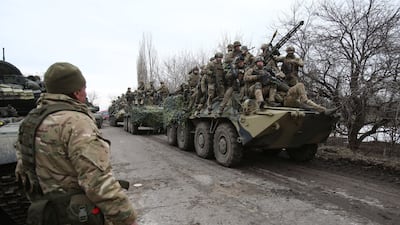
Ukrainian soldiers prepare to repel an attack in Ukraine's Lugansk region on February 24, 2022. AFP -
Volodymyr Zelenskyy in Kyiv on February 24, 2022, after Russia launched a full-scale invasion. AFP -
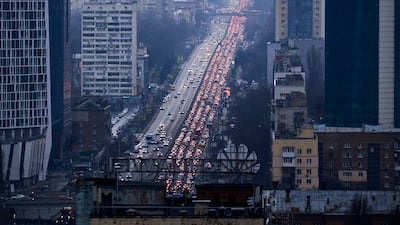
A mass exodus from Kyiv after pre-offensive missile strikes by Russian armed forces on February 24, 2022. Getty Images -
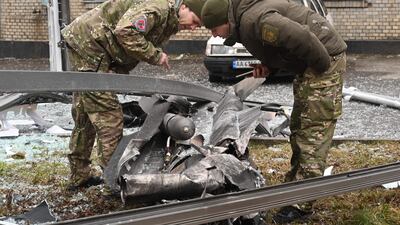
Security personnel inspect the remains of a shell in Kyiv on February 24, 2022, soon after Russian President Vladimir Putin announced a military operation in Ukraine. AFP -
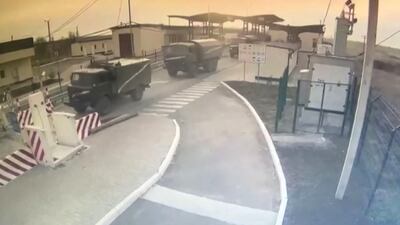
CCTV footage shows Russian military equipment crossing a Crimea border checkpoint on February 24, 2022. AFP -
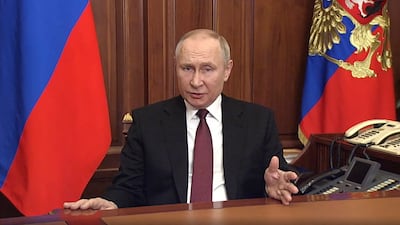
Russian President Vladimir Putin in the Kremlin early on February 24, 2022, when he announced a 'military operation' in Ukraine. AFP



