


Six mummies thought to be the remains of children who were sacrificed by pre-Incan inhabitants of the Andes about 1,200 years ago have been discovered in Peru.
The bodies of seven adults, all wrapped in cloth, were found in the same tomb, in the archaeological complex of Cajamarquilla, east of Lima.
Ancient religions of the region — which were followed by the Aztec, Mayan and Incan empires and ethnic groups — believed that humans could be sacrificed to accompany recently deceased people into the “world of the dead,” or that sacrificing adults or even children could appease angry gods and intimidate enemies.
-
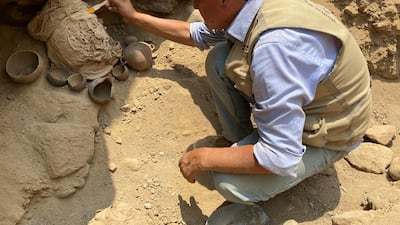
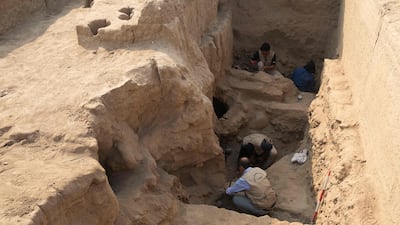
An archaeologist works to recover the remains of one of 14 pre-Incan mummies found at an archaeological complex in Peru on February 13, 2022. Reuters -
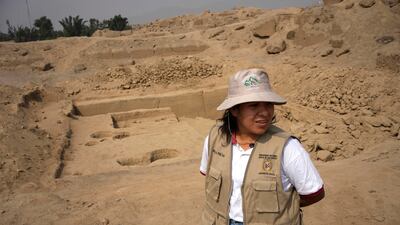
Chief archaeologist Yomira Huaman said six of the mummies were children while eight were adults. AP -
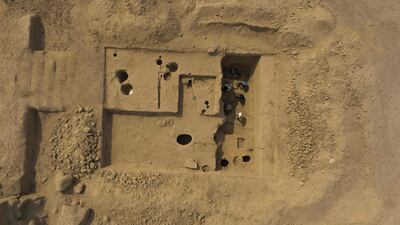
The archaeological site in the ancient town of Cajamarquilla is 25 kilometres from Lima. AFP -
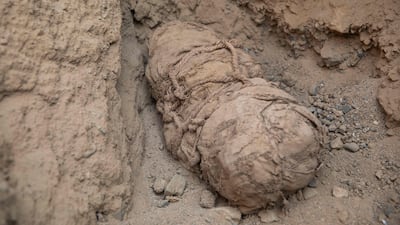
The mummies are between 800 and 1,000 years old. AFP -
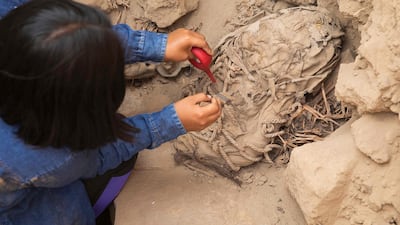
Archaeologists believe the children and adults were sacrificed in honour of a prominent figure, whose mummy was found in late 2021, so that they could accompany him in the afterlife. AFP -
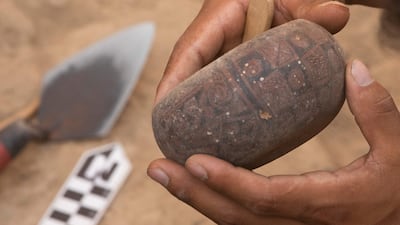
A decorated calabash found at the Cajamarquilla archaeological complex in Peru. AFP -
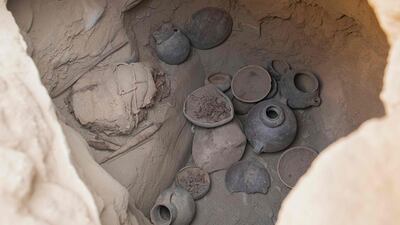
Other objects found during the dig include ceramic pots and knitting gear. AFP -
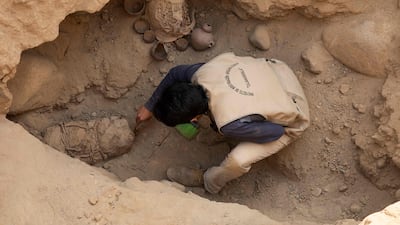
The discovery follows the finding of another pre-Incan tomb, thought to belong to a distinguished local trader, in November last year in the same area. AFP -
Bones from animal offerings were also found in the trader's tomb. AFP -
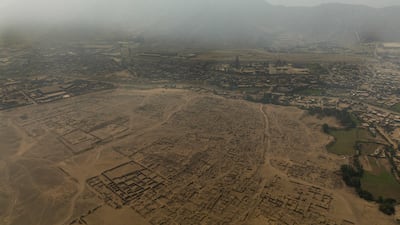
The tomb was found under the town square of Cajamarquilla. AFP -
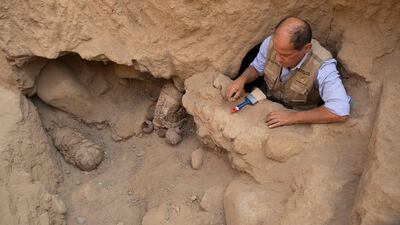
One of the archaeologists said Andine societies believed that after death, people did not simply disappear. AFP


The discovery follows the finding of another tomb in November last year in the same area. Archaeologists at the National University of San Marcos discovered a pre-Incan tomb, thought to belong to a distinguished local trader.
Bones from animal offerings and clay pots were also found in the tomb, under the town square of Cajamarquilla, an ancient city.
Yomira Huaman, an archaeologist of the Investigation Project in the complex, said that recent techniques could help determine a link between the two sites and explain why the sacrifice occurred and what role it played in pre-Incan culture.
"What's happening here, why are there so many funeral bales of children? Further specialised investigations, such as those done with DNA, strontium and nitrogen, I think can help us understand,” she told Associated Press.
“That way, we can say what really took place in Cajamarquilla, and if it's associated with the tomb of the mummy [found in November last year].”
Pieter Van Dalen, who is responsible for the research project, said Andine societies believed that people did not disappear after death.
“We've found in relation to the tomb of the mummy of Cajamarquilla we discovered on November 2021, another 13 bodies [funerary bundles] of people, of which six are of children," said Mr Van Dalen.
"It appears that all of these people were sacrificed to accompany the mummy, the soul of the mummy on the path of the death to the final destination, according to the ideology of the Andean populations.”
In 2018, researchers made another major grisly discovery.
Scientists from the Universidad Nacional de Trujillo and Tulane University found the remains of over 200 Llamas and 140 children ― thought to be the world’s largest sacrifice of children, in Peru's northern Huanchaco district.
Researchers believe the brutal killings might have been spurred by a belief that increasingly extreme sacrifices would be needed to stop bad weather from destroying crops.
Agencies contributed to this report

