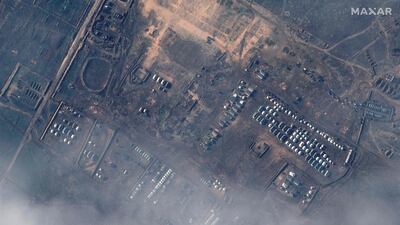
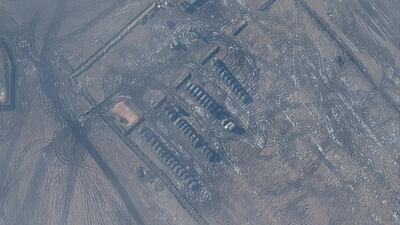
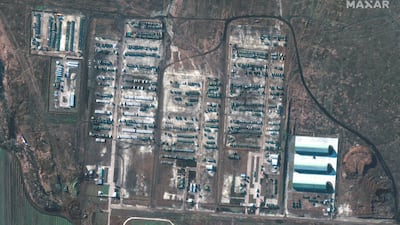
Russian soldiers take part in drills in the Rostov region in southern Russia. AP Photo

UK tells allies to cut economic dependence on Russia and 'step up' in support of Ukraine


  • English
  • Arabic

Britain has urged its allies to scale back their economic dependence on Russia and stand in solidarity with Ukraine in the face of increasing aggression from its neighbour.

Liz Truss, the UK’s foreign secretary, issued the clarion call during a visit to Australia as tensions between the West and Moscow ratchet up.

Before crisis talks between the US and Russia on Friday — largely seen as one of the last chances to avert a Russian invasion of Ukraine — Ms Truss delivered a speech at the Lowy Institute in Sydney.

She warned Russian President Vladimir Putin he must “desist and step back” from war in Ukraine or risk being dragged into a prolonged conflict.

“Invasion will only lead to a terrible quagmire and loss of life, as we know from the Soviet-Afghan war and conflict in Chechnya,” she said, referencing Moscow's past conflicts that cost hundreds of thousands of lives.

Ms Truss urged allies to "step up" in the face of the crisis, linking the Ukraine conflict to a slew of increasingly emboldened authoritarian regimes who are looking to "export dictatorship."

"The Ukrainians will fight this, it could be a quagmire" she said. "Ukraine is a proud country with a long history. They have known invading forces before from the Mongols to the Tartars ... their resilience runs deep. If they have to, Ukrainians will fight to defend their country."

When asked by the Australian think tank’s executive director Michael Fullilove why she was confident the “free world would stand its ground” against Russia, she replied: “I think it’s very important to note the commitments that Russia made in the 1994 Budapest Agreement in exchange for Ukraine giving up its nuclear weapons.”

“Russia agreed alongside the UK and US to protect Ukraine’s sovereignty and territorial integrity,” she added. “So the claims that are being made by Vladimir Putin are completely wrong about what has happened but it is true and I made this point in my speech, that the free world has not been doing enough since the end of the Cold War, to make sure that we are deterring aggressors.”

British Foreign Secretary Liz Truss sent a warning to Vladimir Putin during a visit to Australia for talks with her Australian counterpart. AP

She said any invasion of Ukraine would incur a “massive cost” for Russia and the UK is “prepared to put very severe sanctions in place” and bolster Ukraine’s defence capabilities.

“But the free world also needs to work together to reduce economic dependence on Russia to put in place the agreements that help countries have alternatives in terms of trade and investment,” she added. “So in the future, it becomes harder for those aggressive regimes to use economic dependence as a way of getting what they want.

“So yes, we are very ready to act in the immediate term.”

She pointed to the CPTPP (the Comprehensive and Progressive Agreement for Trans-Pacific Partnership) as an example of how the West uses agreements “to protect ourselves from aggressors — from a position of economic and defensive strength.”

Ms Truss’s comments came as US Secretary of State Antony Blinken prepares for talks with Russian Foreign Minister Sergey Lavrov in Geneva.

The talks between Mr Blinken and Mr Lavrov come just 11 days after their deputies met in Geneva and agreed to preserve dialogue amid Russia's build-up of tens of thousands of troops on Ukraine's border.

Unlike the January 10 session, which lasted for nearly eight hours, the pair are expected to have a concise exchange as they determine whether diplomacy remains possible.

They will meet at the lakeside luxury Hotel President Wilson, named after the US leader whose decisions included intervening against the Bolshevik revolution.

“These are difficult issues we are facing, and resolving them won't be done quickly. I don't expect we'll solve them in Geneva”, Mr Blinken said in Geneva.

“But we can advance our mutual understanding”, Mr Blinken said, and if Russia de-escalates on the ground, “that can turn us away from this crisis in the weeks ahead".

US President Joe Biden bluntly assessed on Wednesday that his counterpart Vladimir Putin is likely to “move in” on Ukraine and warned of a “disaster for Russia".

Mr Biden said he believes Mr Putin does not want a full-scale war and warned the Russian leader would pay a “dear price” if he launches a military incursion.

Russia, which already fuels a deadly insurgency in eastern Ukraine that has killed more than 13,000 people since 2014, has demanded guarantees that Nato never accept the former Soviet republic as a member or expand elsewhere in Moscow's old sphere.

The US has declared the idea a “non-starter” and accused Russia of undermining Europe's post-Cold War order by bullying another country into submission.

Mr Blinken headed to Geneva after a solidarity trip to Kyiv and talks with Britain, France and Germany in Berlin, the city that symbolised Europe's transformation from the divisions of the Iron Curtain.

German Chancellor Olaf Scholz and Britain's Prime Minister Boris Johnson discussed the situation on the Ukrainian border and agreed that further Russian military aggression against Ukraine must be averted, a German government representative said on Friday.

In a phone call on Thursday, Mr Scholz and Mr Johnson also agreed that it must be clear that Russia would have to face considerable costs in case of further aggression.

In her speech, Ms Truss also urged Mr Putin to engage in “meaningful discussions” about the crisis following the build-up of Russian forces near the border with Ukraine.

The foreign secretary said Russia's aggression towards Ukraine shows the “Kremlin has not learnt the lessons of history”, and that “invasion will only lead to a terrible quagmire and loss of life, as we know from the Soviet-Afghan war and conflict in Chechnya”.

The Soviet war in Afghanistan stretched throughout the 1980s, costing thousands of lives.

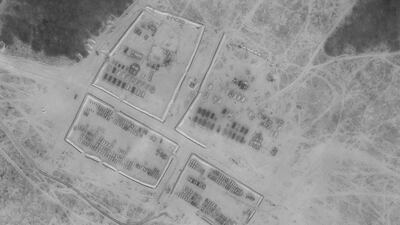
  • A satellite image shows a Russian battle group deployment in the Kursk Training Area, Russia, on December 21, 2021. Reuters
    A satellite image shows a Russian battle group deployment in the Kursk Training Area, Russia, on December 21, 2021. Reuters
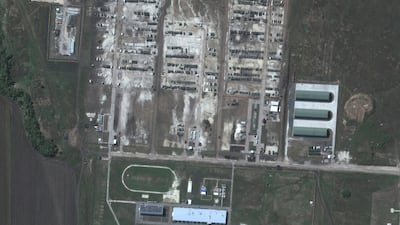
  • Russian forces in Soloti, Russia, on September 7, 2021. Reuters
    Russian forces in Soloti, Russia, on September 7, 2021. Reuters
  • A satellite image shows Russian forces in Soloti, Russia, on December 5, 2021. Reuters
    A satellite image shows Russian forces in Soloti, Russia, on December 5, 2021. Reuters
  • Russian forces in Soloti, Russia, on September 7, 2021. Reuters
    Russian forces in Soloti, Russia, on September 7, 2021. Reuters
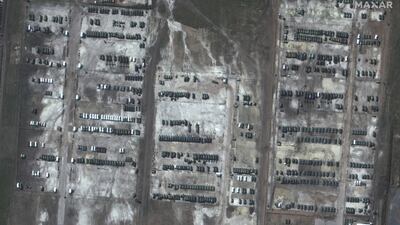
  • A satellite image released by Maxar Technologies shows Russian armoured units training in the Pogonovo Training Area near Voronezh, Russia, on November 26, 2021. Reuters
    A satellite image released by Maxar Technologies shows Russian armoured units training in the Pogonovo Training Area near Voronezh, Russia, on November 26, 2021. Reuters
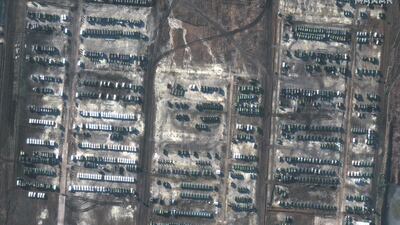
  • A satellite image released by Maxar Technologies reportedly shows Russian ground forces deployed at the Opuk Training Area on December 22, 2021. AFP
    A satellite image released by Maxar Technologies reportedly shows Russian ground forces deployed at the Opuk Training Area on December 22, 2021. AFP
  • Russian ground forces deployed at the Opuk Training Area on December 22, 2021. AFP
    Russian ground forces deployed at the Opuk Training Area on December 22, 2021. AFP
  • A satellite image of a Russian troop location in Soloti, Russia, provided by Maxar Technologies and taken on December 5, 2021. AP
    A satellite image of a Russian troop location in Soloti, Russia, provided by Maxar Technologies and taken on December 5, 2021. AP
  • A Russian troop location in Bakhchysarai, Russia. AP
    A Russian troop location in Bakhchysarai, Russia. AP

The foreign secretary and Defence Secretary Ben Wallace have used their visit to Australia to bolster Britain's defence and diplomatic ties with Australia.

Ms Truss has highlighted the need for allies such as the UK and Australia to work together to counter the challenge posed by Russia and China on the world stage.

She hit out at “global aggressors” who are “emboldened in a way we haven’t seen since the Cold War”.

“That is why regimes like Belarus, North Korea and Myanmar find their closest allies in Moscow and Beijing,” she added.

Ms Truss said that threats to “freedom, democracy and the rule of law” are global challenges, not regional issues and so require an international response from the “free world”.

“We need to work with partners like Australia, Israel, India, Japan, Indonesia and more,” she added.

“Building closer ties with our friends and drawing other countries closer to the orbit of free-market democracies will ultimately make us all safer and freer in the years to come.

“It is time for the free world to stand its ground.”

How to become a Boglehead

Bogleheads follow simple investing philosophies to build their wealth and live better lives. Just follow these steps.

•   Spend less than you earn and save the rest. You can do this by earning more, or being frugal. Better still, do both.

•   Invest early, invest often. It takes time to grow your wealth on the stock market. The sooner you begin, the better.

•   Choose the right level of risk. Don't gamble by investing in get-rich-quick schemes or high-risk plays. Don't play it too safe, either, by leaving long-term savings in cash.

•   Diversify. Do not keep all your eggs in one basket. Spread your money between different companies, sectors, markets and asset classes such as bonds and property.

•   Keep charges low. The biggest drag on investment performance is all the charges you pay to advisers and active fund managers.

•   Keep it simple. Complexity is your enemy. You can build a balanced, diversified portfolio with just a handful of ETFs.

•   Forget timing the market. Nobody knows where share prices will go next, so don't try to second-guess them.

•   Stick with it. Do not sell up in a market crash. Use the opportunity to invest more at the lower price.

A timeline of the Historical Dictionary of the Arabic Language
  • 2018: Formal work begins
  • November 2021: First 17 volumes launched 
  • November 2022: Additional 19 volumes released
  • October 2023: Another 31 volumes released
  • November 2024: All 127 volumes completed
Islamophobia definition

A widely accepted definition was made by the All Party Parliamentary Group on British Muslims in 2019: “Islamophobia is rooted in racism and is a type of racism that targets expressions of Muslimness or perceived Muslimness.” It further defines it as “inciting hatred or violence against Muslims”.

Evacuations to France hit by controversy
  • Over 500 Gazans have been evacuated to France since November 2023
  • Evacuations were paused after a student already in France posted anti-Semitic content and was subsequently expelled to Qatar
  • The Foreign Ministry launched a review to determine how authorities failed to detect the posts before her entry
  • Artists and researchers fall under a programme called Pause that began in 2017
  • It has benefited more than 700 people from 44 countries, including Syria, Turkey, Iran, and Sudan
  • Since the start of the Gaza war, it has also included 45 Gazan beneficiaries
  • Unlike students, they are allowed to bring their families to France

Russia's Muslim Heartlands

Dominic Rubin, Oxford

Mercer, the investment consulting arm of US services company Marsh & McLennan, expects its wealth division to at least double its assets under management (AUM) in the Middle East as wealth in the region continues to grow despite economic headwinds, a company official said.

Mercer Wealth, which globally has $160 billion in AUM, plans to boost its AUM in the region to $2-$3bn in the next 2-3 years from the present $1bn, said Yasir AbuShaban, a Dubai-based principal with Mercer Wealth.

Within the next two to three years, we are looking at reaching $2 to $3 billion as a conservative estimate and we do see an opportunity to do so,” said Mr AbuShaban.

Mercer does not directly make investments, but allocates clients’ money they have discretion to, to professional asset managers. They also provide advice to clients.

“We have buying power. We can negotiate on their (client’s) behalf with asset managers to provide them lower fees than they otherwise would have to get on their own,” he added.

Mercer Wealth’s clients include sovereign wealth funds, family offices, and insurance companies among others.

From its office in Dubai, Mercer also looks after Africa, India and Turkey, where they also see opportunity for growth.

Wealth creation in Middle East and Africa (MEA) grew 8.5 per cent to $8.1 trillion last year from $7.5tn in 2015, higher than last year’s global average of 6 per cent and the second-highest growth in a region after Asia-Pacific which grew 9.9 per cent, according to consultancy Boston Consulting Group (BCG). In the region, where wealth grew just 1.9 per cent in 2015 compared with 2014, a pickup in oil prices has helped in wealth generation.

BCG is forecasting MEA wealth will rise to $12tn by 2021, growing at an annual average of 8 per cent.

Drivers of wealth generation in the region will be split evenly between new wealth creation and growth of performance of existing assets, according to BCG.

Another general trend in the region is clients’ looking for a comprehensive approach to investing, according to Mr AbuShaban.

“Institutional investors or some of the families are seeing a slowdown in the available capital they have to invest and in that sense they are looking at optimizing the way they manage their portfolios and making sure they are not investing haphazardly and different parts of their investment are working together,” said Mr AbuShaban.

Some clients also have a higher appetite for risk, given the low interest-rate environment that does not provide enough yield for some institutional investors. These clients are keen to invest in illiquid assets, such as private equity and infrastructure.

“What we have seen is a desire for higher returns in what has been a low-return environment specifically in various fixed income or bonds,” he said.

“In this environment, we have seen a de facto increase in the risk that clients are taking in things like illiquid investments, private equity investments, infrastructure and private debt, those kind of investments were higher illiquidity results in incrementally higher returns.”

The Abu Dhabi Investment Authority, one of the largest sovereign wealth funds, said in its 2016 report that has gradually increased its exposure in direct private equity and private credit transactions, mainly in Asian markets and especially in China and India. The authority’s private equity department focused on structured equities owing to “their defensive characteristics.”

Results

6.30pm: The Madjani Stakes (PA) Group 3 Dh175,000 (Dirt) 1,900m

Winner: Aatebat Al Khalediah, Fernando Jara (jockey), Ali Rashid Al Raihe (trainer).

7.05pm: Maiden (TB) Dh165,000 (D) 1,400m

Winner: Down On Da Bayou, Royston Ffrench, Salem bin Ghadayer.

7.40pm: Maiden (TB) Dh165,000 (D) 1,600m

Winner: Dubai Avenue, Fernando Jara, Ali Rashid Al Raihe.

8.15pm: Handicap (TB) Dh190,000 (D) 1,200m

Winner: My Catch, Pat Dobbs, Doug Watson.

8.50pm: Dubai Creek Mile (TB) Listed Dh265,000 (D) 1,600m

Winner: Secret Ambition, Tadhg O’Shea, Satish Seemar.

9.25pm: Handicap (TB) Dh190,000 (D) 1,600m

Winner: Golden Goal, Pat Dobbs, Doug Watson.

Ferrari 12Cilindri specs

Engine: naturally aspirated 6.5-liter V12

Power: 819hp

Torque: 678Nm at 7,250rpm

Price: From Dh1,700,000

Available: Now

Who has lived at The Bishops Avenue?
  • George Sainsbury of the supermarket dynasty, sugar magnate William Park Lyle and actress Dame Gracie Fields were residents in the 1930s when the street was only known as ‘Millionaires’ Row’.
  • Then came the international super rich, including the last king of Greece, Constantine II, the Sultan of Brunei and Indian steel magnate Lakshmi Mittal who was at one point ranked the third richest person in the world.
  • Turkish tycoon Halis Torprak sold his mansion for £50m in 2008 after spending just two days there. The House of Saud sold 10 properties on the road in 2013 for almost £80m.
  • Other residents have included Iraqi businessman Nemir Kirdar, singer Ariana Grande, holiday camp impresario Sir Billy Butlin, businessman Asil Nadir, Paul McCartney’s former wife Heather Mills. 
Hunting park to luxury living
  • Land was originally the Bishop of London's hunting park, hence the name
  • The road was laid out in the mid 19th Century, meandering through woodland and farmland
  • Its earliest houses at the turn of the 20th Century were substantial detached properties with extensive grounds


Dubai Bling season three

Cast: Loujain Adada, Zeina Khoury, Farhana Bodi, Ebraheem Al Samadi, Mona Kattan, and couples Safa & Fahad Siddiqui and DJ Bliss & Danya Mohammed 

Rating: 1/5

THE BIO: Martin Van Almsick

Hometown: Cologne, Germany

Family: Wife Hanan Ahmed and their three children, Marrah (23), Tibijan (19), Amon (13)

Favourite dessert: Umm Ali with dark camel milk chocolate flakes

Favourite hobby: Football

Breakfast routine: a tall glass of camel milk

Who was Alfred Nobel?

The Nobel Prize was created by wealthy Swedish chemist and entrepreneur Alfred Nobel.

  • In his will he dictated that the bulk of his estate should be used to fund "prizes to those who, during the preceding year, have conferred the greatest benefit to humankind".
  • Nobel is best known as the inventor of dynamite, but also wrote poetry and drama and could speak Russian, French, English and German by the age of 17. The five original prize categories reflect the interests closest to his heart.
  • Nobel died in 1896 but it took until 1901, following a legal battle over his will, before the first prizes were awarded.
Updated: January 21, 2022, 9:41 AM