


From sweeping “zero covid” border shutdowns to restrictions on travel to and from southern African countries, travel bans are once more gripping the world.
At least 15 countries have new restrictions in place as fears grow that the Omicron variant of the coronavirus could be more transmissible than the more common Delta strain.
Even if the virus does not worsen illness among infected people, higher case numbers through increased transmission could still place unbearable strain on hospitals around the world this winter.
But on Tuesday, Nicholas A Christakis, a professor of social and natural science at Yale University, suggested that travel bans could only buy time and could be too little, too late.
-
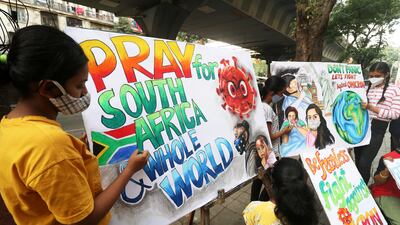
Indian students apply the finishing touches to paintings created to raise awareness of the variant in Mumbai. Reuters -

International travellers wearing personal protective equipment arrive at Melbourne's Tullamarine Airport as Australia records its first cases of the Omicron variant. AFP -
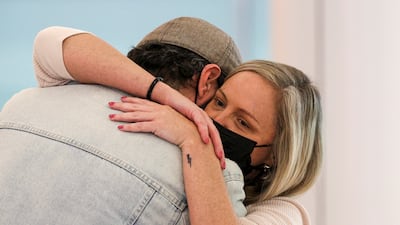
A greeting at the international terminal of Sydney Airport, as countries respond to the new variant. Reuters -
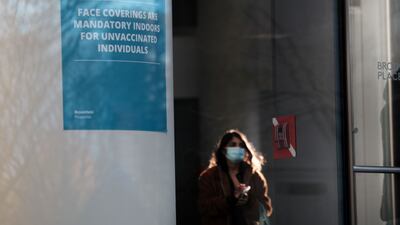
A sign asking people to wear face coverings in a building in Manhattan as the newly discovered Omicron variant appears in countries around the world. AFP -
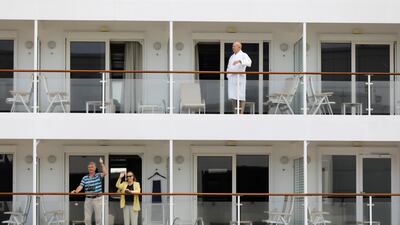
Tourists wave as the ‘Europa’ passenger liner arrives in South African waters off Cape Town as the new coronavirus variant Omicron spreads in other countries. Reuters -
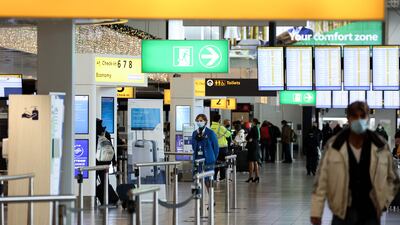
Schiphol airport in Amsterdam. Dutch health authorities said they have found another case of the Omicron Covid-19 variant among passengers arriving from South Africa, bringing the country’s total to 14. AFP -
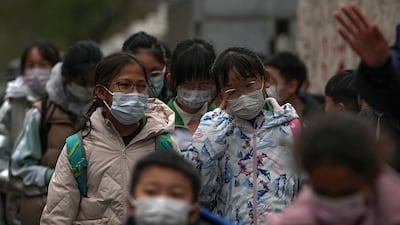
Pupils wear face masks in Beijing. Despite the global worry, scientists say it remains unclear whether the Omicron variant is more dangerous than other strains of the virus. AP -
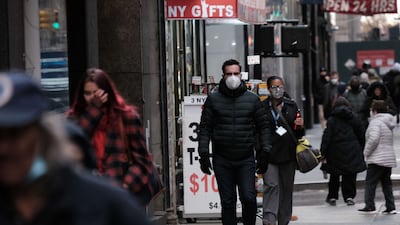
People wearing face masks in Manhattan. New York's governor has declared a state of emergency due to the risk of a surge of Covid-19 cases as winter sets in. AFP -

British Health Secretary Sajid Javid meets a member of staff at a vaccine centre in Guy's and St Thomas' Hospital, London. Getty Images -
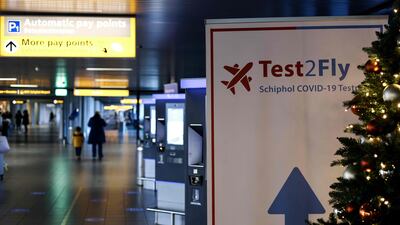
A sign points the way to a Covid-19 test centre at Schiphol Airport in the Netherlands. AFP -
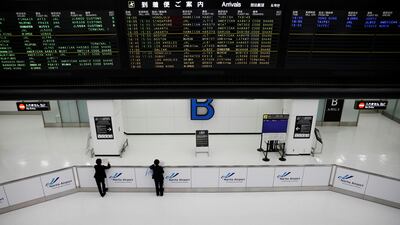
Narita International Airport in Japan is quiet after travel was restricted to prevent the spread of Omicron. Reuters -
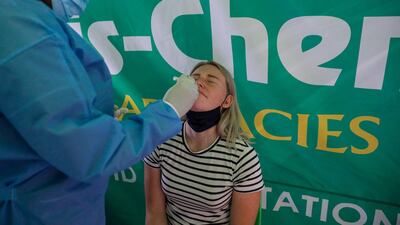
A PCR test at O.R. Tambo International Airport in Johannesburg. AFP -
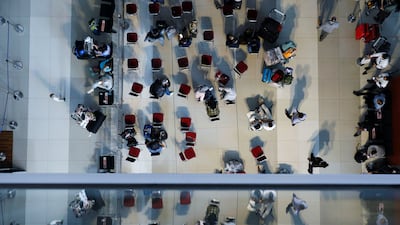
Soekarno Hatta International airport. Indonesia has banned the arrival of travellers who have recently been in eight southern African countries. Reuters -
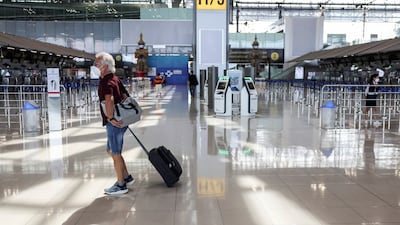
Suvarnabhumi Airport in Bangkok after Thailand banned entry from eight southern African countries due to the Omicron variant. Reuters -
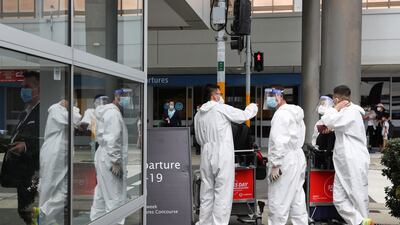
Travellers wear personal protective equipment outside the international terminal at Sydney Airport, Australia. Reuters -

Passengers wearing protective gear at Incheon International Airport in South Korea, where health authorities have imposed an entry ban on foreign arrivals from eight African countries, including South Africa. EPA -
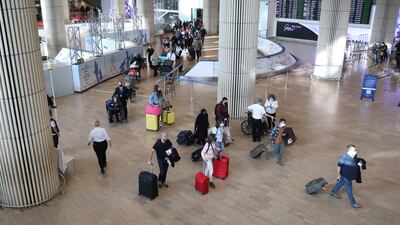
Ben Gurion International Airport near Tel Aviv. The Israeli government approved a 14-day ban on foreign arrivals over concerns about Omicron. EPA -
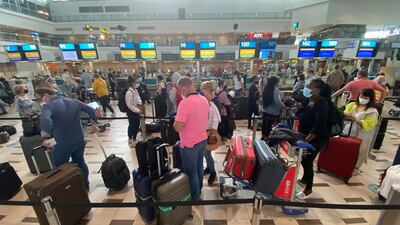
Travellers queuing in the hope of boarding an overbooked Lufthansa flight at Cape Town International Airport. Antonie Robertson / The National -
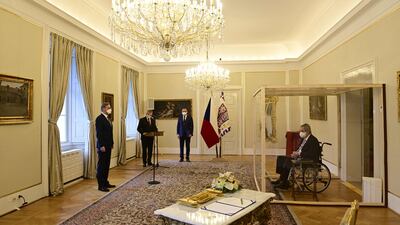
Covid-stricken Czech President Milos Zeman sits in a plastic cage as he appoints Petr Fiala as Prime Minister, near Prague. AFP -
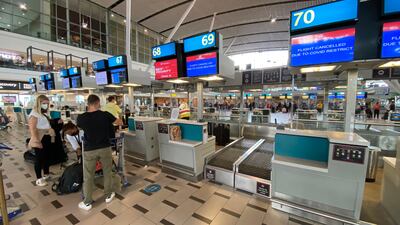
Tourists checking in at Cape Town International Airport in South Africa. Antonie Robertson / The National -
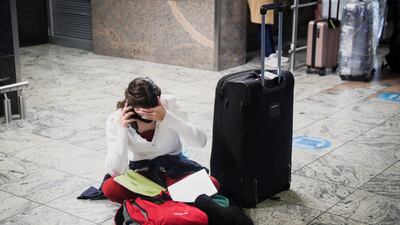
Several airlines have stopped flying out of South Africa amid the spread of the new variant, causing disruption at O.R. Tambo International Airport in Johannesburg. Reuters -
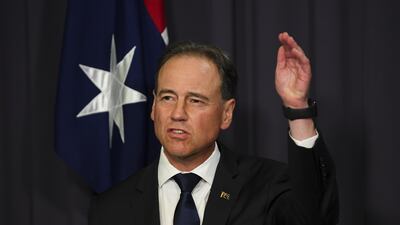
Australian Health Minister Greg Hunt at a press conference at Parliament House in Canberra. Two cases of the recently discovered Omicron variant were detected in New South Wales. EPA -
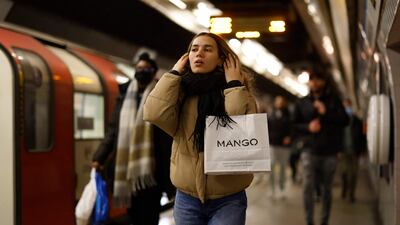
Passengers, many not wearing face coverings, on the London Underground. Health Secretary Sajid Javid said mandatory mask-wearing would return to shops and public transport in England but there are concerns over how the rule will be enforced. AFP -
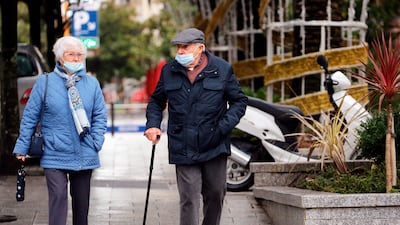
A stroll, with face masks, in Biarritz, south-western France. French Health Minister Olivier Veran said France had no confirmed cases of the Omicron variant and was not changing its strategy of increasing vaccinations and booster shots. AP -
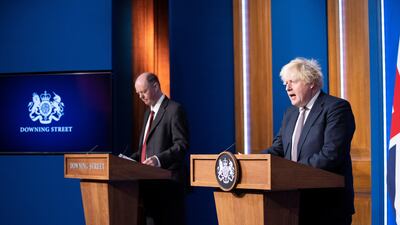
British Prime Minister Boris Johnson and Chief Medical Officer Chris Whitty during a press conference on the variant in London. Reuters


“We may assume Omicron is everywhere and that border closures are of little use,” Dr Christakis said, referring to analysis that the variant could have emerged about a month before it was identified.
That has now been confirmed by the news that the Netherlands detected Omicron in samples from Covid patients on November 23, prior to an announcement by officials that it had entered the country on Sunday on a flight from South Africa.
The World Health Organisation appears to concur with Dr Christakis, urging caution where border closures were concerned.
“Travel restrictions may play a role in slightly reducing the spread of Covid-19 but place a heavy burden on lives and livelihoods,” Matshidiso Moeti, WHO’s regional director for Africa, said on Monday.
“WHO is correct to advise that travel bans may delay but will not prevent the arrival of any more transmissible variant than Delta,” Mark Woolhouse, professor of infectious disease epidemiology at the University of Edinburgh, told The National.
“This is a well-established epidemiological principle and has been demonstrated by the spread of the Delta variant worldwide, regardless of countries' policy regarding international travel,” he said.
All it takes for a variant to take hold in a population is a small number of cases, Dr Woolhouse said.
Those infected with a potentially more transmissible variant could in theory arrive in a country before the variant is identified by health authorities.
“Epidemiological studies of this pandemic so far have demonstrated that travel has little or no impact on the size of a country's epidemic. This is because if the 'R' number is greater than one then even a handful of imported cases is enough to start a wave,” he said.
The 'R' number is the average number of cases generated by one person infected.
That seems to have been the case in the UK, which banned travel to and from India on April 23, a country in the grip of the virulent Delta variant.
The variant at the time of the ban was “of concern” to the WHO and had been present in the UK since March 8, when a case was identified. Despite the ban, Delta overwhelmed UK health services.
Buying time
“It’s becoming clear that Omicron is already spreading in communities outside southern Africa. Travel bans are a blunt instrument. They can buy time but are of only limited effectiveness,” said Martin McKee, professor of European public health at the London School of Hygiene and Tropical Medicine.
He said such bans were only one tool in an arsenal of anti-coronavirus measures that need a more systemic implementation.
“It is more important to make travel as safe as possible. This means pre- and post-travel PCRs, but this must be with tests that pick up the Omicron signature, the S Gene Target Failure," he said, referring to a unique genetic characteristic of the virus.
“However, border defences will never be enough alone so, in the face of this new variant, countries must reinforce their testing and tracing systems and non-pharmacological measures such as better ventilation and mask-wearing,” he said.

