
The UAE's plan to develop and launch a series of highly accurate radar satellites has taken an important step forward.
The UAE Space Agency has formed an industrial consortium to develop the "Sirb" project that would potentially see the first satellite launched by 2026, said state news agency Wam on Sunday.
The initiative, first announced in 2022, aims to develop a "constellation" of three synthetic aperture radar (SAR) satellites that can create detailed images of land use, ice cover and surface changes with uses ranging from tracking oil spills to following weather to monitoring climate change.
Radar satellites have the capability to capture images, day or night, and irrespective of atmospheric conditions.
Sheikh Khaled bin Mohamed, Crown Prince of Abu Dhabi and Chairman of the Abu Dhabi Executive Council and Sheikh Hamdan bin Mohammed, Crown Prince of Dubai and Chairman of the Executive Council of Dubai launched the "execution phase" of the programme.
“We will enhance local expertise in the field of space to support our ambitious vision for the UAE to become a global hub for manufacturing and operating satellites," said Sheikh Khaled. "We are focusing on creating opportunities for national companies and the private sector to be part of this significant journey and to support the development of the space sector’s infrastructure.”
Sheikh Hamdan said Sirb marked a "strategic turning point in the UAE space sector, transitioning from a governmental and academic sector to an integrated governmental, private and academic sector that supports the development of microtechnology and progresses the space sector’s industrial development".
"Empowering start-ups, small and medium enterprises and entrepreneurs tops our priority list, as they are the main drivers for economic growth.”
Sarah Al Amiri, Minister of State for Public Education and Advanced Technology and chairperson of UAE Space Agency, said the executive phase of the project was a "milestone in our space journey".
"Today, we chart a course aligned with the UAE's unwavering commitment and tenacity in advancing the space sector and ensuring its prosperity and sustainability, with the steadfast backing of our leadership.”
UAE defence conglomerate Edge has been named as strategic partner; Yahsat and Bayanat will both manage satellite operations and data; while the National Space Science and Technology Centre will provide assembly, integration and testing operations.
Central to the Sirb programme is the commercialisation of the satellites and the data they generate with the satellites supporting a wide range of scientific and commercial applications.
The project also aims to nurture partnerships with global institutions and offer incentives, as an extension of the space economic zones project, to consolidate the UAE’s position as a global hub for talent, investment and innovation, Wam said.
The Sirb satellites - Sirb is the Arabic term for a flock of birds - will be built through partnerships between the Emirati public and private sector together with international players.
The UAE's space sector, meanwhile, continues to go from strength to strength. Last week it was announced a dedicated academy to help future generations of Emiratis build careers in the growing space sector was being established.
Both the academy and the Sirb initiative are part of a Dh3 billion ($820 million) space fund that was set out last year.
Arabic names of UAE’s space missions and what they mean - in pictures
-
A rendering of a planned satellite as part of the Sirb radar satellite constellation. Sirb translates to flock of birds. Photo: UAE Government Media Office -
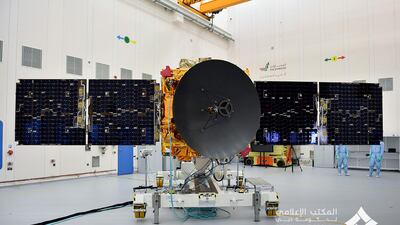
The Al Amal, or Hope, probe reached Mars orbit on February 9, 2021. Dubai Media Office Twitter account -

Hope probe’s first image of Mars. Emirates Mars Mission/EXI 2021 -

The communication nanosatellite, Nayif-1, developed by students from the American University of Sharjah and engineers at the Mohammed bin Rashid Space Centre. Photo: Mohammed bin Rashid Space Centre -
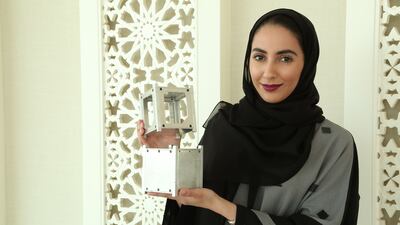
Fatma Loota, Deputy project manager of Nayif-1 at the MBRSC who is holding a model of the nanosatellite Nayif-1 in 2015. Photo: Mohammed bin Rashid Space Centre -
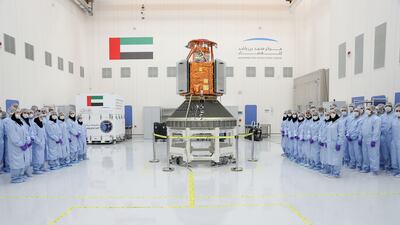
Engineers pose for a photograph with a model of KhalifaSat - the first satellite built entirely by Emirati engineers. The satellite was named after Sheikh Khalifa bin Zayed, Late President of the UAE. Wam -
KhalifaSat, the UAE's first domestically built satellite, captured the Sheikh Zayed Grand Mosque in Abu Dhabi in 2021. Photo: KhalifaSat / Mohammed bin Rashid Space Centre -
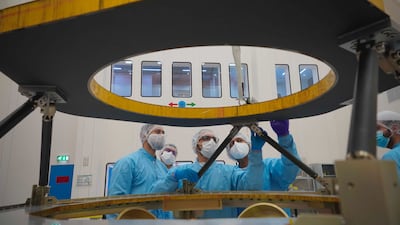
The Mohammed bin Rashid Space Centre is building the MBZSat, expected to be the region's most powerful imaging satellite. It is named after the UAE President Sheikh Mohammed bin Zayed. Dubai Media Office -
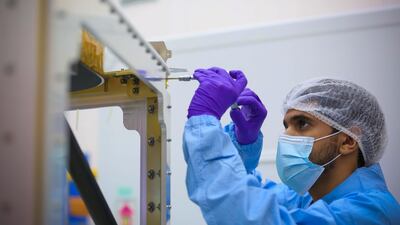
An MBRSC engineer works on the MBZSat. Photo: Dubai Media Office



