


The global rise of the private space sector has helped show how governments cannot go it all alone when reaching for the stars and it is no different for the UAE.
Over the next decade, the Emirates plans to invest more than Dh3 billion ($816 million) in the private space sector to grow the country’s capabilities in space.
Economic zones dedicated to space activities will be set up across Abu Dhabi, Dubai and Sharjah to allow start-ups and established businesses to set up operations.
Officials hope this would help the country become a major space power in the region, with a well-developed ecosystem consisting of public and privately led projects — similar to how Nasa has harnessed the power of the thriving privately owned space companies in the US.
deputy director general of the UAE Space Agency
In an exclusive interview with The National, Ibrahim Al Qasim, deputy director general of the UAE Space Agency, laid out plans for growing the private space sector.
“What this means is you will see more companies established and more of them plugging into these space economic zones, seeking to partake in missions and get more contracts than ever before,” he said.
“A few months ago, we announced a collaboration with Masdar City in Abu Dhabi to establish the first space economic zone. We’re hoping to establish a second in Dubai, which will be announced very soon.
“And the third one will be in Sharjah. The idea around this is to provide a soft-landing for companies that want to come from abroad.

“We’ve spent well over Dh1.5 billion ($408 million) on building capacity within the space industry over the last eight years and we’re more than doubling that over the next decade.”
Laws and regulations, including permits, which would allow interested companies to set up base in the UAE, are already available through a space law passed in 2019.
Companies would also have access to funding from a new initiative launched by the space agency, called Space Analytics and Solutions, which has a budget of Dh20 million.
The programme aims to help start-ups build space-based applications that focus on food security, climate change, infrastructure and the oil and gas industry.
The space agency hopes that as these companies progress, they would become less reliant on government funding.
“Space is expensive and it’s tough, and it’ll continue to be the role for governments to absorb the risk of starting these companies,” said Mr Al Qasim.
“Some of the greatest private companies in space today, for example, SpaceX, wouldn’t have achieved the amazing success that they have today and pushed the boundaries of innovation if it wasn’t for the support of Nasa and government contracts.
“However, it’s because of the way they were positioned to spearhead innovation and not depend on a comfortable government budget, that they were forced to really innovate and change what we think was possible in space. I think we will continue to do that.”
Emirates Mars Mission laid the path for the private space sector
The UAE’s journey towards growing a private space sector started with the Emirates Mars Mission, when a local company that did not even specialise in space started manufacturing parts for the Hope spacecraft.
Mr Al Qasim said the government contract helped the company “push the cusp of their industrial output and diversify their portfolio”.
“The ripple effect of the Emirates Mars Mission is quite enormous, including driving the public awareness and interest in space, science and technology. We saw a lot more interest in creating start-ups,” he said.
-

HOPE MISSION MILESTONES - IN PICTURES: On July 16, 2014, the UAE announced its Mars mission would reach the planet in 2021, in time for the country's Golden Jubilee. Photo: Nasa -

On May 8, 2015, during a glittering ceremony at Qasr Al Watan, Abu Dhabi, the name of the spacecraft and timeline of the mission is unveiled by Sheikh Mohammed bin Rashid, Vice President and Ruler of Dubai. Photo: Emirates Mars Mission -
On November 12, 2017, at the Dubai Airshow, a prototype of the Mars spacecraft goes on display. Photo: Mohammed bin Rashid Space Centre -
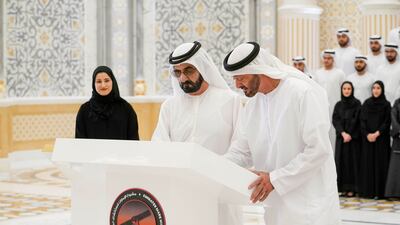
On January 5, 2020, Sheikh Mohamed bin Zayed, Crown Prince of Abu Dhabi and Deputy Supreme Commander of the Armed Forces, right, and Sheikh Mohamed sign the final piece of the Hope Probe before it is shipped to Japan for the launch. Photo: Wam -
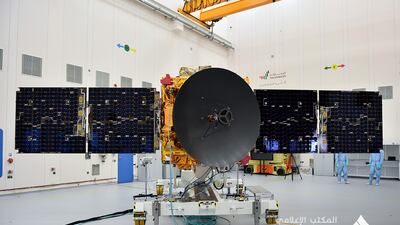
On January 21, 2020, a launch window between July 14 and August 3, 2020, is announced. The spacecraft would lift off from Japan’s Tanegashima Space Centre, aboard the HII-A rocket. On May 19, it is announced the first launch attempt would be made on July 15, 2020. Photo: Dubai Media Office -
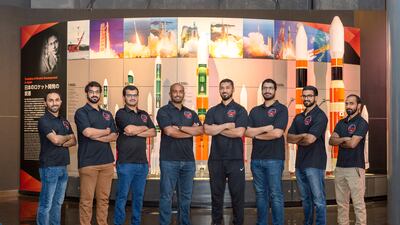
On April 5, 2020, Emirati engineers are sent, months in advance, to the launch site due to Covid-19. Some team members stay behind because only a limited number of people are allowed on site. Photo: Emirates Mars Mission -
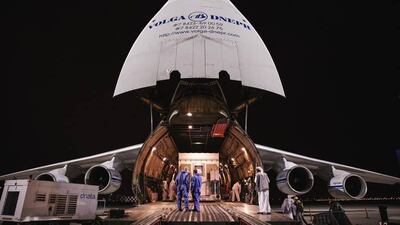
On April 25, 2020, the space orbiter arrives on Tanegashima island, 1,000 kilometres south of Tokyo. Photo: Emirates Mars Mission -
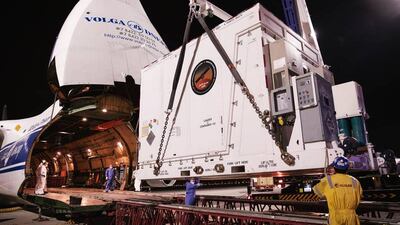
The vehicle travelled in a special container to avoid damage and flew on one of the world's largest cargo planes. Photo: Emirates Mars Mission -
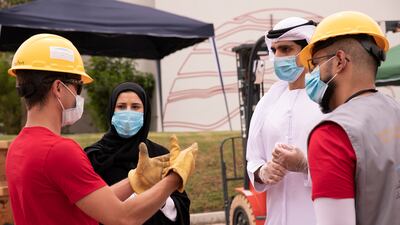
Sarah Al Amiri, Minister of State for Advanced Technology and chairperson of the UAE Space Agency, and mission director Omran Sharaf, third left, discuss with engineers shipping the Hope probe to Japan. Photo: Mohammed bin Rashid Space Centre -

The Hope probe arrives in Tanegashima island for a launch attempt on July 15, 2020. Courtesy: Yoshiaki Sakita -
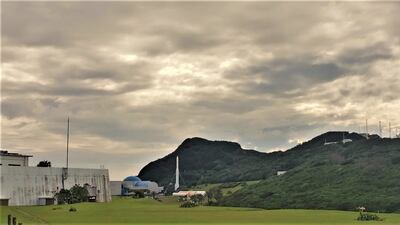
Heavy rainfall and strong winds delay the mission twice, on July 15 and July 17. Courtesy: Shoma Watanbe -
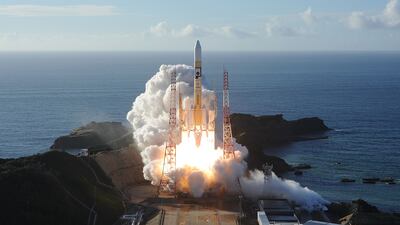
On July 20, 2020, the Hope probe lifts off and begins its 493-million-kilometre journey to Mars. AFP -

Sarah Al Amiri celebrates a successful take-off with launch provider Mitsubishi Heavy Industries. AFP -
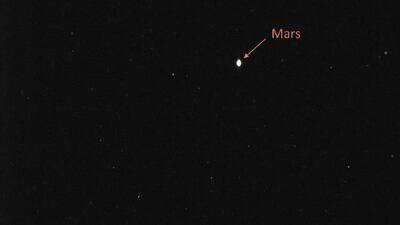
On July 22, 2020, the probe captures an image of Mars two days after it began its journey to the Red Planet. Sheikh Mohammed shared this image on Twitter. Photo: Sheikh Mohammed Twitter -
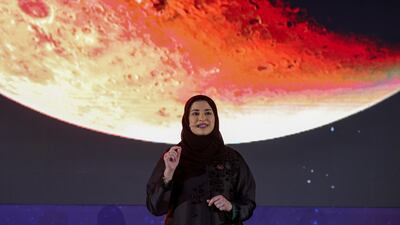
On February 9, 2021, Sarah Al Amiri hosted an event at Dubai's Burj Park and gave live updates on the mission. Reuters -
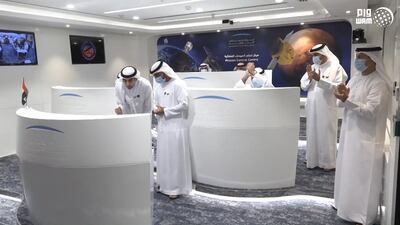
On February 9, 2021, mission director Omran Sharaf announces the Hope probe has successfully entered Mars orbit. Photo: Wam -
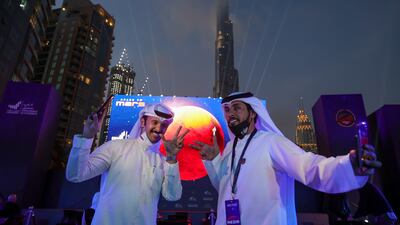
Joyous scenes at the event in Burj Park. Christopher Pike / Reuters -
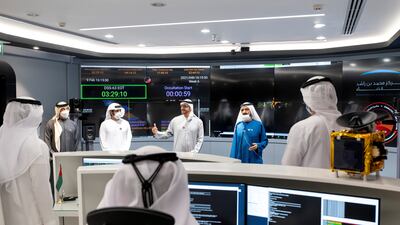
Moments after the announcement, Sheikh Mohamed bin Zayed and Sheikh Mohammed bin Rashid thank staff at mission control in Dubai. Photo: Ministry of Presidential Affairs -
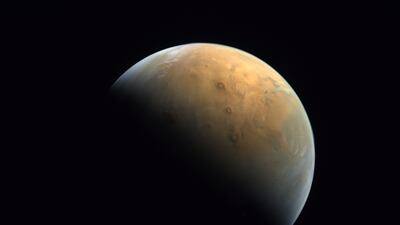
On February 14, 2021, the spacecraft sends its first global image of the Red Planet. Photo: Emirates Mars Mission -
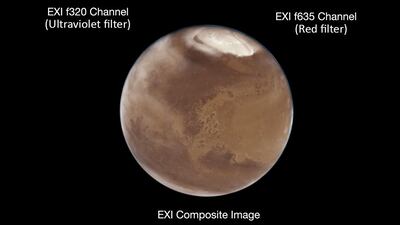
On October 1, 2021, the UAE releases the first set of data collected by the mission, including images and science readings of the atmosphere and weather. Photo: Emirates Mars Mission -
This image taken by the Hope probe’s ultraviolet spectrometer shows sunlight reflected from the extended cloud of atomic hydrogen gas that surrounds Mars. The sunlight is visible only as a dark disk hidden within the gas. Emirates Mars Mission -
On January 1, a second set of data is released for free to the public. This image was enhanced by Andrea Luck and shows another cloudy day on the planet. The North Pole, Olympus Mons and Tharsis Montes are also visible. Photo: Hope Mars Mission / Andrew Luck


The UAE’s next big space mission, a spacecraft that would explore seven asteroids and perform a Venus fly-by, will be built mostly by the private sector.
It will be a defining moment for the country’s ambitions of a well-established private sector, as well as pave the way for future and more complex missions.
It is also hoped that more local companies that do not cater to the space sector would start getting involved as they did with the Mars mission.
The Mohammed bin Rashid Space Centre, an organisation in Dubai that has executed the UAE’s leading space missions, is working with companies on its upcoming Earth-imaging satellite MBZ-Sat.
Amer Al Sayegh, project manager of the satellite, said 90 per cent of the satellite’s part would be built locally.
“The main challenge we face when we work with the private sector is that they are used to existing industries like oil and gas, automobiles or infrastructure,” he said.
“When it comes to satellites systems, it was difficult to convince them that this would also have a big volume.”
The space centre has been working closely with companies to guide them on how to build satellite parts.
Falcon Group, for example, is a UAE-based organisation that is now manufacturing parts for the MBZ-Sat.
-
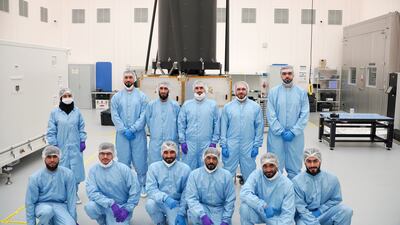
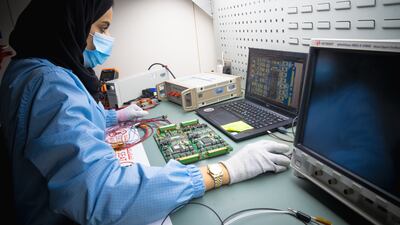
Emirati engineers will start developing the final version of MBZ-Sat, the region’s most advanced imaging satellite. All photos: Dubai Media Office -
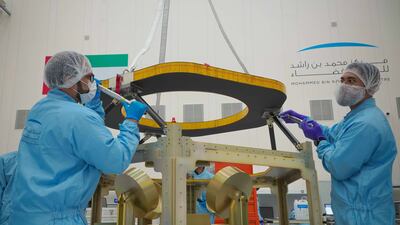
Engineers at the Mohammed bin Rashid Space Centre have completed the critical design review and will begin building the flight model, the final version that will be launched into space -
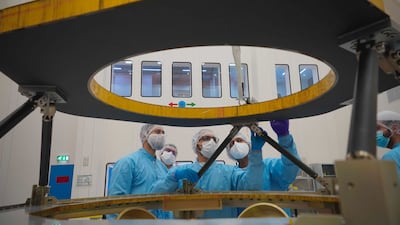
The 800kg satellite will be carried into orbit on a SpaceX rideshare mission, aboard a Falcon 9 rocket, in 2023 -
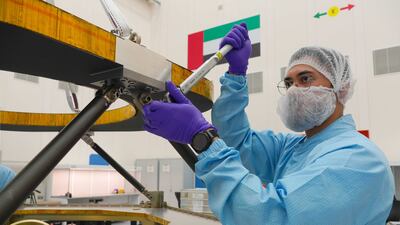
This is the second Earth-observation satellite that was built entirely by Emirati engineers. The first was KhalifaSat, which has been operational since 2018 -
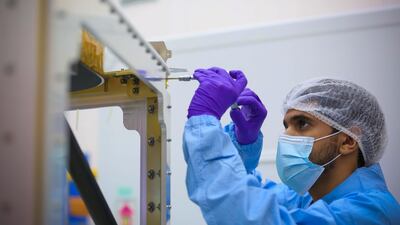
MBZ-Sat has a fully automated image scheduling and processing system that will allow it to produce 10 times the images that the space centre currently does -
The satellite will have the UAE’s biggest telescope, with an advanced high-resolution camera that will take images from 500km above the Earth’s surface


It has specialised in automation, hydrodynamic bearing and refurbishment since 1989, but had no experience in the space sector.
Rejin Jose Kurian, managing director of Falcon Group, said they have been learning about the industry from the space centre for more than a decade now.
“We're more than happy to cater to this industry. It gives us an opportunity to learn more because we've been dealing with the construction, oilfield, marine and aerospace industries, which all have different sets of standards that you need to cater to,” he said.
“Astronautical is the top of the ladder, so if you have to partner with them and provide resources they need from us, we have to be at the best of our capabilities.”
The space centre has also launched the Space Ventures programme that gives office space and guidance to start-ups.
To grow the private sector even further, the space agency is also working on bringing space tourism to the UAE.
Mr Al Qasim revealed to The National that the agreement that was signed in 2019 with Richard Branson’s Virgin Galactic to bring space tourism flights to Al Ain Airport is no longer in effect, without explaining further.
Instead, the country is now working with Jeff Bezos’s Blue Origin to set up spaceports.
He said discussions with the company, which has already flown 20 people on its suborbital flights, are under way.

